How to Fund a Community Real Estate Project, Phase by Phase
Match predevelopment, acquisition, construction, and opening costs with capital that can arrive on time and fit the specific property.

Community real estate funding is a timing problem as much as a fundraising problem. A team may need $40,000 to test a building months before a construction lender can make a loan. It may have a grant award that reimburses completed work, but no cash for the next invoice. It may close on a property before its long-term operating revenue begins. The useful question is: what money is needed for which phase, on what terms, and with what evidence?
This guide follows the property feasibility checklist and worked sources-and-uses budget. It describes possible financing tools, not a fixed Built By DAO capital stack or an investment offer. The site, location, use, sponsor, eligibility, and investor terms determine what actually fits.
Phase 1: Pay for evidence before asking people to fund a build
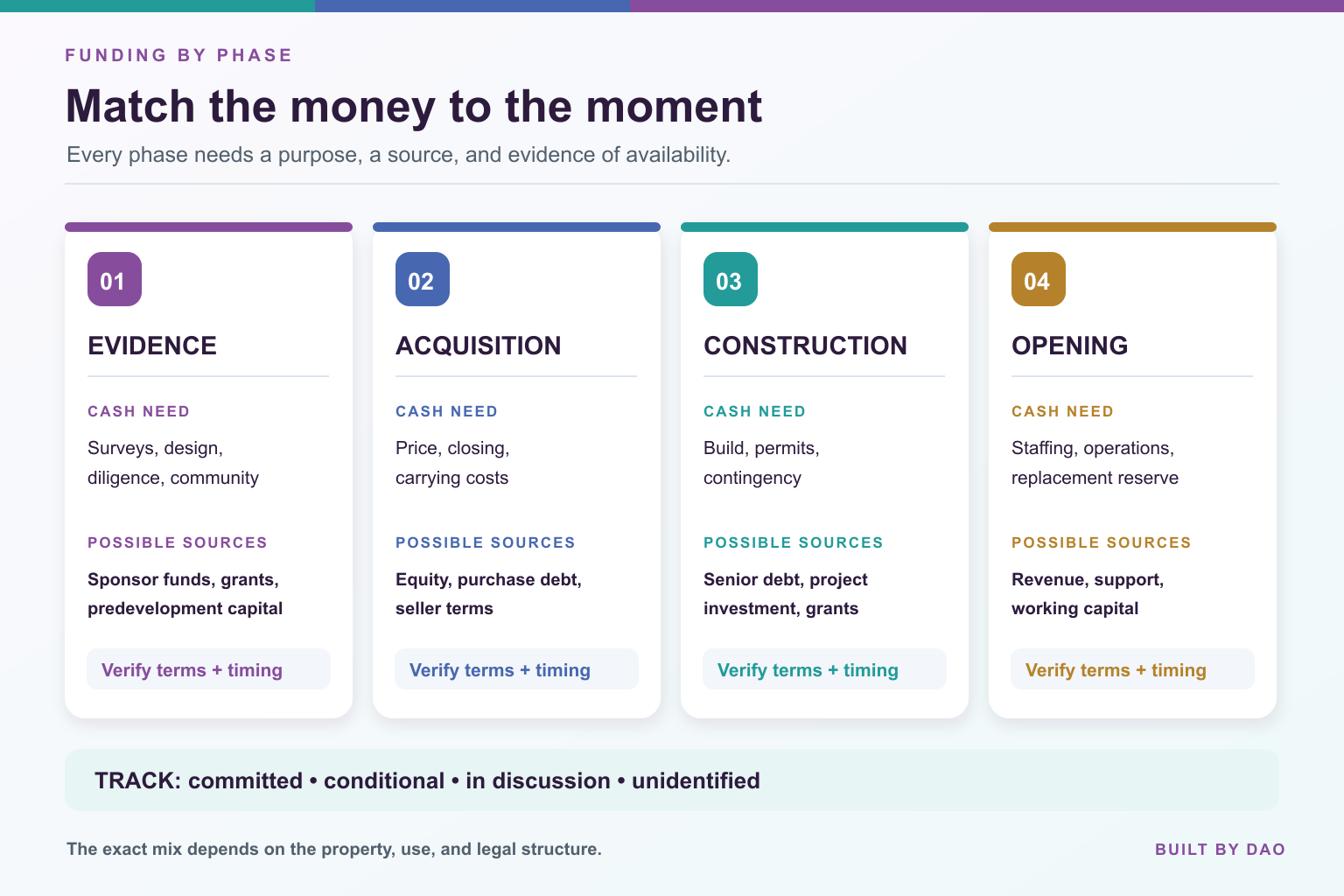
Early work may include title and ownership research, site access, surveys, architecture, environmental review, legal structuring, resident engagement, and an initial operating model. These costs create information; they do not always create collateral a bank can lend against. A sponsor might use its own funds, a predevelopment grant, a recoverable advance, a mission-aligned partner, or another negotiated source. Each has a cost or obligation that belongs in the budget.
The early ask should be specific: “We need this amount for these tests, by these dates, to decide whether to proceed.” Define the stop conditions and who controls the resulting reports. A site option or other limited control arrangement may preserve time to do that work without buying too early. The EPA's implementation guidance treats funding, partners, and sequencing as part of the reuse strategy rather than an afterthought.
Phase 2: Secure the property without pretending the build is funded
Acquisition may involve project equity, a purchase loan, seller terms, a bridge instrument, a public disposition process, or a negotiated combination. Some sites require deposits or carrying costs before closing. Others require approvals or remediation plans before a lender will participate. The team needs a dated closing checklist: price, title, conditions, approvals, financing commitments, cash due, and a credible path to the next phase.
Buying only because the purchase price is covered can strand the project. Before closing, show how the full development cost and operating plan will be carried or identify explicit conditions that protect the project if those sources do not arrive. The budget example shows why a modest planned gap can conceal a much larger gap in committed capital.
Phase 3: Assemble construction capital around the real scope
Construction funding normally depends on a tested scope, cost estimate, schedule, permits or approval path, contractor plan, contingency, and an operating forecast. Potential sources include senior debt, sponsor equity, mission-aligned project investment, grants, philanthropic support, and place-based programs where eligible. Some projects may explore a Qualified Opportunity Fund structure or a token-based instrument as part of their legal capital design. None of these fits every property, and one source may place conditions on another.
The capital stack should say who provides each dollar, when it can be drawn, what secures it, what must happen first, and how it is repaid or otherwise treated. An investor's participation is distinct from a steward's role in the DAO. A capital partner should be able to understand the project-level opportunity, risks, use of funds, and decision rights. Read Built By DAO's investor overview for the broader approach and the QOF deep dive for that one possible tax-related path. Actual offering terms require deal-specific legal documents.
Phase 4: Finance the opening and a durable operation
Construction completion does not pay the next utility bill. Before opening, identify working capital, lease-up or program ramp costs, staffing, insurance, maintenance, replacement reserves, and debt service. Name the operating entity and revenue or support sources. If a community organization will run a space, its agreement, budget, and capacity are as important as the ribbon cutting.
This phase can change the building plan upstream. A larger shared room may need a stronger operator; a use with irregular income may require a larger reserve; a phased fit-out may lower initial cash needs. The community-design brief guide helps connect user needs to a workable program, and the project-management guide keeps spending, decisions, and handover aligned.
Make one capital roadmap that can survive a hard question
For each phase, put five items on a single page: cash required, proposed source, evidence of source status, conditions and timing, and the decision that spending will enable. Mark each source as committed, conditionally awarded, under discussion, or unidentified. Reconcile that roadmap to the sources-and-uses total and to a month-by-month cash forecast. Name an owner for every open item.
A credible capital conversation is about a particular property and a particular next decision. Built By DAO can consider flexible project-level structures depending on context, but the route starts with the real site, uses, team, and numbers. Submit a property if you have a candidate; start an investor conversation if you want to explore financing a project.
Related Posts

Sources and Uses: A Worked Community Real Estate Budget
See a hypothetical $2.4 million community building budget, a $100,000 planned funding gap, and why commitment status and cash timing matter.

Real Estate Is Still the Gold Standard. Blockchain Just Makes It Smarter.
Real estate remains one of the most trusted investment vehicles. Blockchain technology adds new layers of security, transparency, and liquidity without disrupting what already works.

Understanding EQT Token Economics
EQT is the equity credit that turns 10% of your rent into ownership. Here's exactly how it works — accumulation, vesting, redemption, and governance.