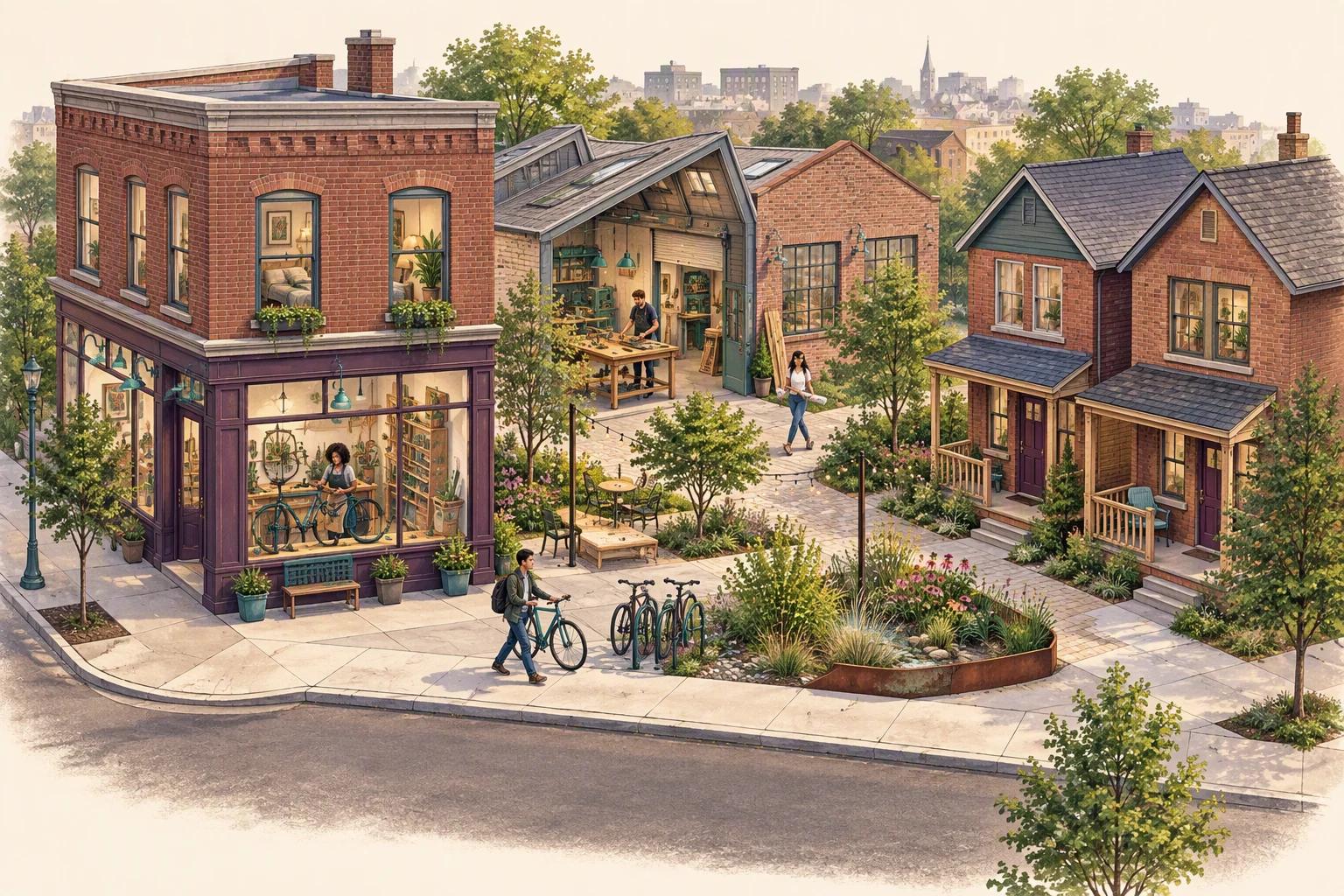
Built By DAO connects homes, shared workshops and local enterprise through community-led development. Explore how a Qualified Opportunity Fund can put eligible capital gains behind qualifying projects—and what the new 2027 rules mean for investors.
Patient capital → productive placesThe Opportunity Zone investment model
Federal law & IRS guidance reviewed September 28, 2026
A permanent program. A new cycle.
2026 sets the stage. 2027 starts the next chapter.
The 2025 law renewed Opportunity Zones permanently. For investors and property partners, the opportunity is to align a durable business plan with the right fund, location and timing.
A QOF is a corporation or partnership that invests in qualifying Opportunity Zone property. It gives investors a defined equity relationship with a fund whose capital supports qualifying assets or businesses.
Identify qualifying capital or §1231 gain and its reinvestment window.
02
Fund equity
Invest in a qualifying equity interest and make the tax election.
03
Qualified business
The fund invests in qualifying business equity or holds qualifying business property directly.
04
Productive place
Capital supports the property and operating plan that meet the program’s requirements.
The common investor window is 180 days; pass-through and other special timing rules can change when it starts. Confirm the gain and deadline before structuring the investment. IRS: Opportunity Zone FAQs
The fund is the investment vehicle.
It self-certifies annually on Form 8996. Its 90% asset test generally uses the average at the midyear and year-end measurement dates. Self-certification is not an IRS endorsement of an investment.
Location, acquisition price, rehabilitation scope, demand and operating performance determine what the capital can accomplish. The agreement defines fees, distributions, decision rights and the expected holding strategy.
For qualifying investments made from 2027
Two gains. Two different moments.
The original gain you reinvest and the future appreciation of your QOF investment have different treatment. Keeping them separate makes the opportunity easier to understand.
AT INVESTMENT
Defer the original gain.
A qualifying election defers eligible gain until the five-year anniversary or an earlier inclusion event.
AT FIVE YEARS
Recognize a smaller amount.
The basis increase is 10% of deferred gain, or 30% for a qualified rural opportunity fund. Remaining includible gain becomes taxable; plan liquidity for that date.
AT TEN YEARS & BEYOND
Unlock the appreciation benefit.
An eligible election can exclude appreciation on a qualifying investment sold after a ten-year hold. For post-2026 investments, the basis benefit is limited by the value at year 30.
Compare a qualifying investment made in 2027 under the two fund types.
10%90%
Five-year basis increase
$10,000
Original gain included in income
$90,000
Amounts are gain, not tax owed. Assumes a full five-year hold, no earlier inclusion event or other basis adjustments, and an investment value of at least $100,000 at inclusion. Federal tax rates, state treatment and investment performance are not modeled.
The five-year tax event and the investment’s eventual exit are separate. The ten-year rule is a tax holding-period requirement, not a promise of a redemption or a return. Public Law 119–21, §70421
A building can become a platform for a neighborhood.BBD’s model connects property renewal with practical skills, useful space and the capacity to keep building.
The Built By DAO connection
Put patient capital behind places that work.
Restoring a building takes more than an acquisition. It takes construction, equipment, an operating plan and time. A qualifying QOF structure can align a long investment horizon with that work.
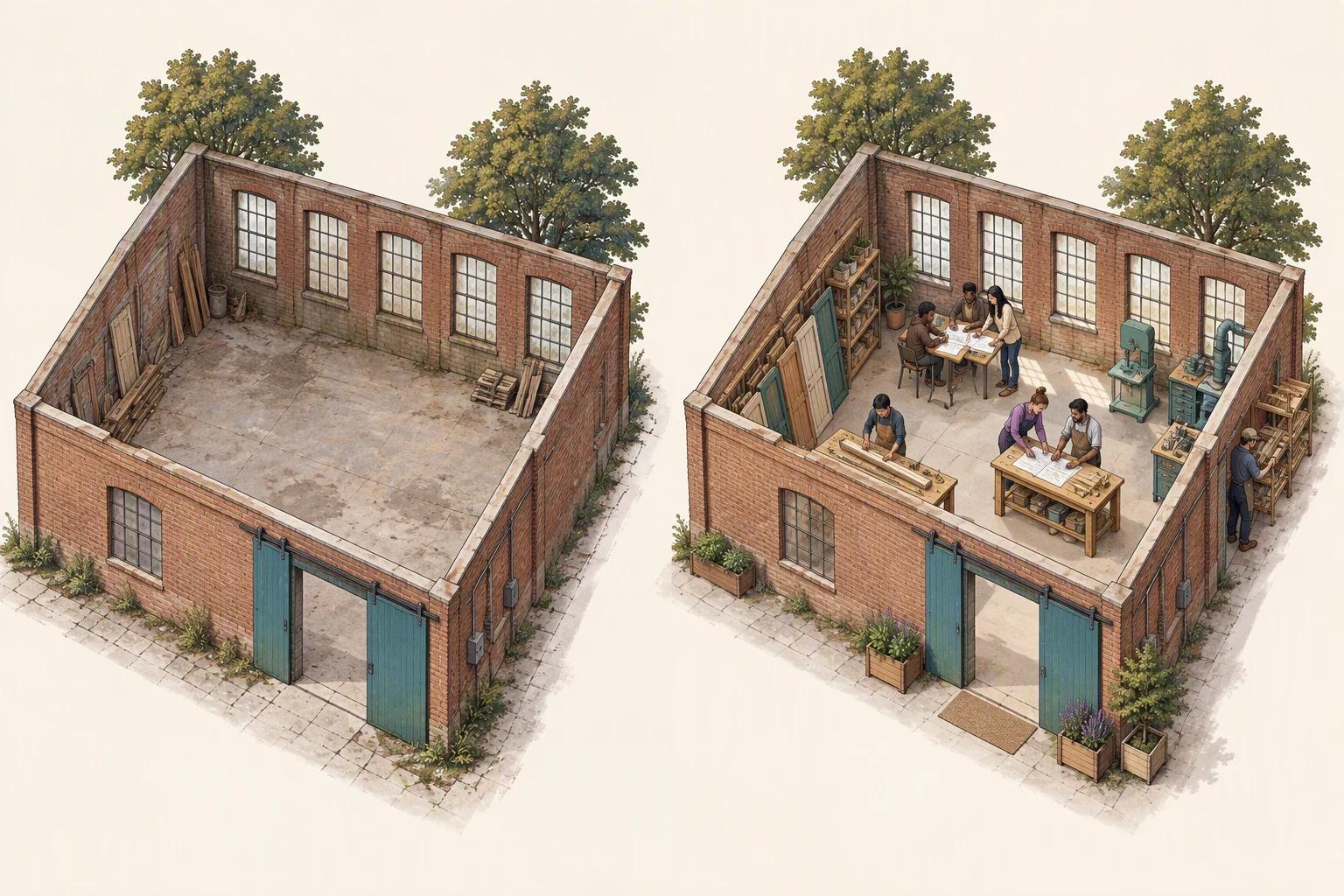
A Foundry with purpose
Turn an underused building into a hub for making, repairing and recovering materials. For a QOF route, connect the renovation and equipment plan to a qualifying property or operating business.
Explore a housing strategy with a clear relationship between rehabilitation, occupancy and ongoing operations. A long-term rental plan and a build-to-sell plan require different tax analysis.
Connect workshops and commercial space to people who can put them to use. Underwriting starts with useful activity, demand and a credible path to revenue.
The location, acquisition, improvements and operating business must work together. These are the practical questions that turn an interesting building into a credible QOF conversation.
Confirm the tract and vintage.
Use Treasury’s official data to establish the designation that applies to the property. A 2018 map and the new nomination map serve different purposes.
Most legacy zones remain designated through 2028; legacy Puerto Rico zones end in 2027. For post-2026 acquisitions, Notice 2026-40 generally requires a newly designated zone, with specific working-capital-plan and ordinary-course replacement exceptions. An old designation alone is insufficient for a new acquisition.
Acquired business property generally needs original use or substantial improvement. For an existing building, the improvement test measures qualifying additions to its adjusted basis over 30 months.
When a building and its land are purchased together, the substantial-improvement calculation generally uses the building’s adjusted basis, excluding land. The actual acquisition allocation and qualifying capital costs determine the calculation.
At the QOZ business level, at least 70% of tangible property must qualify and at least 50% of gross income must come from active business in a zone, applying the relevant rules and safe harbors. These are separate from the fund’s 90% test.
A qualifying business can use a written working-capital plan and spending schedule under the 31-month safe harbor. The plan, actual expenditures and ongoing business tests need to align; the safe harbor is conditional.
Rural property reuse can fit BBD’s interest in overlooked buildings and local productive capacity. The law offers two distinct advantages with different qualification tests.
30%
Five-year basis increase
For eligible post-2026 investments in a qualified rural opportunity fund. The fund must meet the 90% qualifying rural-asset standard; a single rural holding does not establish that status.
Qualifying basis additions must exceed 50% of the property’s starting adjusted basis, versus more than 100% under the standard test. This applies to zones comprised entirely of a rural area and has been effective since July 4, 2025.
Assuming the substantial-improvement route applies, with land excluded:
More than $200,000Standard qualifying improvement additions
More than $100,000Qualifying rural improvement additions
Both use the 30-month improvement window. This comparison isolates one qualification test; it is not a construction budget or a determination that a BBD property qualifies. IRS Notice 2025-50 Revenue Ruling 2018-29
Make the opportunity concrete
Bring the gain. Bring the property. Let’s explore the fit.
We can start with an investor’s objectives or a property’s potential. A useful first conversation connects four pieces.
01
Your capital
Expected gain amount, realization timing and the horizon you have in mind.
02
The place
An address, asset type and the future use you see for it.
03
The plan
Acquisition, improvements, operating assumptions and delivery milestones.
04
The agreement
Fund or project entity, eligibility, economics, reporting and the route to an eventual exit.
We’ll use your details to respond to this enquiry. Privacy policy
The details, in plain language
Questions investors ask.
What is a Qualified Opportunity Fund?
A QOF is a corporation or partnership organized to invest in qualifying Opportunity Zone property. An LLC can use that tax classification. The fund files Form 8996 annually and must satisfy the applicable asset tests.
Yes, when an eligible gain is timely invested in a QOF on or after January 1, 2027. The applicable reinvestment deadline still matters. Notice 2026-40 distinguishes this from legacy deferred gain automatically included on December 31, 2026, which cannot simply be rolled over again.
The deferral election applies to the eligible gain amount you reinvest. It does not require reinvesting all sale proceeds. Capital beyond the eligible gain can have different tax treatment; identify the qualifying portion with your adviser.
The investor-level QOF benefit requires a qualifying equity interest. A loan is a different instrument. A token label alone establishes neither fund qualification nor tax treatment; its legal rights and the underlying structure must satisfy the rules.
The benefit concerns eligible appreciation under the applicable basis election. Operating income, distributions and sales of property held as inventory have their own treatment. The IRS is seeking comments on housing-inventory rules; those possible changes are not current benefits.
An investor’s economic and decision rights come from the investment documents. BBD membership and stewardship are separate roles. The conversation starts with the property, your capital and the agreement that connects them.
Read the primary sources.
Based on enacted law and published federal guidance reviewed September 28, 2026. BBD project applications above are our interpretation of how the model could fit; qualification is determined for each actual structure and property.
Public Law 119–21, §70421 Enacted July 4, 2025 · permanent renewal, investor benefits and effective dates.
IRS Notice 2026-40 2026–2027 transition · gain timing, existing zones and property acquisitions.
Educational information, not an offer of securities or individual tax advice. Investment terms, availability and eligibility are established by the applicable documents. Review gain timing, federal and state treatment, qualification and investment risk with your own tax and legal advisers.
Built by people. Built to last.
Give long-term capital a local purpose.
Explore the property, the plan and the investment structure with Built By DAO.