Sources and Uses: A Worked Community Real Estate Budget
See a hypothetical $2.4 million community building budget, a $100,000 planned funding gap, and why commitment status and cash timing matter.

“We need to raise $2 million” is not yet a finance plan. A project budget must show uses—everything the project will pay for—and sources—the money or financing expected to pay those costs. It must also show which sources are committed, what conditions remain, and when the cash can actually be spent.
This is a worked example for a hypothetical neighborhood building with homes above a flexible ground-floor space. It is a teaching model, not a Built By DAO property budget, an offering, or a cost estimate for a real address. Start with the property feasibility checklist if you have not yet tested the site and use. Our funding-by-phase guide then connects the budget to a capital-raising sequence.
Start with every use of funds
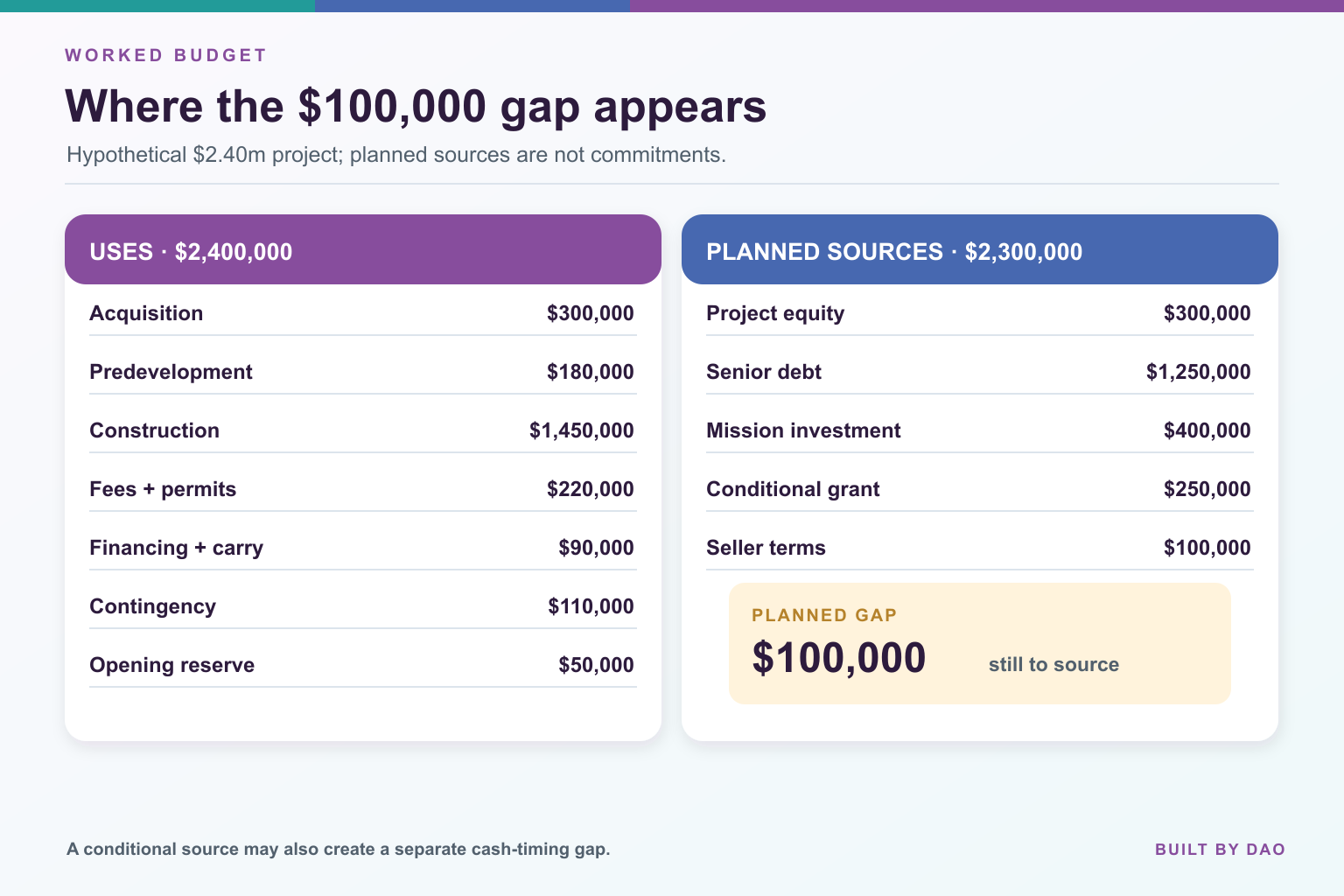
Imagine a preliminary total development cost of $2.40 million:
- Acquisition — $300,000: Purchase price and acquisition closing costs, subject to refinement.
- Predevelopment — $180,000: Survey, due diligence, environmental work, early design, legal and community process.
- Construction — $1,450,000: Building rehabilitation and site work under an assumed scope.
- Professional fees and permits — $220,000: Later design, engineering, approvals, inspections and related costs.
- Financing and carrying costs — $90,000: Loan fees, interest during work, insurance and other holding costs.
- Contingency — $110,000: Explicit allowance for unknowns; not an invitation to skip diligence.
- Opening reserve — $50,000: Initial operations and a near-term cash cushion.
Total uses: $2,400,000.
Categories must be defined consistently. If early architecture is in predevelopment, do not count it again under professional fees. If a construction estimate excludes utility upgrades, include them elsewhere or identify the estimate as incomplete. A contingency percentage is meaningful only relative to a defined scope and risk register. HUD's Section 108 underwriting manual uses sources-and-uses and project feasibility to test whether a development's funding and cost assumptions fit together.
Put every proposed source on the other side
Suppose the team is exploring this mix:
- Sponsor or project equity — $300,000: Confirm contributors, instrument and availability.
- Senior debt — $1,250,000: Subject to underwriting, collateral and terms.
- Mission-aligned investment — $400,000: Subject to investor interest and legal structure.
- Conditional grant — $250,000: Subject to award, eligibility and reimbursement rules.
- Seller terms — $100,000: Subject to a negotiated agreement; may reduce cash needed at closing.
Total planned sources: $2,300,000. None is represented as committed in this example.
$2.40 million in uses − $2.30 million in planned sources = a $100,000 planned funding gap. That is the smallest obvious gap. If only $300,000 were actually committed, the unfunded amount would be much larger. A proposal, an application, and a signed financing commitment are different states. Put a status, evidence link, expected decision date, conditions, and responsible person next to every source.
Seller financing also needs careful accounting. It may defer part of the purchase price rather than add cash to the project's bank account; it still has repayment terms and may affect lender consent. A grant paid after invoices are submitted can be a valid source for final costs while failing to supply cash at the moment a contractor must be paid. The Enterprise development guide likewise places budget and financing work in the predevelopment stage, before a project is ready to build.
Check timing, conditions and compatibility
Add a second view with columns for predevelopment, acquisition closing, construction draws, and opening. For each source, record first available date, permitted uses, disbursement conditions, maturity or repayment, security, and what happens if it falls away. Then compare monthly or milestone cash needs with available cash, not just the eventual total. The opening reserve should not be borrowed invisibly to cover an acquisition shortfall.
Debt capacity depends on more than a lender's willingness to lend against a building. The finished use must produce a credible operating picture and meet the lender's underwriting and collateral requirements. Grants may restrict use, geography, income levels, or timing. Project-level investments, token-based arrangements, and Qualified Opportunity Fund structures may be possible in some contexts; each requires its own legal and economic work. Built By DAO's investor overview describes the range, and the QOF guide covers that specific route. Do not put a source into the spreadsheet simply because it exists in theory.
Test the budget before the next commitment
What if construction rises 10%? On the illustrative $1.45 million construction line, that adds $145,000. With sources unchanged, total uses become $2.545 million and the planned gap becomes $245,000. What if the conditional grant arrives only after construction invoices? The total gap stays $100,000 on paper, but the project may need bridge cash sooner. Those are two different problems and they demand different solutions.
Also build a separate operating projection: income or support, vacancy or utilization, staffing, insurance, utilities, taxes where applicable, maintenance, replacement reserves, and any debt service. A project can close its development budget and still fail in its first year. The right next step may be a smaller scope, a different use mix, a longer option, a stronger operator, or additional capital. Record the change and rerun both the development and operating numbers.
The output should be one current worksheet with dated assumptions, a source-status tracker, a cash-timing view, and a decision log. The team should be able to explain every line in a conversation with residents, a lender, or a potential capital partner. For the sequence of who might fund which stage, read how to fund a community real estate project. For a building you want to discuss with us, submit the property; for a project-level capital conversation, visit the investor page.
Related Posts

How to Fund a Community Real Estate Project, Phase by Phase
Match predevelopment, acquisition, construction, and opening costs with capital that can arrive on time and fit the specific property.

Real Estate Is Still the Gold Standard. Blockchain Just Makes It Smarter.
Real estate remains one of the most trusted investment vehicles. Blockchain technology adds new layers of security, transparency, and liquidity without disrupting what already works.

Understanding EQT Token Economics
EQT is the equity credit that turns 10% of your rent into ownership. Here's exactly how it works — accumulation, vesting, redemption, and governance.