Detroit Side Lots, Neighborhood Lots, and Community Projects: Which Path Fits?
Compare Detroit Side Lots, Neighborhood Lots, and group project routes, then prepare the parcel, ownership, budget, and maintenance plan.
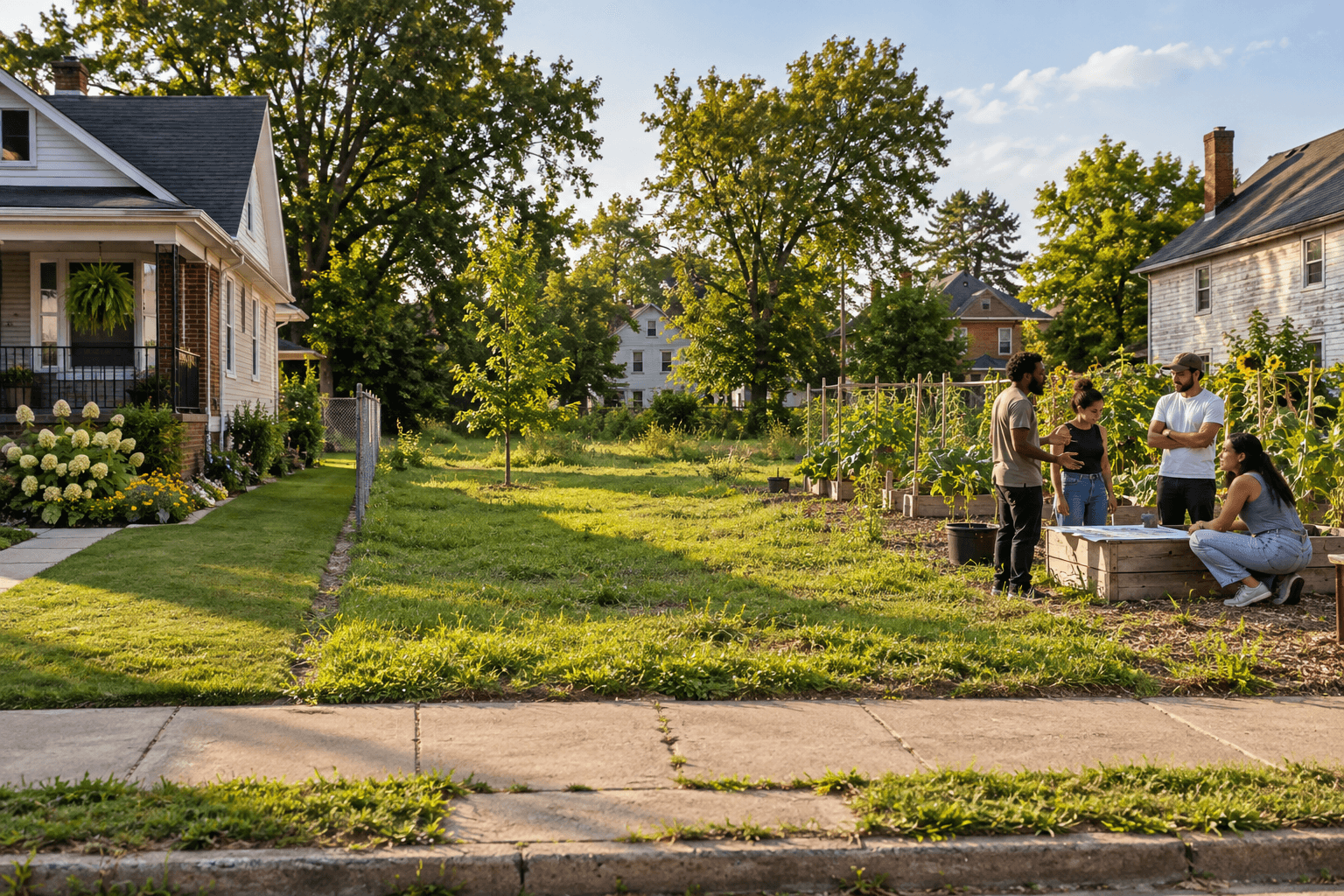
A vacant lot beside your house, a lot down the block, and a group of parcels for a community project can look similar from the sidewalk. They do not follow the same purchase path. The Detroit Land Bank Authority organizes vacant land into programs with different buyers, uses, application materials, and obligations. Choosing the right route before designing the project can save months of avoidable work.
This guide is a decision tool for residents and neighborhood groups. For the broader question of finding a property and comparing land-bank channels, see our Detroit Land Bank guide. The program descriptions below reflect the DLBA's published information as reviewed in September 2026; always check the current listing and policy before applying.
First question: who owns the parcel?
Do not start with a sale price. Start with the address and parcel identification. Search the DLBA's listings and map, then confirm whether the Authority actually owns the parcel and whether it is available. A vacant lot in Detroit might be owned by the DLBA, the City, a private owner, another public body, or someone whose tax and title situation has changed since an old map was published. Those are different conversations.
Save the listing link and program category. Note the parcel size, zoning, visible conditions, nearby buildings, and any restrictions or review area shown. If the lot is DLBA-owned but not listed, the Authority's inquiry process may be the right first move; an unlisted parcel is not automatically available on demand. A title professional should confirm ownership and encumbrances before a team commits serious capital.
Side Lot: extend an occupied home's use
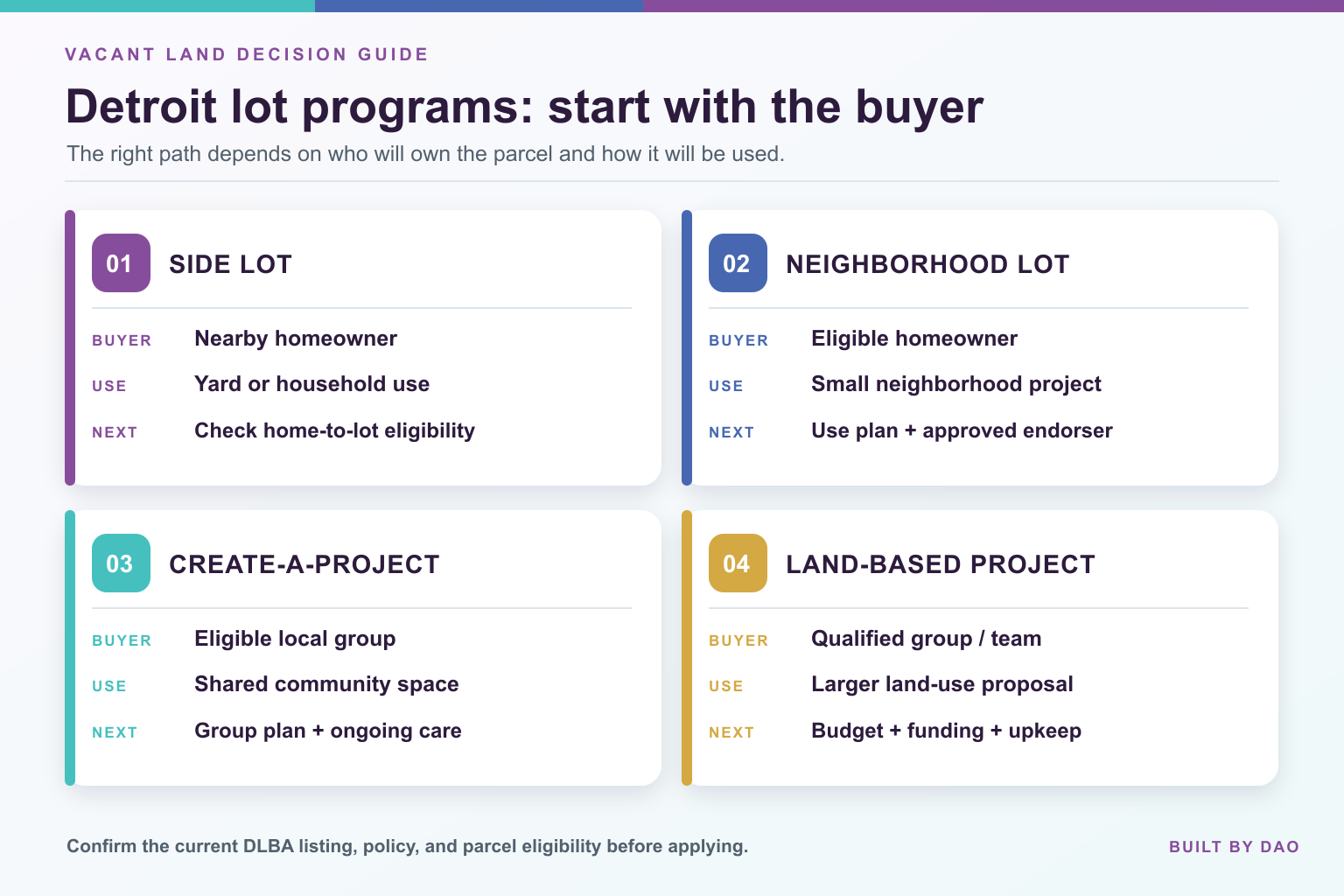
The Side Lot program serves eligible owners of occupied homes near qualifying vacant lots. It is designed for land that becomes part of the household's residential, recreational, or growing space. The DLBA checks the relation between the applicant's home and the lot, ownership and occupancy, taxes, zoning, parcel size, and any relevant compliance history. The public program page currently lists a low fixed purchase price, but the specific parcel must still be eligible.
This route is useful when one household can genuinely own and maintain the lot. It is not a shortcut for a block club to place a shared garden in one person's name. If the purpose is a public-facing place with multiple stewards, the project's ownership and use should be designed explicitly rather than disguised as a yard.
The DLBA says eligible Side Lots are first offered to nearby homeowners for a defined period before some may enter another land-reuse program. Availability can therefore change. Search the actual address instead of assuming that every empty lot beside a house is still a Side Lot.
Bring to the first check: your home address, proof of ownership and occupancy, the lot address, a simple intended use, and the current DLBA listing.
Neighborhood Lot: a nearby homeowner's small project
The Neighborhood Lot program reaches some lots that are not a Side Lot next door. The DLBA describes it as serving eligible homeowners within 500 feet of a lot for small-scale neighborhood improvements. Applicants need a plan for use, such as green space, growing, recreation, stormwater management, or habitat. The program also involves owner-occupancy evidence, tax standing, and endorsement by an approved Neighborhood Lot Endorser.
The endorsement is more than a signature from any friend on the block. The DLBA identifies eligible local organizations and district representatives who can endorse the proposed use. Ask who is registered for the area and what the endorser needs to review. The published program also includes a compliance period: a buyer is expected to complete and maintain the approved project. Read the current terms and build the upkeep into your plan.
A nearby resident might use a Neighborhood Lot to turn an unmanaged parcel into a maintained pocket of green space. It remains a purchase by an eligible homeowner under the program's rules. A neighborhood group that wants the organization to hold title should study a group-eligible route instead.
Bring to the first check: your home and lot addresses, proof of owner occupancy, a sketch of the proposed use, a maintenance plan, and the name of a qualified endorser.
Create-A-Project: a community group takes responsibility
The DLBA's Create-A-Project program is aimed at legally recognized, neighborhood-active groups planning small community spaces, such as gardens or other land-based improvements. Its published criteria address the applicant organization, eligible Neighborhood Lot parcels, a project plan, plot plan, approval process, and a commitment to complete and maintain the use for a set period. The program is a more natural starting point when the group—not a convenient individual—needs to be accountable for the land.
An application should answer who will own the site, who makes decisions, where materials and water will come from, how access will work, how costs are covered, and who maintains the place after the founding volunteers are gone. The DLBA publishes parcel and organizational eligibility rules; a creative idea does not waive those rules. Some projects may be better suited to the separate Land-Based Projects route or another DLBA process. Ask the Authority which route fits the size, site, and intended use.
Bring to the first check: the organization's legal name and neighborhood relationship, lot listing, use plan, plot plan, budget, funding evidence, and named long-term stewards.
What about a larger or more complex site?
The DLBA also describes Land-Based Projects and Marketed Properties for proposals that do not fit the household lot programs. A land-based proposal may need a formal budget, proof of funds, site maintenance plan, and additional review. Marketed properties can include new-build sites, bundles, or other properties evaluated through a proposal process. A building or several parcels should not be forced into a one-lot program because the form looks easier.
There are also accessory-structure, oversized-lot, and improved-lot categories. Their eligibility may turn on a structure, parcel size, or existing improvement. The DLBA's current land-reuse page is the best place to check those details before making plans. Its Land Review Areas may restrict sales or add approvals in certain locations. A property's program label is a starting point; its individual listing is the controlling practical record.
A useful four-step test before applying
1. Match the applicant to the program. Is the buyer an owner-occupant, a legally organized community group, or a development team? Decide who should ultimately hold and maintain the land. Do not transfer that duty to the wrong person merely to satisfy a form.
2. Match the parcel to the proposed use. Confirm the DLBA listing, parcel dimensions, zoning, program category, any Land Review Area, access, and visible site condition. A garden, parking area, accessory structure, or new home can trigger different reviews.
3. Put the cost of care beside the cost of purchase. Estimate site cleanup, soil or environmental work if relevant, water, fencing, paths, tools, taxes, insurance, and recurring maintenance. A low acquisition price is only one line in a multi-year budget. Name the people or organization that will do the work.
4. Produce one clear project brief. Include addresses, applicant, use, neighborhood benefit, sketch, timeline, budget, funding source, and maintenance responsibility. For a group project, add how decisions are made and who speaks for the organization. This brief can support a DLBA conversation and later community design, even if the first parcel turns out to be unsuitable.
From a lot purchase to lasting neighborhood value
Imagine a block group with an active garden and a vacant parcel nearby. One member owns a home beside the parcel, so the Side Lot program initially looks simple. But if the block group wants the garden to remain open and governed by the group, one member's personal yard may be the wrong ownership path. The group can compare the listed parcel and its eligibility with Create-A-Project or Land-Based Projects, prepare a real maintenance budget, and choose a structure that matches the promised access. This is an illustrative scenario, not a claim about a particular DLBA listing.
The lesson applies to housing and buildings too: property sourcing, ownership, design, financing, and long-term management have to agree. Our project journey shows the full sequence, and the community-ownership visual guide explains why keeping the value of a place close to its users matters.
Have a Detroit parcel or building that could support a useful project? Share the property with Built By DAO. If you represent a block club, neighborhood organization, developer, or funding partner, start a partnership conversation. An address and a clear purpose are enough to begin the right questions.
Quick answers
Can a block club buy a Side Lot?
The Side Lot route is for eligible nearby homeowners. A block club should investigate a program that accepts an organization as the applicant and owner, such as Create-A-Project or an appropriate project route, if that matches the parcel and use.
Is a Neighborhood Lot the same as a Side Lot?
No. The Neighborhood Lot program can reach a qualifying lot within the DLBA's stated distance of an eligible homeowner and requires a use plan and endorsement. A Side Lot is tied to the eligible relationship between a home and a lot. Check the listing for the offered category.
Does a low land-bank price mean a low-cost project?
No. Site work, approvals, water, improvements, insurance, taxes, and maintenance still need funding. Build a multi-year budget before treating a parcel as a finished neighborhood asset.
Related Posts
Chicago City-Owned Vacant Land: A Guide to ChiBlockBuilder and Community Projects
Find a City-owned Chicago lot, choose the right ChiBlockBuilder route, and plan a credible garden, side yard, housing, or neighborhood project.
Detroit Land Bank: A Guide to Property and Community Projects
Find the right Detroit Land Bank route for a house, vacant lot, or neighborhood project, then plan the ownership and stewardship that make it last.

Renting in Chicago While Wealth Stays Out of Reach: What Income Inequality Costs You
Chicago's income gap isn't just a statistic — it shapes where people live, what they can afford, and whether they ever build wealth. Here's what that means for renters, and what's changing.