Deconstruction vs. Demolition: What Should Happen Before a Building Comes Down?
Compare deconstruction, selective salvage, and demolition through a practical building assessment: safety, recoverable materials, local buyers, cost, and schedule.
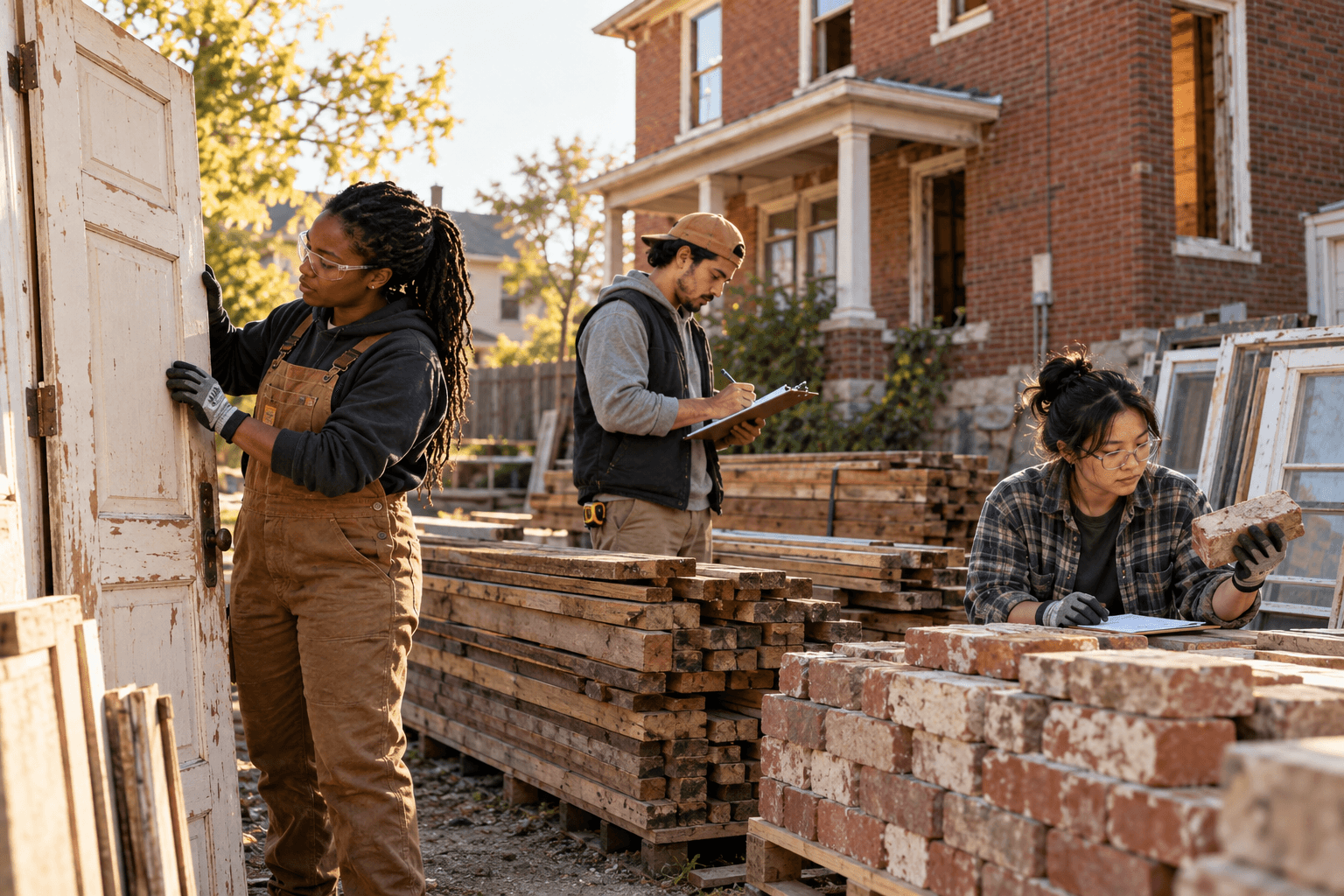
An empty building can look like a single decision: keep it or tear it down. In practice, there is another question between those choices. What can be kept from the building, and what would it take to recover it safely?
Deconstruction takes a building apart so materials can be reused. Conventional demolition prioritizes removal, often with heavy equipment. Selective salvage sits between them: recover worthwhile components first, then remove the remaining structure. The right choice depends on the building, the people working on it, the local reuse market and the project schedule. It should be made after an assessment, not from a photograph of the facade.
This guide gives property owners, community groups and project teams a way to frame that assessment. It is a planning guide, not a substitute for a qualified contractor, structural survey or local permit review.
Three paths, one site
- Full deconstruction: A qualified crew dismantles much of a sound structure in sequence and separates reusable materials. It fits when the building offers substantial recoverable material, the schedule allows the work, and those materials have a destination.
- Selective salvage: A crew removes chosen components before the rest is demolished. It fits when certain materials have clear value but taking the whole building apart would not.
- Mechanical demolition: Equipment removes the structure under a waste and recycling plan. It may be the sound choice when condition, hazards, timing, or material mix make careful disassembly impractical.
These are project approaches, not moral categories. The EPA describes deconstruction as a spectrum, from reusing an entire structure to carefully removing selected components. It also notes that partial deconstruction can be an excellent option when full deconstruction does not fit the building.
Start with safety and control
Before estimating salvage value, establish who controls the property and who is responsible for its condition. A potential buyer, land bank or neighborhood organization may see opportunity in a vacant building without yet having the right to enter it or remove anything. Confirm ownership, access, permissions and the intended redevelopment path first.
Then assess the structure with qualified people. OSHA requires an engineering survey by a competent person before demolition operations to evaluate the framing, floors, walls and potential for unplanned collapse. Utility lines must also be shut off or otherwise controlled before work begins. The same hazards matter when workers will enter a building to recover materials. OSHA's demolition overview is a useful starting point for the safety conversation.
Older buildings may contain asbestos, lead and other hazardous materials. The applicable rules depend on the building and the work; federal, state and local requirements are not identical. EPA's asbestos guidance for demolition explains why identification and proper handling must be planned before removal. A salvage idea is not a reason to put a crew into an unsafe structure.
Inventory what could have a second life
The most useful early document is a room-by-room and exterior material inventory. Photograph components, note approximate quantities and condition, and record how they are attached. A beautiful item that cannot be removed intact may have little reuse value. A plain stack of sound lumber may be more useful than a decorative fixture with no buyer.
Look for:
- Sound dimensional lumber or heavy timber that can be removed and inspected.
- Doors, trim, flooring, cabinets and hardware in reusable condition.
- Brick or stone that can be separated and cleaned without excessive breakage.
- Fixtures, equipment or architectural elements with a specific next use.
- Materials suitable for recycling even when direct reuse is not possible.
Age is a clue, not a verdict. EPA identifies wood-framed buildings, specialty materials, sound structures and some brick construction as promising candidates; it also recommends partial salvage when a building does not meet all those conditions. Its Deconstruction Rapid Assessment Tool considers condition, hazards, material inventory and architectural features together.
The inventory needs a destination column. Who will use each material, in what condition, and where will it be stored until then? Reuse value is more than an asking price. Someone must remove, clean, test where required, transport and store the item before it can replace a new purchase or be sold.

Compare the whole project cost
A fair comparison asks contractors to price the same scope and assumptions. Start with three options: conventional demolition with required recycling, selective salvage followed by demolition, and full deconstruction where the assessment supports it. Then compare:
- Site preparation and compliance: surveys, permits, utility disconnections, environmental work, protection of adjacent properties and site restoration.
- Labor and equipment: crew time, supervision, equipment rental and specialist work.
- Material handling: sorting, cleaning, transport, storage, recycling and disposal.
- Recovery: a realistic buyer's offer or a documented use in another project, less the costs of making the material usable.
- Schedule: how each option changes the next phase of the property project.
Avoid applying a national per-square-foot price to a specific building. Local labor, disposal fees, building condition and access can change the result substantially. EPA's lifecycle construction guide describes deconstruction as more labor- and time-intensive in many cases, while recovered material and avoided disposal can offset some of that cost. Its older case studies are examples of the method, not current quotes for Chicago or Detroit.
Turn the estimates into five questions the team can answer with evidence: Is the structure safe to enter and dismantle? Which materials can actually come out intact? Who has agreed to take or use them? What remains of their value after cleaning, transport, and storage? And can the redevelopment schedule accommodate the work? Record the assessments, inventory, bids, offers, and timing behind each answer.
This is the difference between calling a building “full of valuable material” and showing that a particular batch of doors, brick or framing has a workable next use.
What public policy can—and cannot—settle
Some cities have chosen to require deconstruction for certain buildings. Portland, Oregon, offers a concrete example: its current rule covers houses or duplexes built in 1940 or earlier and some historic resources. A certified deconstruction contractor and required pre- and post-work forms are part of that process. The rule does not mean every building everywhere must be taken apart, and it should not be treated as Chicago or Detroit policy. See Portland's current permit requirements.
A local policy can create an opening for material reuse, but a project still needs trained crews, safe sites, buyers or users, and places to store recovered materials. If you are evaluating a Chicago or Detroit property, check that jurisdiction's current permit and environmental requirements directly. Do not assume another city's ordinance applies.
Why this matters to Built By DAO
Built By DAO's interest in buildings goes beyond the finished structure. A project can also support practical work, skill development and a local supply of useful materials. Deconstruction and selective salvage belong in that conversation because they ask what a neighborhood can keep and use again.
That possibility becomes concrete only at the project level: a property we can assess, a scope we can price, a crew that can do the work safely and a destination for recovered materials. The assessment comes before any claim about savings, jobs or what a site will become.
If you have a building in mind, share the property details. If your organization could help put materials, skills, or a site to work, start a partnership conversation. See how BBD approaches a building transformation to place this decision in the full project sequence.
Frequently asked questions
Is deconstruction always better than demolition?
No single method fits every building. The safer and more useful approach is to evaluate structural condition, hazards, recoverable material, local demand and schedule before choosing full deconstruction, selective salvage or demolition.
Can a building be partly salvaged?
Yes. EPA explicitly describes recovery of selected assemblies and materials as part of the deconstruction spectrum. Selective salvage can preserve valuable items even when dismantling the entire structure is impractical.
Does salvage make a project cheaper?
It may offset some costs, but only a site-specific comparison can answer that. Include labor, equipment, disposal, cleaning, transport, storage, material value and schedule in the same estimate. An item without a buyer or planned use is not automatically a credit.
What should happen before anyone enters a vacant building to recover materials?
Confirm legal access and have qualified people assess structural and environmental hazards. The removal contractor should establish a safe work and utility plan and identify applicable permits and rules. Never treat an image or exterior walkaround as clearance for interior work.
Related Posts

Community Real Estate Project Management: From Site Control to Opening
How to manage a neighborhood property project across decisions, schedule, budget, funding, construction changes, and handover to a long-term operator.

The Feasibility Checklist for a Community Building
Screen property control, permitted use, building condition, community demand, economics, and team capacity before committing to a neighborhood building.

From Community Input to a Buildable Design Brief
A practical guide to turning neighborhood needs into space requirements, honest tradeoffs, documented decisions, and a brief that a project team can use.