Built By DAO
How Shared Decisions Work
The rules for Contributor, Investor and Council participation, voting eligibility, approved actions and residents’ voice.

Work, Capital and Stewardship Have Separate Roles
Major decisions in Built By DAO use three governing houses: Contributor, Investor and Council. Reviewed work supplies Contributor power. Capital has a role within the Investor house. Council members participate through consent or a reasoned objection.
A proposal sets out the action being considered and the rules for deciding it. Who may vote, which houses must approve and when the result can be carried out are established parts of that process. These choices matter when interests overlap or members disagree.
Dashboard Previews
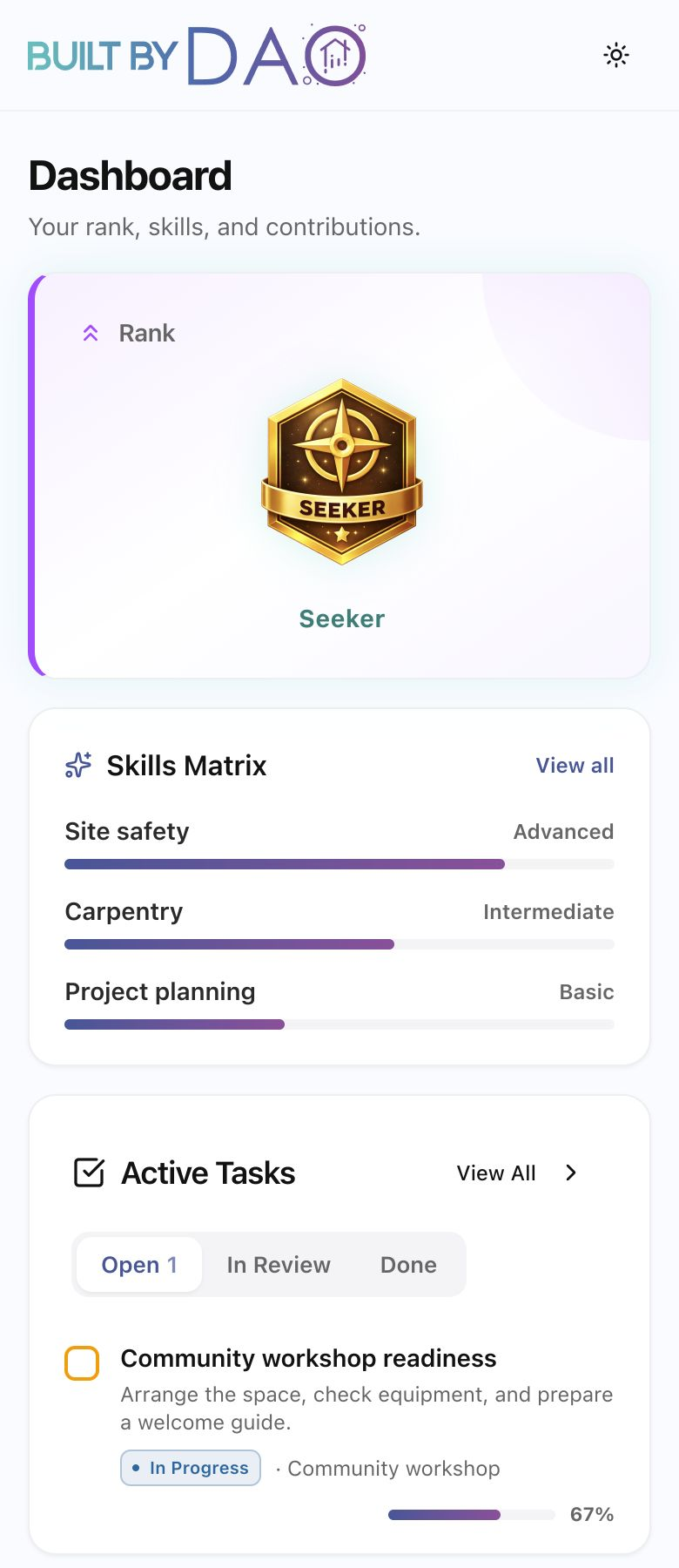
Membership
Membership, skills and active tasks in the dashboard preview.View Full PreviewTask Review Helps Determine Contributor Power
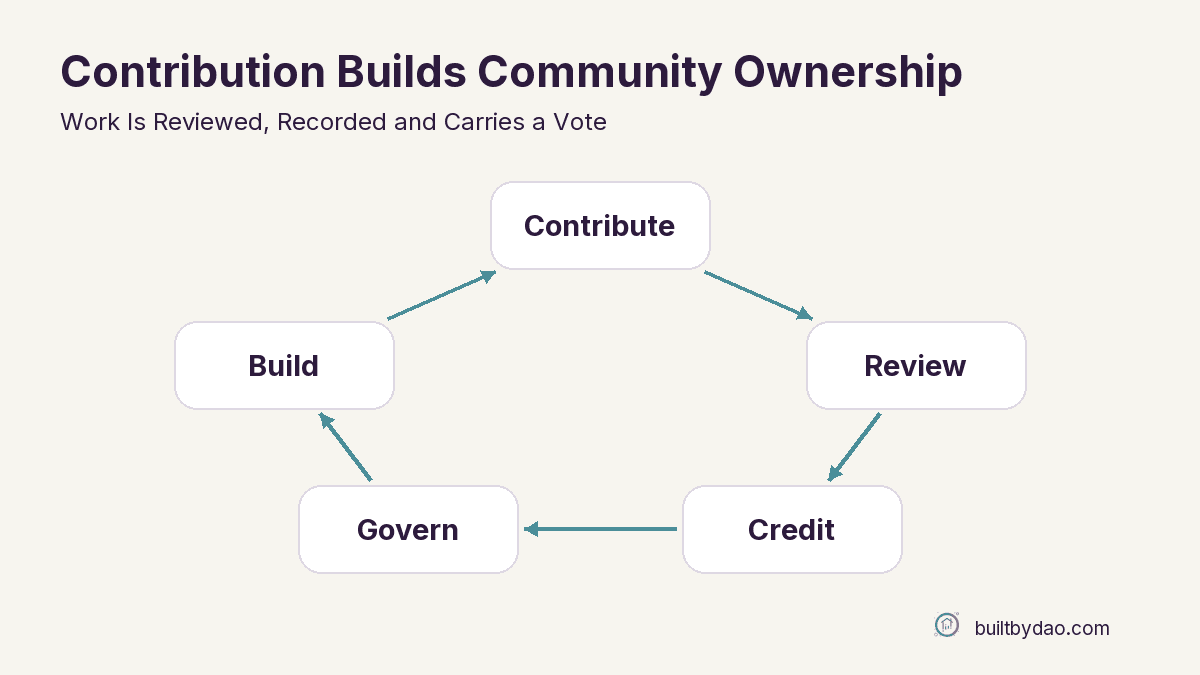
Eligible, reviewed work earns Contribution EQTBLT, the non-transferable record for work credit. Issuance requires accepted evidence, an authorized funded project release, good standing and confirmation. The credit cannot be bought or sold, has no member cash-out and confers no legal ownership interest.
The quality of review therefore affects more than one task: accepted contribution becomes part of the basis for voting power. How can evidence standards remain consistent across reviewers and projects? How would members identify favorable treatment or collusion in reviews?
The Houses Apply Their Own Rules
A proposal’s category determines which houses are required. Each required, non-empty house must pass its participation and approval rules. Defined overrides apply to some non-constitutional decisions; the category and rules determine when those exceptions are available.
Contributor
Power starts with the square root of eligible Contribution EQTBLT, then applies bounded rank and tenure factors. Four times the eligible contribution produces twice the base power before those factors.
Investor
Investor weight counts only within this house and does not increase Contributor power. If someone qualifies in more than one house, how does that overlap affect the consent process?
Council
Each member gives consent or a reasoned objection. How can members identify and challenge Council capture, and how does the process account for people who do not participate?
Voting Eligibility Is Fixed Before the Ballot
A snapshot commits the eligible voter set and voting power before voting opens. The proposal then moves through voting, finalization, a cooling-off period and execution. Its category sets quorum, voting duration and the actions it may authorize.
Freezing the voter set makes the basis of the decision explicit. It still leaves practical questions: how are eligibility disputes understood before the decision is carried out? Does the participation threshold allow decisions to proceed without placing too much weight on a small turnout? Does the cooling-off period give affected members enough time to examine the approved action?
Residents’ Experience and Work-Based Voting
In a future qualifying member property, verified base rent would earn rent-derived EQTBLT once per period. The rate is set for the lease term, normally 5 to 15 percent, with 10 percent standard. Rent remains due in cash; the credit gives no title, future rent reduction or fixed cash right.
Housing credit does not add Contributor voting weight. That prevents rent payments from buying that power. It also makes resident representation an important question: how are the experience and needs of people living with a decision heard alongside the reviewed work that carries Contributor votes?
The Dashboard Is Live; Governance Integration Is Prepared
The dashboard is live. Its v2 contract integration remains prepared rather than deployed in production. Rule previews explain the governance design, while an action’s availability depends on its required contracts, policies and permissions.
No hub or member property is open yet. The planned Foundry and homes give these rules a practical purpose: people would use them to direct shared places and the resources behind them. Examining review quality, participation and accountability now addresses how those decisions would work when interests differ.