Lesson 6 of 14
How Community Projects Are Financed
What you will learnExplain the roles of grants, debt, equity and other support; connect sources to eligible uses; and test a project budget, a cash-timing problem and an operating change using supplied information.
In this lesson
Start with the idea
A useful place needs more than a construction budget. Homes need a route from acquisition to occupancy. A local enterprise needs space, equipment and enough operating capacity to begin serving customers. A shared workshop needs people who can run it, maintain tools and support learning. Money has to reach each part at the time it is needed.
BBD's capital guide connects these purposes: a place, productive capability and the first housing projects. This lesson explains how to read such a plan, compare funding sources and see the difference between a balanced total and a workable flow of cash.
What you will learn: Explain the roles of grants, debt, equity and other support; connect sources to eligible uses; and test a project budget, a cash-timing problem and an operating change using supplied information.
1. Start with what the money must make possible
A use of funds is something the project expects to pay for. Acquisition buys a property or another required asset. Preparation can include investigation, design and professional work. Construction and fit-out turn a place into suitable space. Equipment makes particular activities possible. Opening and operations support the people and services that turn a completed room into a useful place.
These categories interact. Buying an inexpensive building may leave more rehabilitation work. Choosing recovered materials may require sorting, storage and skilled preparation. Adding a training program may need teaching time as well as equipment. A whole-project budget makes those connections visible before a team promises more than it can carry.
A contingency is an allowance for uncertainty within a defined scope. It is useful because early work contains unknowns. It does not make an unlimited change affordable. A team should know which estimate includes contingency and avoid counting the same allowance twice.
Operating runway is the capacity to pay operating costs for a stated period while activity develops. A reserve is money held for a defined future need or uncertainty. A reserve planned for essential repairs is doing a different job from money available for routine spending today. Using it changes what protection remains.
BBD's lead-hub guide illustrates this broader view. Its proposed $1.75 million allocation includes acquisition, hub buildout, equipment, operating runway, a separate operating reserve and a seed for first homes. It treats capability and continuity as parts of the project, alongside the physical property.
2. Different sources bring different relationships
A source of funds is where the project expects money or another resource to come from. Its amount matters, but so do its purpose, timing, conditions and effect on the people involved.
Grants: support for a defined purpose
A grant provides support under specified conditions. It may fund an eligible activity, population or outcome. Some grants advance cash; others reimburse eligible spending after documentation and approval. The recipient still has to carry out the agreement and account for its use.
A training grant, for example, may support instructors and eligible learning activity while leaving property acquisition outside its scope. A grant for equipment may leave the ongoing maintenance bill with the operator. The useful question is which part of the work the award actually supports.
Debt: money with repayment obligations
Debt is borrowed money. Its terms describe repayment, interest, fees, security and other conditions. Debt service means the payments required on the debt over a period. A project needs a credible source for those payments, as well as enough money to complete the building.
A longer repayment period can reduce a regular payment compared with repaying the same principal quickly, but the full cost and risk depend on the terms. A delay before opening can be especially difficult when payments begin before useful operating income arrives. Compare repayment dates with the activity that is supposed to support them.
Equity: capital with ownership-related rights and risk
Equity is an investment with rights defined by its legal arrangement. Those can include economic participation, decision rights and rules about transfers or exit. Equity generally carries the risk of the venture rather than a simple promise to repay a fixed loan on schedule.
A project should explain how any expected return relates to actual performance and what other goals or restrictions shape the arrangement. Patient capital describes a willingness to accept a longer time horizon or other terms suited to the work. The phrase alone does not specify ownership, return, repayment or exit rights; the actual agreement does.
Community capital and practical support
Community capital describes participation by people connected to a place or purpose. It could take different legal forms. A community investor, a donor and a lender can all care about the neighborhood while holding different rights. The label does not settle the terms.
In-kind support supplies something useful other than cash: materials, equipment, space or professional assistance, for example. It can reduce a required purchase when the resource fits the work. It cannot pay an unrelated cash bill merely because someone assigned it a value. Receiving useful doors does not provide cash for payroll.
A good plan asks what each source brings and what it asks in return. Who bears delay or loss? Who receives a benefit? Which decisions need approval? What continuing work does accepting the support create?
3. Understand intermediaries and public tools
Some financing reaches a project through institutions with their own purposes and requirements. Learning the route helps a team find the right conversation.
A Community Development Financial Institution, or CDFI, is a specialized financial organization serving underserved communities. The U.S. Treasury's CDFI Fund describes several types, including banks, credit unions, loan funds and venture capital funds. A CDFI can be a potential financing partner; the designation does not make every project eligible or supply one standard loan product.
Public support also takes different forms. A few U.S. examples show why the route matters:
Scroll horizontally to see all columns →
| Tool | Basic role | A useful first question |
|---|---|---|
| Community Development Block Grant, or CDBG | Federal community-development funding administered through eligible state and local recipients | Does the local program support this activity and its intended beneficiaries? |
| HOME Investment Partnerships | Support administered through participating jurisdictions for qualifying affordable housing activities | Which local housing priorities, eligible costs and continuing requirements apply? |
| Low-Income Housing Tax Credit, or LIHTC | Tax credits allocated through housing agencies to support qualifying low-income rental housing | Does the housing proposal fit an allocation path, and can the team carry its long-term requirements? |
| New Markets Tax Credit, or NMTC | Tax incentives encourage investment through certified Community Development Entities, which finance eligible community activity | Is there an appropriate intermediary and an eligible financing opportunity for this use? |
These tools do different jobs. HUD explains that CDBG decisions are made through the relevant government recipient; HUD does not provide those local project grants directly to a business or organization. LIHTC is a tax-credit mechanism for qualifying rental housing, rather than a general-purpose grant for a shared room. Treasury explains that a business seeking NMTC-supported finance should connect with an appropriate Community Development Entity.
A mixed-use idea may contain activities with different eligibility and accounting requirements. Its homes, business space and learning program do not automatically share one funding route. Program fit, project readiness and qualified local advice determine whether a tool belongs in the plan. Learning what a tool is for comes before treating its name as a source commitment.
4. Read BBD's proposed capital plan as a connected model
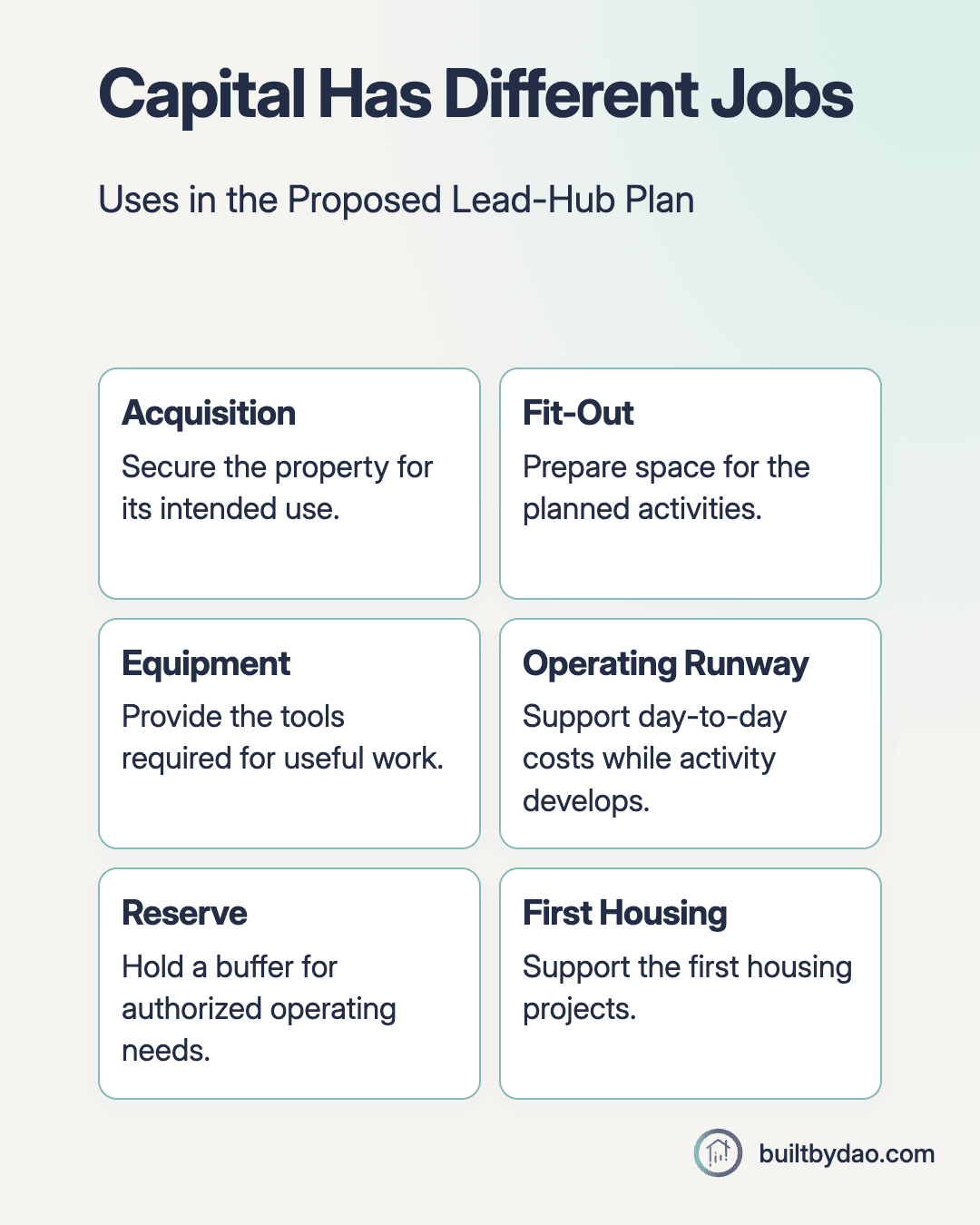
The current BBD guide presents this lead-hub planning allocation:
Scroll horizontally to see all columns →
| Proposed use | Amount |
|---|---|
| Acquisition | $75,000 |
| Hub buildout | $400,000 |
| Equipment | $275,000 |
| Operating runway | $175,000 |
| Operating reserve | $500,000 |
| First homes | $325,000 |
| Total | $1,750,000 |
The guide pairs it with a target funding mix of $525,000 investor equity, $525,000 grant funding, $350,000 community capital and $350,000 debt/CDFI financing. Those sources also total $1,750,000. The guide identifies the figures as a proposed planning model; commitments and final terms are documented separately.
The teaching value is the relationship among uses. Buildout creates working zones. Equipment supports material recovery, making and learning. Runway carries launch activity. A separately planned reserve provides room for authorized operating needs. The first-homes allocation connects the hub's capability to housing work.
The plan also makes distinct progress questions possible: what was budgeted, what has been committed through contracts or orders, what has been paid and what has been delivered ready for use? A payment and a completed capability are related milestones, but each answers a different question.
5. Worked example: a balanced budget and a timing gap
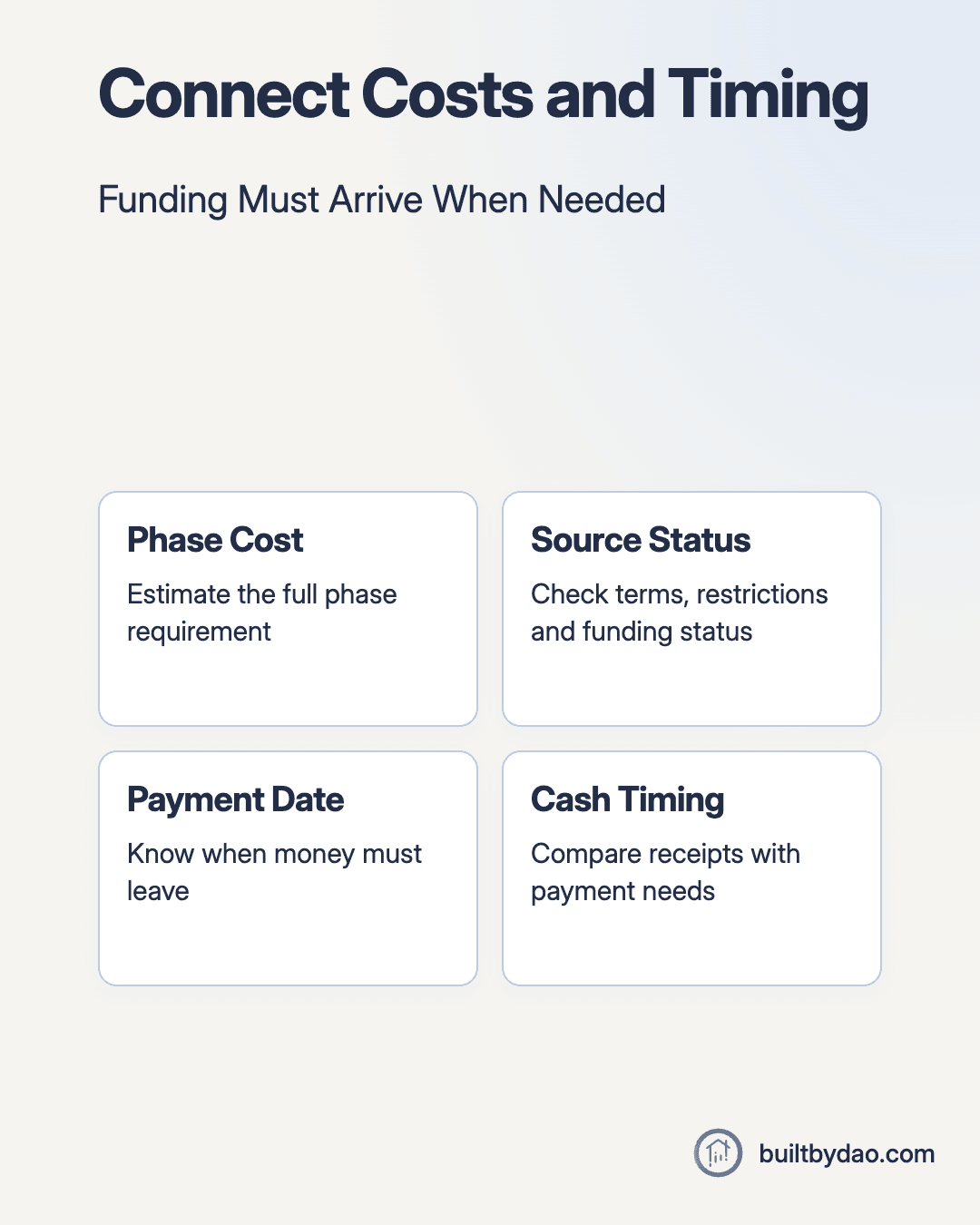
Consider an original teaching project: several homes above a ground-floor space for a local enterprise and a small shared learning room. The following figures are invented so we can see how a financing plan works. They are not BBD project costs or financing terms.
Build the uses and sources together
Scroll horizontally to see all columns →
| Use | Amount |
|---|---|
| Property acquisition | $300,000 |
| Rehabilitation and fit-out | $520,000 |
| Design, investigation and other preparation | $100,000 |
| Equipment and opening setup | $60,000 |
| Construction contingency | $80,000 |
| Initial operating cash | $90,000 |
| Separately held repair reserve | $50,000 |
| Total uses | $1,200,000 |
In this example, rehabilitation excludes the separately listed contingency. The operating cash and repair reserve have different purposes.
Scroll horizontally to see all columns →
| Assumed source | Amount |
|---|---|
| Long-term loan | $500,000 |
| Equity investment | $300,000 |
| Rehabilitation grant | $250,000 |
| Unrestricted cash donations | $150,000 |
| Total sources | $1,200,000 |
The difference between sources and uses is zero. That is a necessary check, but it does not yet show whether the grant covers the relevant costs, the loan terms are workable or cash will arrive when bills fall due.
Test the reimbursement sequence
Assume the first construction payment is $180,000. At that moment the project has only $120,000 of cash available for this payment after other obligations and restrictions. Its grant agreement would reimburse $100,000 of the eligible payment afterward. Assume the other sources arrive later under their agreements.
The immediate gap is $180,000 minus $120,000: $60,000. The later $100,000 reimbursement cannot make the earlier payment on its own. The project needs a timing solution before committing to the payment sequence.
Possible responses include negotiating a permitted advance, arranging suitable interim financing, changing an agreed draw schedule or revising the construction sequence. Each requires actual terms and may change cost or delivery. Quietly counting the repair reserve as spare money would change the reserve plan; it would not explain the problem.
If a $60,000 interim loan is approved and later repaid from the reimbursement, the forecast must include that repayment and any financing cost. It must also show how the remaining reimbursement supports later obligations. Reusing the same $100,000 as if it were still uncommitted would count the money twice.
Test whether operation can carry the debt
Now examine a separate annual operating scenario. Assume collected income is $150,000, routine operating costs are $95,000, planned reserve contributions are $10,000 and annual debt service is $36,000. The debt-service figure is supplied for this exercise; it is not calculated from an unstated loan rate.
The remaining annual amount is $150,000 − $95,000 − $10,000 − $36,000 = $9,000. That modest margin depends on the assumptions holding.
If collected income falls by 10%, it becomes $135,000. With the same costs, reserve contribution and debt service, the result becomes negative $6,000. A balanced opening budget did not prevent this operating shortfall.
The response needs to examine the actual cause and choices: collection assumptions, service demand, operating costs, financing terms or scope. Raising charges may affect the intended users. Reducing staffing may affect service or care. Using reserves may create a future gap. A useful financing decision considers those effects alongside the arithmetic.
6. Guided practice: a donated resource and a cash bill

A team has $40,000 of unrestricted cash. It needs $30,000 for paid preparation work and $20,000 for equipment. A partner offers suitable equipment that would replace $12,000 of the equipment purchase. The team can accept it without additional costs in this exercise.
What does the offer change? Does the team have enough cash for the revised work?
Sample answer
Compare your reasoning
The cash equipment purchase falls from $20,000 to $8,000. Paid preparation remains $30,000. Revised cash needs are $38,000, leaving $2,000 from the available $40,000.
The offer helps because the equipment fits a required use and replaces an actual purchase. Recording $12,000 of equipment support does not increase the cash balance to $52,000. In a real decision, suitability, delivery, installation and ongoing care would also matter. Here the supplied assumptions let us isolate the difference between useful in-kind support and spendable cash.
7. Independent practice: find the gap and the consequence
Work through these separate questions using the supplied figures.
- A project has total uses of $600,000. Its expected sources are $250,000 debt, $180,000 equity, $120,000 grant and $30,000 unrestricted donations. Is the plan balanced? Name two possible responses and one consequence to investigate for each.
- A separate payment of $75,000 is due before a reimbursement arrives. The project has $50,000 available for it. The award will reimburse $40,000 afterward. What is the immediate timing gap? Why is subtracting the later reimbursement from the bill the wrong test for paying on time?
- A separate operating plan collects $100,000 annually, spends $65,000 on routine operation, contributes $5,000 to reserves and owes $24,000 in debt service. What remains? What happens if routine operating costs rise by $8,000 while the other figures stay the same?
Answers and reasons
Compare your reasoning
1. The sources total $580,000, leaving a $20,000 funding gap. The project might seek another suitable source, with attention to its terms and availability. It might reduce or phase a use, with attention to whether the remaining place can still serve its purpose. More debt would add repayment demands; deleting an essential access improvement could make the proposal unusable. A useful response identifies both the amount and its practical consequence.
2. The immediate gap is $25,000. The payment needs $75,000 when only $50,000 is available. A later reimbursement can support an agreed timing arrangement, but it is unavailable for the earlier payment unless a real advance or interim source supplies cash. Subtracting $40,000 from $75,000 describes a later net burden under the assumption, not the cash required on the due date.
3. The original remainder is $6,000. It is $100,000 − $65,000 − $5,000 − $24,000. After the $8,000 cost increase, the result is negative $2,000. The plan needs a response to the operating gap. Having completed construction does not remove that continuing responsibility.
8. Connect the capital to the place people need
A strong capital plan explains what each source supports, when it becomes available and what obligations continue. A strong project also explains who benefits from the resulting homes, enterprises and shared capability, and who carries their operating demands.
BBD's guide offers a way into that conversation: follow capital from a proposed allocation through commitments and payments to useful delivered work. Ask which stage the figures describe. Then connect the financial picture to the work and people it is intended to support.
Sources
- BBD Where Your Investment Goes.
- BBD How Investment Works.
- BBD Community Real Estate Project Management.
- BBD What We're Building.
- U.S. Treasury CDFI Fund: CDFI Certification.
- U.S. Treasury CDFI Fund: New Markets Tax Credit Program.
- HUD Community Development Block Grant Program.
- HUD Programs: HOME Investment Partnerships.
- IRS Instructions for Form 8609: Low-Income Housing Credit Allocation and Certification.
The mixed-use project, funding amounts, timing scenarios and practice budgets are original teaching examples. Public-program descriptions introduce the purpose and route of each tool; the cited agencies provide its current requirements.