How DAO Governance Works: From Proposal to Execution
Follow a BBD proposal through its category, eligible participation, decision, cooling-off period, execution and review.
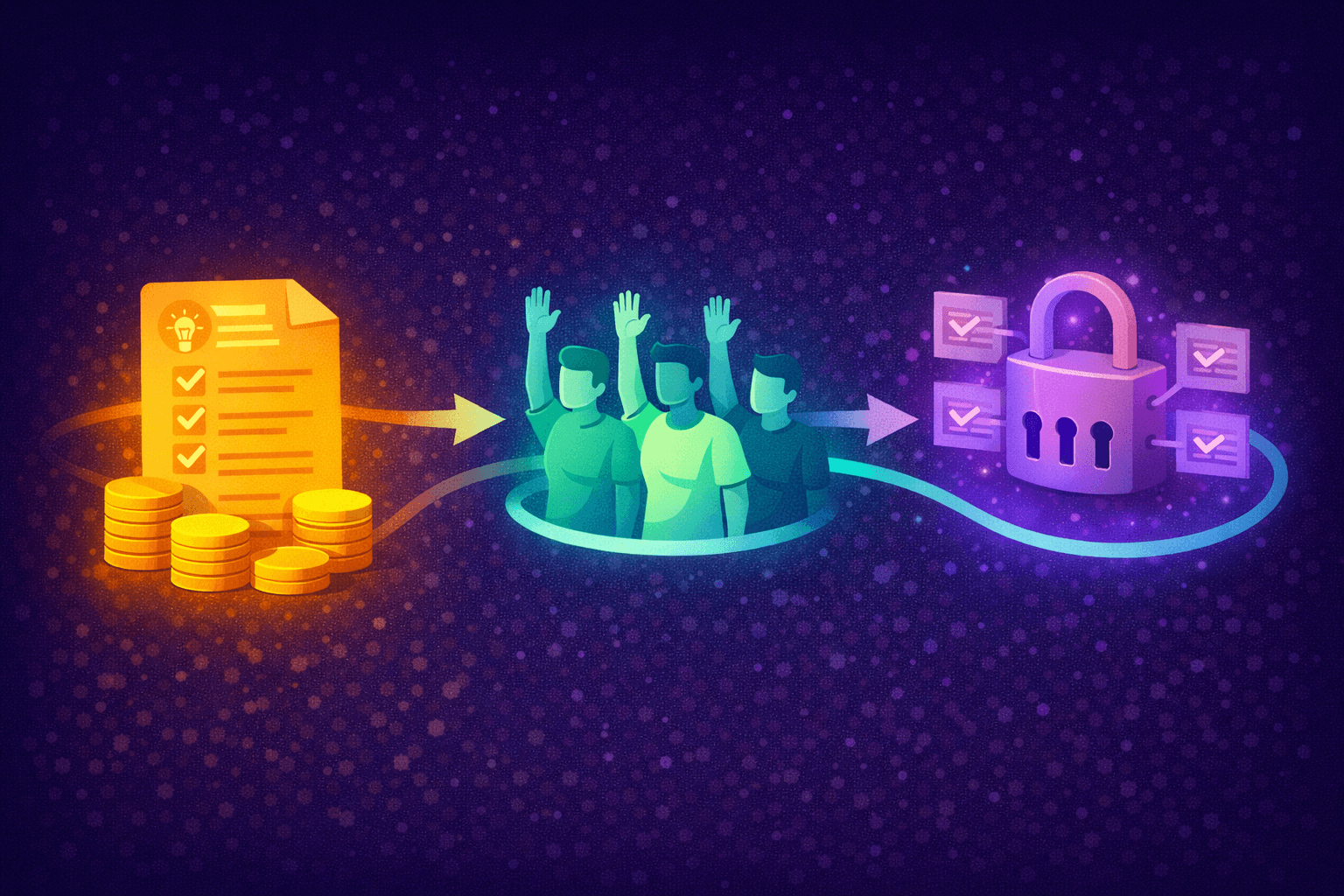
Follow a proposal from an idea to an executed decision
A governance system is easier to understand when you follow one decision all the way through. Imagine a proposal to equip a shared workshop: the idea needs a defined scope, a budget, an approval path and people responsible for delivery.
This is an illustrative example. It is not a report of an approved project. It shows how BBD's governance design connects a decision to action.
For an introduction to the people involved, start with community governance basics.
1. Define the action
Write down what the proposal would authorize. Identify the equipment or work, the expected result, the budget and the person responsible for coordinating delivery.
The current BBD proposal design includes a description, category, target, value and action. The category matters because it determines the required participation and policy. It is more precise than asking members to approve an idea without knowing what approval allows.
2. Establish the decision rules
BBD's governance design separates Contributors, Investors and Leadership Council. Categories determine which houses participate and the applicable approval, quorum, duration and cooling-off requirements.
Treasury and constitutional decisions have different requirements from ordinary proposal categories. Readers should use the proposal documentation and current policy for a particular action rather than apply a single percentage or voting window from a general article.
3. Establish eligible participation
The design uses an eligibility snapshot before voting opens. This defines the relevant voter set and denominators for the decision. Contributor standing is also checked under the applicable rules.
Contributor power draws on effective WORK contribution, with the curve and bounded rank-and-tenure weighting described in the voting documentation. Investor credentials participate within their own house. This separation keeps capital from silently inflating contributor power.
4. Give people a concrete proposal to examine
For the workshop example, participants might ask whether the equipment fits the intended work, who is trained to use it and how it will be maintained. They might compare buying, borrowing or sharing equipment already available through a partner.
Those questions improve the proposal. They also make the eventual decision easier to evaluate: a budget can be approved against a defined use, not simply an appealing idea.
5. Record the outcome and observe the required wait
After the voting window, the proposal can be finalized according to its policy. A passed proposal then follows the required cooling-off period before execution.
Passing a vote and executing an action are separate states. The distinction gives participants an understandable record of what has been decided and what has actually happened.
A useful interface shows each state explicitly rather than presenting a proposal as complete as soon as a voting result is available.
6. Execute with the right authority
The authorized action must still satisfy the target system's permissions. The current contract design keeps proposal approval and execution connected, while the treasury rules define controlled allocations and releases.
For work in the physical world, execution also needs delivery records. Equipment arrives, installation is checked, responsibilities are assigned and the project retains the relevant documentation.
7. Close the loop with the community
The final question is whether the decision achieved its intended result. Is the workshop usable? Is the equipment maintained? Is the budget record complete? Can the next person understand what happened?
That review connects governance to operations. It gives the community a basis for improving the next proposal and creates a useful record for contributors and project partners.
Put participation to work
BBD brings useful work, shared places and capital into a model people can understand. Governance supports that model when the rules are clear and decisions lead to accountable action.
See how contribution is recorded, how a building becomes a hub, or find your place in BBD.
Related Posts

Community Governance: Who Decides in Built By DAO?
An introduction to BBD’s Contributors, Investors and Council, and how shared decisions connect to accountable action.

South Shore Is Not a Turnaround Story. It's a Custody Question.
South Shore has the bones. What it's been missing is a system that keeps wealth in the hands of the people who built the neighborhood. Community development works when residents hold the keys, not just the lease.

Decentralized Governance: Collective Decisions for Collective Success
DAOs put decision-making back in the hands of the community through blockchain-powered governance. Explore how decentralized voting, smart contracts, and transparency create fairer organizations.