Impact Investing 101: Real Estate That Does Good
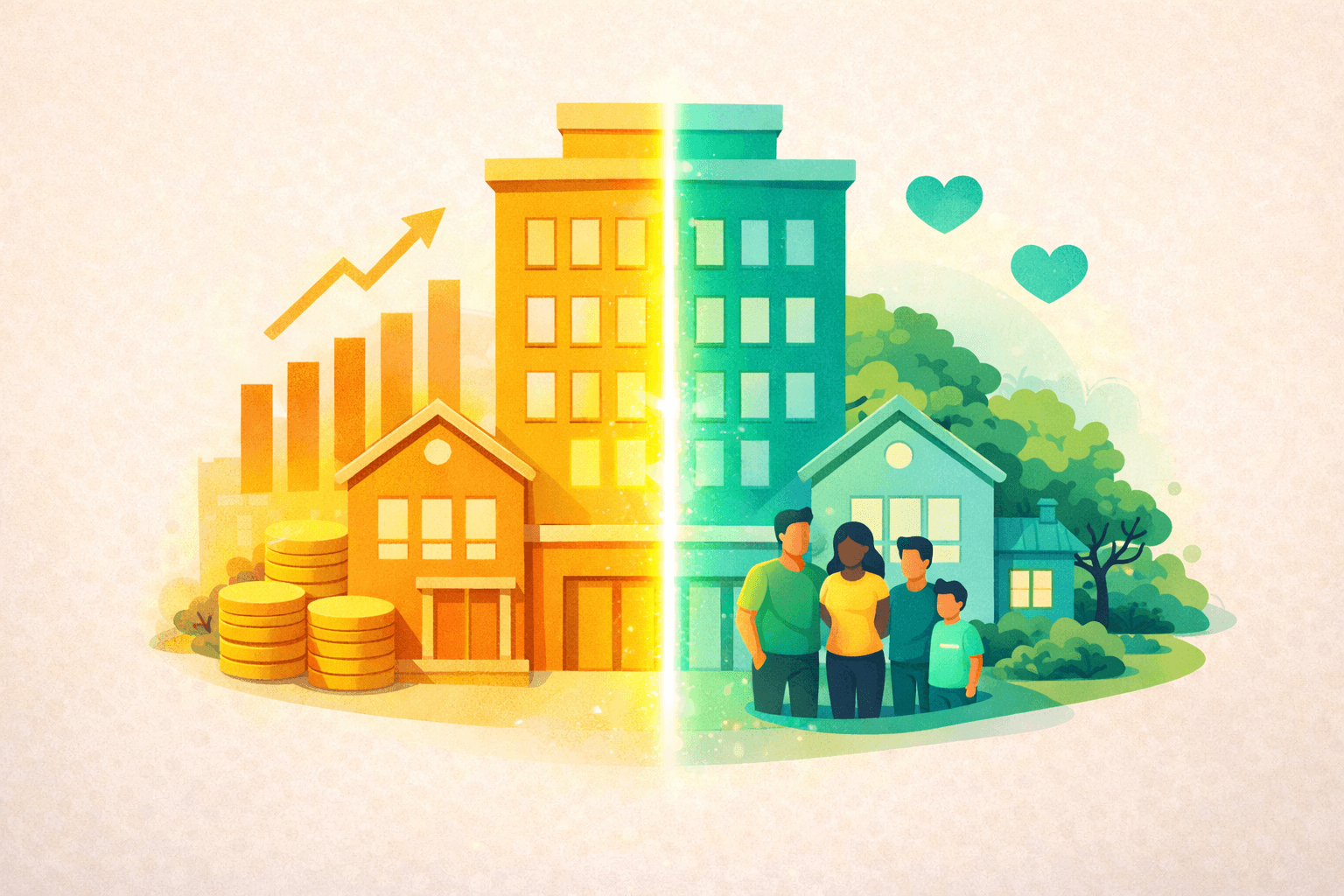
Impact investing in real estate combines financial returns with measurable social outcomes. Here's how it works and where Built By DAO fits.
Important: Past performance is not indicative of future results. Real estate investments are illiquid and carry significant risk. This is not financial advice. Consult a qualified financial advisor before making any investment decisions.
What Is Impact Investing?
Impact investing is the practice of deploying capital into ventures that generate both financial returns and measurable positive social or environmental outcomes. It sits between traditional investing (maximize returns, ignore externalities) and philanthropy (maximize impact, accept zero returns).
The Global Impact Investing Network (GIIN) estimates the impact investing market at over $1.1 trillion in assets under management. It is no longer a niche. Pension funds, endowments, family offices, and individual accredited investors increasingly allocate to impact strategies — not out of charity, but because the risk-adjusted return profiles are competitive with conventional investments.
Why Real Estate Is a Natural Fit
Real estate is one of the most effective asset classes for impact investing, and the reason is straightforward: housing is a fundamental human need. Every dollar invested in housing development has direct, measurable effects on the people and communities it serves.
Compared to other impact categories, real estate offers several advantages:
- Tangible assets. You are investing in physical buildings with intrinsic value, not abstract financial instruments.
- Measurable outcomes. You can count the number of affordable units created, track tenant income levels, measure energy efficiency, and quantify equity distributed.
- Stable cash flows. Residential rental income is among the most predictable revenue streams in real estate, driven by consistent demand for housing.
- Inflation hedge. Real estate values and rental income generally track or exceed inflation over long time horizons.
- Local multiplier effect. Housing development creates construction jobs, supports local businesses, and increases the tax base of the communities where projects are built.
The Spectrum of Impact Real Estate
Not all impact real estate investments are the same. The sector spans a range of approaches:
Affordable Housing Development
Investing in new construction or rehabilitation of housing for low- and moderate-income households. Often structured with Low-Income Housing Tax Credits (LIHTC) and targeted to households earning 30-80% of Area Median Income.
Workforce Housing
Serving households at 60-120% AMI — the teachers, nurses, and service workers who earn too much for subsidized housing but too little for market-rate apartments. This is where Built By DAO focuses most of its development.
Green and Sustainable Housing
Investing in energy-efficient buildings that reduce operating costs and carbon emissions. Green certifications (LEED, Energy Star, Passive House) provide third-party validation of environmental impact.
Community-Owned Housing
Structures where residents have ownership stakes and governance rights — community land trusts, cooperatives, and equity-sharing models. These create long-term affordability and community wealth rather than extracting it.
Understanding Risk-Adjusted Returns
A common misconception about impact investing is that you must sacrifice financial returns for social good. The data tells a different story.
Research from the GIIN's annual investor survey consistently shows that the majority of impact investors report meeting or exceeding their financial return expectations. In real estate specifically, impact-oriented funds have demonstrated competitive returns because they target a massive underserved market with strong fundamental demand.
That said, impact real estate investments carry the same risks as any real estate investment:
- Illiquidity. Real estate is not a stock you can sell in seconds. Capital is typically locked for years.
- Market risk. Local economic downturns, job losses, or population decline can affect occupancy rates and property values.
- Development risk. Construction delays, cost overruns, and permitting challenges are common.
- Interest rate risk. Rising rates increase borrowing costs and can reduce property valuations.
- Regulatory risk. Changes in zoning, tax incentives, or tenant protections can affect project economics.
Understanding these risks is essential before committing capital to any real estate investment, impact-oriented or otherwise.
Measuring Social Impact
One of the biggest challenges in impact investing is measurement. How do you quantify "doing good" in a way that is rigorous and comparable?
The industry has converged on several frameworks:
- IRIS+ (GIIN) — a catalog of standardized metrics used by impact investors globally. Includes housing-specific metrics like units created, tenant income levels, and affordability preservation duration.
- UN Sustainable Development Goals (SDGs) — particularly SDG 11 (Sustainable Cities and Communities) and SDG 1 (No Poverty). Many impact funds map their outcomes to specific SDGs.
- GRESB — a benchmark for real estate ESG (Environmental, Social, Governance) performance. Institutional investors increasingly require GRESB participation.
For community-owned housing specifically, additional metrics matter:
- Equity distributed — total dollars of equity credited to residents
- Tenure stability — average length of tenancy and displacement rates
- Governance participation — percentage of residents who engage in community votes
- Wealth created — total wealth accumulated by resident-owners through equity appreciation
Built By DAO's Approach to Impact Investing
Built By DAO sits at the intersection of workforce housing, community ownership, and blockchain transparency. Here is what makes our model distinct:
Resident equity as a core feature
Every tenant earns EQT credits equal to 10% of their rent. This is not a marketing tagline — it is a structural feature of every lease. Investors in Built By DAO properties know that their capital is directly creating a wealth-building mechanism for tenants.
Transparent governance
All financial decisions, property management actions, and community votes are recorded on-chain. Investors can verify exactly how funds are allocated, how properties are maintained, and what returns look like — without relying on quarterly reports filtered through management.
Measurable, auditable impact
Because EQT credits are tracked on-chain, the social impact of a Built By DAO investment is not estimated — it is calculated precisely. Total equity distributed, number of participating households, average wealth accumulated per tenant, and governance participation rates are all auditable in real time.
Aligned incentives
In a traditional real estate investment, the owner's interests (maximize rent, minimize maintenance spending) are often opposed to the tenant's interests (affordable rent, well-maintained units). In Built By DAO's model, residents are partial owners. Their interests and the investors' interests are structurally aligned around long-term property value and community stability.
Is Impact Investing Right for You?
Impact investing in real estate is best suited for investors who:
- Have a long time horizon (5-10+ years) and can tolerate illiquidity
- Want portfolio diversification beyond stocks and bonds
- Care about measurable social outcomes alongside financial returns
- Are comfortable with the complexity of real estate as an asset class
- Meet accreditation requirements for private real estate offerings (for most direct investments)
If that describes you, community-owned housing may be one of the most compelling opportunities in the impact real estate space. The demand is enormous, the social outcomes are clear, and the economic fundamentals are strong.
Invest in Housing That Builds Wealth for Everyone
Built By DAO offers accredited investors the opportunity to deploy capital into community-owned workforce housing with transparent governance and measurable impact. Your investment builds homes. Those homes build equity for the people who live in them.
Explore investment tiers or read our investor FAQ to learn more.
This content is for informational purposes only and does not constitute an offer to sell or solicitation of an offer to buy securities. Investment opportunities are available only to accredited investors as defined by applicable securities laws.
Related Posts
Why Smart Investors Are Choosing Community Housing
Community-owned housing offers attractive risk-adjusted returns alongside measurable social impact.

Five Markets Where Renters Need Equity Most
We ranked US cities by rent burden and homeownership gap. These five metros are where rent-to-equity models could make the biggest difference.

Blockchain and DAOs: Securing the Future for Traditional Real Estate Investors
Blockchain and DAOs aren't disruptions to real estate investing — they're enhancements. Learn how tokenization, smart contracts, and decentralized governance strengthen security, transparency, and liquidity for traditional investors.