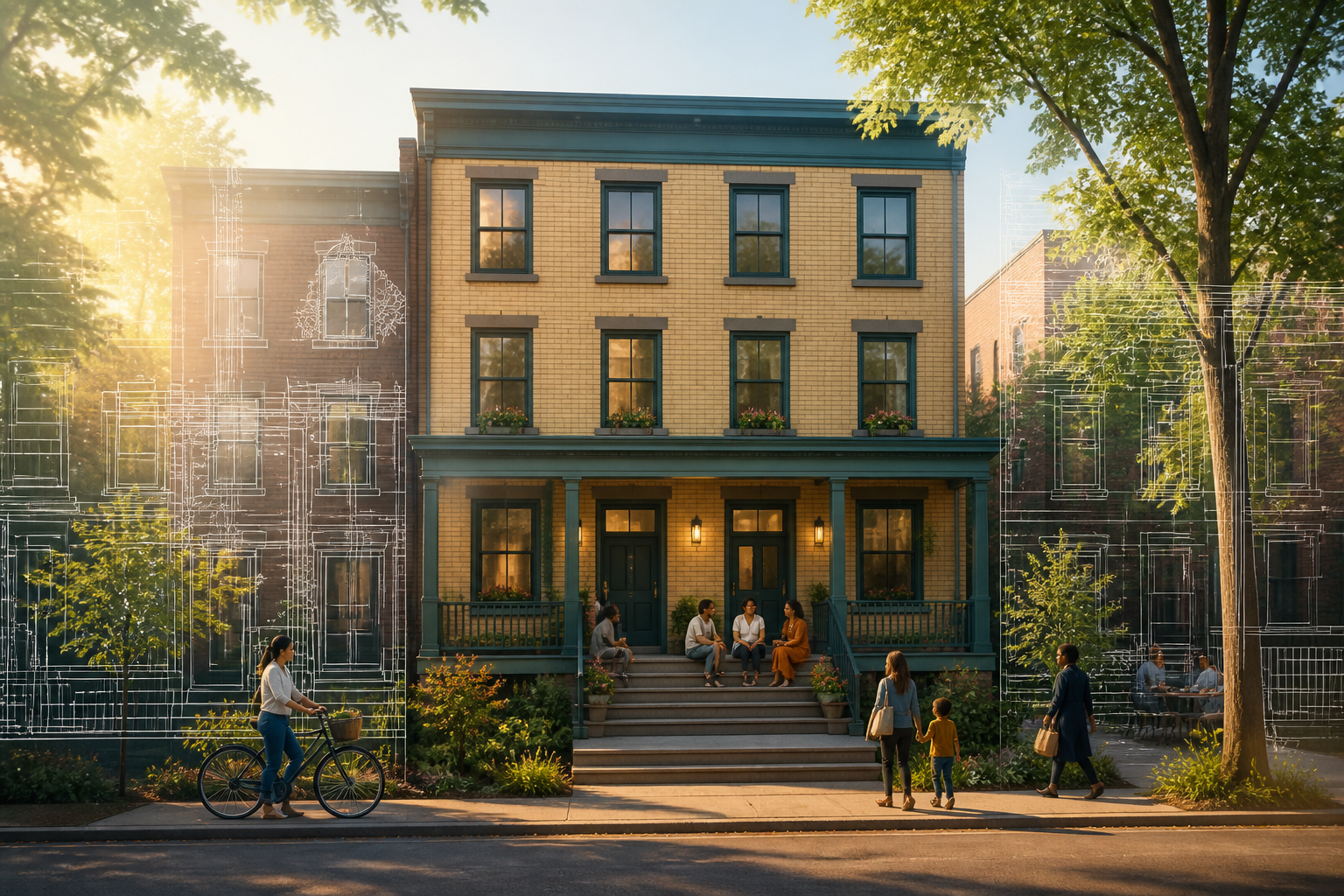
The conversation around housing bill zoning reform cooperatives care about most has shifted in 2026. With the 21st Century ROAD to Housing Act (H.R.6644) became law in July 2026, the federal government has put real weight behind reducing local regulatory barriers to building homes — and, for the first time in decades, has explicitly written housing cooperatives into the programs that fund and support affordable housing. For groups trying to launch a co-op in a community that has long been priced out or passed over, that combination matters.
This page explains, carefully, what the bill actually does on zoning and regulatory streamlining; how local zoning shapes whether a cooperative can get built at all; and what "missing middle" and "by-right" mean in practice. It does not overstate the law. Most zoning power still sits with cities and counties. But the federal posture has changed, and that change opens doors.
What the 2026 housing bill actually does on zoning
The ROAD to Housing Act is best understood as a large bipartisan package of incentives and process reforms rather than a single sweeping mandate. On the zoning and land-use side, several provisions stand out. Read them as encouragement, guidance, and funding — not as a federal override of local zoning codes.
Federal guidance and model frameworks, not federal preemption
A central piece directs the Department of Housing and Urban Development (HUD) to develop and offer guidance on how communities can reform zoning and land-use rules to reduce barriers to housing. This includes frameworks for reviewing by-right development proposals to streamline approvals and reduce uncertainty, model zoning regulations states can use to steer local reform, and approaches that reduce obstacles to a wider range of housing types across affordability levels.
The important nuance: this is guidance and model language, not a command. Washington is not rezoning your block. Instead, the law gives local governments better tools, clearer templates, and — through grants — financial reasons to adopt them.
Incentives tied to local reform
The bill leans on the federal government's most reliable lever: money. It ties certain funding and grant opportunities to communities that take steps to ease housing barriers. The intent is to make zoning reform attractive to local officials who might otherwise face the political friction of changing long-standing rules. For cooperative developers, this matters because the jurisdictions most likely to pursue these incentives are exactly the ones where new approval pathways for multi-unit and shared-ownership housing may open up.
Transit-oriented development and smaller lots
Several provisions encourage transit-oriented development — allowing more permissible units per structure and reducing minimum lot sizes near existing or planned transit. Minimum lot sizes and unit caps are two of the most common quiet killers of small multi-unit projects. Easing them near transit is precisely the kind of change that makes a modest co-op building pencil out.
Pre-reviewed designs and streamlined review
The law funds grants for local governments and tribes to adopt pre-reviewed housing designs — accessory dwelling units, duplexes, townhouses, and similar "missing middle" forms — so that approval is faster and less uncertain. A separate provision streamlines federal environmental (NEPA) review for a broad set of housing-related activities by expanding categorical exclusions, which can shorten timelines for federally supported projects.
Pre-reviewed, pre-approved building types are a genuinely useful idea for co-ops, where groups often have limited budgets for architecture and entitlement and benefit enormously from a faster, more predictable path through permitting.
Cooperatives written into federal programs
The provision most directly relevant to the housing bill zoning reform cooperatives community is not technically a zoning provision at all — but it is foundational. Language championed by Representative Nydia Velázquez explicitly recognizes housing cooperatives as eligible entities for federal housing programs and funding. It fixes vague statutory language that had left co-ops at risk of being excluded from programs they otherwise qualified for. Cooperative housing already supports roughly 1.5 million families in the United States, and this change protects and expands their access going forward.
In short: even where local zoning reform makes a project physically possible, financing is what makes it real. Writing co-ops clearly into federal programs closes a gap that quietly worked against shared-ownership housing for years.
How local zoning affects cooperative development
Zoning is the set of local rules governing what can be built where: how tall, how dense, how many units, how much parking, how far from the lot line. It is municipal, not federal, and it is the single biggest reason a cooperative housing project does or does not happen on a given parcel.
A housing cooperative is a form of ownership, not a building type. Members collectively own the entity that holds the property, and they hold the right to occupy their units. From a zoning officer's perspective, a 12-unit co-op building looks like a 12-unit building — and that is the problem. The barriers below apply to most small and mid-size multi-unit housing, and co-ops sit squarely in their path.
Single-family zoning
Large shares of residential land in many U.S. cities are zoned exclusively for detached single-family homes. On that land, a multi-unit cooperative is simply not allowed, no matter how much a community wants it. This is the broadest structural barrier to co-op development.
Density caps and minimum lot sizes
Even where multi-unit housing is permitted, caps on units per acre and large minimum lot sizes can make a co-op too small to be financially viable. Co-ops depend on spreading shared costs across enough member-households; density limits attack that math directly.
Parking minimums
Requirements to build a fixed number of parking spaces per unit can consume land and budget that a cooperative would rather put toward homes. In dense or transit-rich areas, parking minimums are often the difference between a feasible project and an impossible one.
Discretionary review and uncertainty
Many projects require case-by-case approvals — public hearings, variances, special permits. Each step adds time, cost, and the risk that a project dies after significant investment. For volunteer-led cooperative groups with thin budgets, this uncertainty is frequently fatal before a shovel ever hits the ground.
This is why the federal shift toward by-right pathways and streamlined review is meaningful for co-ops. The bill does not eliminate these local barriers, but it actively encourages and funds the kinds of reforms — by-right approvals, smaller lots, fewer parking mandates, pre-reviewed designs — that remove them.
Missing middle and by-right: the concepts that matter most
Two ideas sit at the center of modern zoning reform, and both are central to cooperative housing.
Missing middle housing
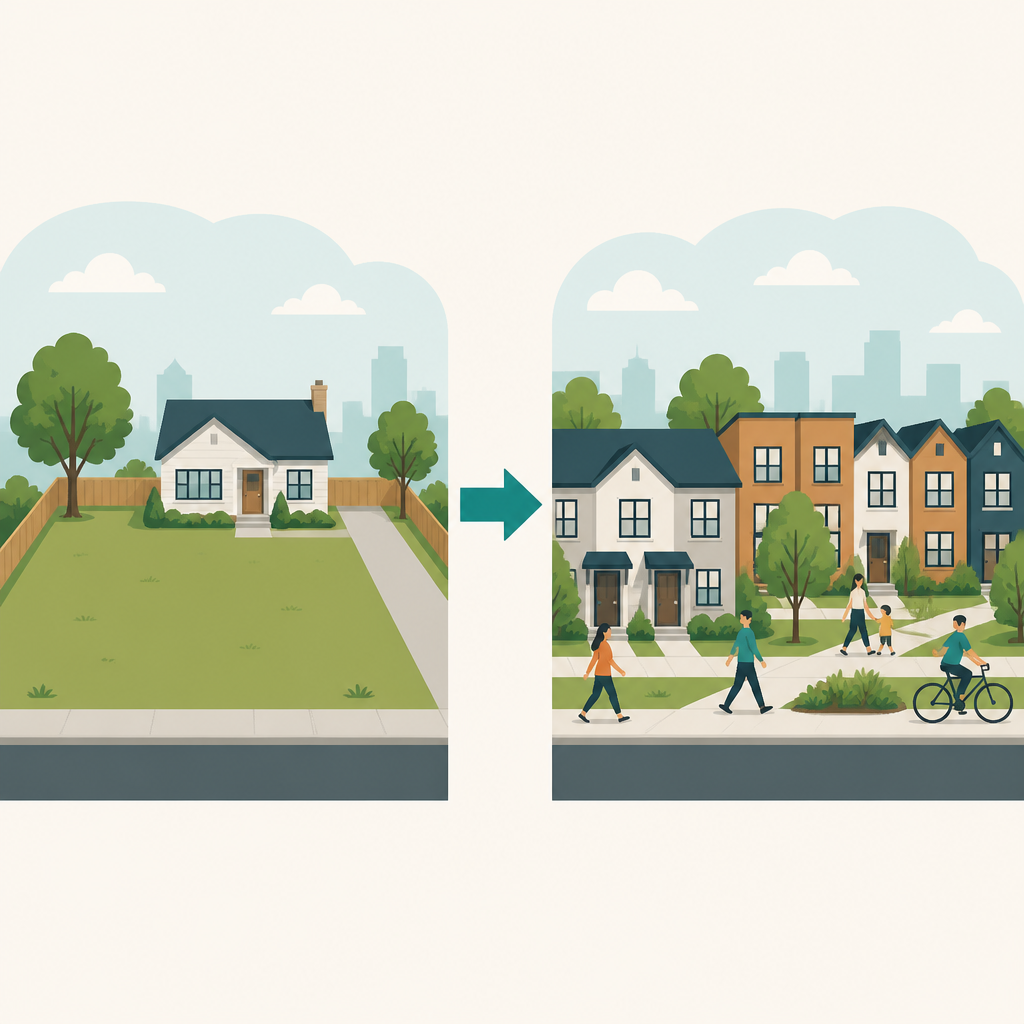
"Missing middle" refers to housing types between detached single-family homes and large apartment buildings: duplexes, triplexes, fourplexes, townhouses, courtyard buildings, and small multi-unit structures. These were once common in American neighborhoods but became illegal to build in many places under mid-20th-century single-family zoning — hence "missing."
Missing middle is the natural home of the housing cooperative. A small co-op building or a cluster of attached homes fits this scale exactly: dense enough to share costs and ownership, modest enough to fit into an existing neighborhood. When the 2026 bill funds pre-reviewed missing-middle designs and encourages zoning that allows these types, it is, in effect, clearing ground for co-ops.
By-right development
A project is approved by right when it complies with the zoning code and can proceed without discretionary, case-by-case approval. By-right is the opposite of the uncertain, hearing-by-hearing process that drains cooperative budgets. When the bill encourages communities to streamline review of by-right proposals, it is targeting the single biggest source of risk and delay for small developers and community groups.
For a cooperative, by-right status changes the entire feasibility calculation. It turns "we might be allowed to build, after a year of hearings, if we win" into "we are allowed to build, and here is the timeline." That predictability is what lets a volunteer-led group raise money and commit.
How Built By DAO + Blueprint fit in
Built By DAO is a venture studio for community-owned development. Through Urban Array, we focus on cooperative housing in disinvested communities — exactly the places where zoning reform and clearer federal co-op eligibility can have the biggest effect.
Our flagship software, Blueprint, helps groups plan, finance, and launch affordable housing cooperatives. As the 2026 housing bill changes the rules — new by-right pathways, smaller lot allowances, pre-reviewed designs, and explicit co-op eligibility in federal programs — the hard part shifts to a practical question: does a project actually work on this parcel, under these rules, with this group?
Blueprint is built to answer that. It helps cooperative groups assess feasibility under the new framework, model the financing, and move from idea to a fundable plan. The law lowers the barriers; Blueprint helps you navigate what is left.
Ready to test whether a co-op pencils out under the new rules? Explore Blueprint at blueprint.builtbydao.com.
Frequently asked questions
Does the 2026 housing bill override local zoning?
No. The ROAD to Housing Act works through guidance, model frameworks, and funding incentives rather than federal preemption. Cities and counties still control their zoning codes. The bill encourages and funds local reform — including by-right approvals and reduced lot-size and unit limits — but adopting those changes remains a local decision.
How does the bill specifically help housing cooperatives?
Most directly, it explicitly recognizes housing cooperatives as eligible entities for federal housing programs and funding, closing ambiguous statutory language that had put co-ops at risk of exclusion. Indirectly, its zoning-streamlining and missing-middle provisions clear the way for the small multi-unit buildings that co-ops typically occupy.
What is "missing middle" housing and why does it matter for co-ops?
Missing middle housing means types between single-family homes and large apartment buildings — duplexes, fourplexes, townhouses, and small multi-unit structures. These are the natural scale for a cooperative: dense enough to share ownership and costs, modest enough to fit existing neighborhoods. Zoning that allows missing middle directly enables co-op development.
What does "by-right" mean for a cooperative project?
By-right means a project that complies with zoning can be approved without discretionary, case-by-case review. For cooperatives, by-right status removes the uncertainty and delay of public hearings and variances — making it far easier to raise money, commit a group, and actually build.
Will zoning reform make co-op housing affordable everywhere now?
Not automatically. Zoning reform removes barriers, but affordability still depends on land cost, financing, construction costs, and local adoption of the reforms the bill encourages. The 2026 law improves the conditions for affordable co-ops; it does not guarantee outcomes in any single community.
How do we find out if a co-op is feasible under the new rules?
Start with a feasibility assessment that accounts for local zoning, the new federal pathways, and your group's finances. Blueprint is designed to walk cooperative groups through exactly this — modeling whether a project works on a specific site under current rules. Get started at blueprint.builtbydao.com.