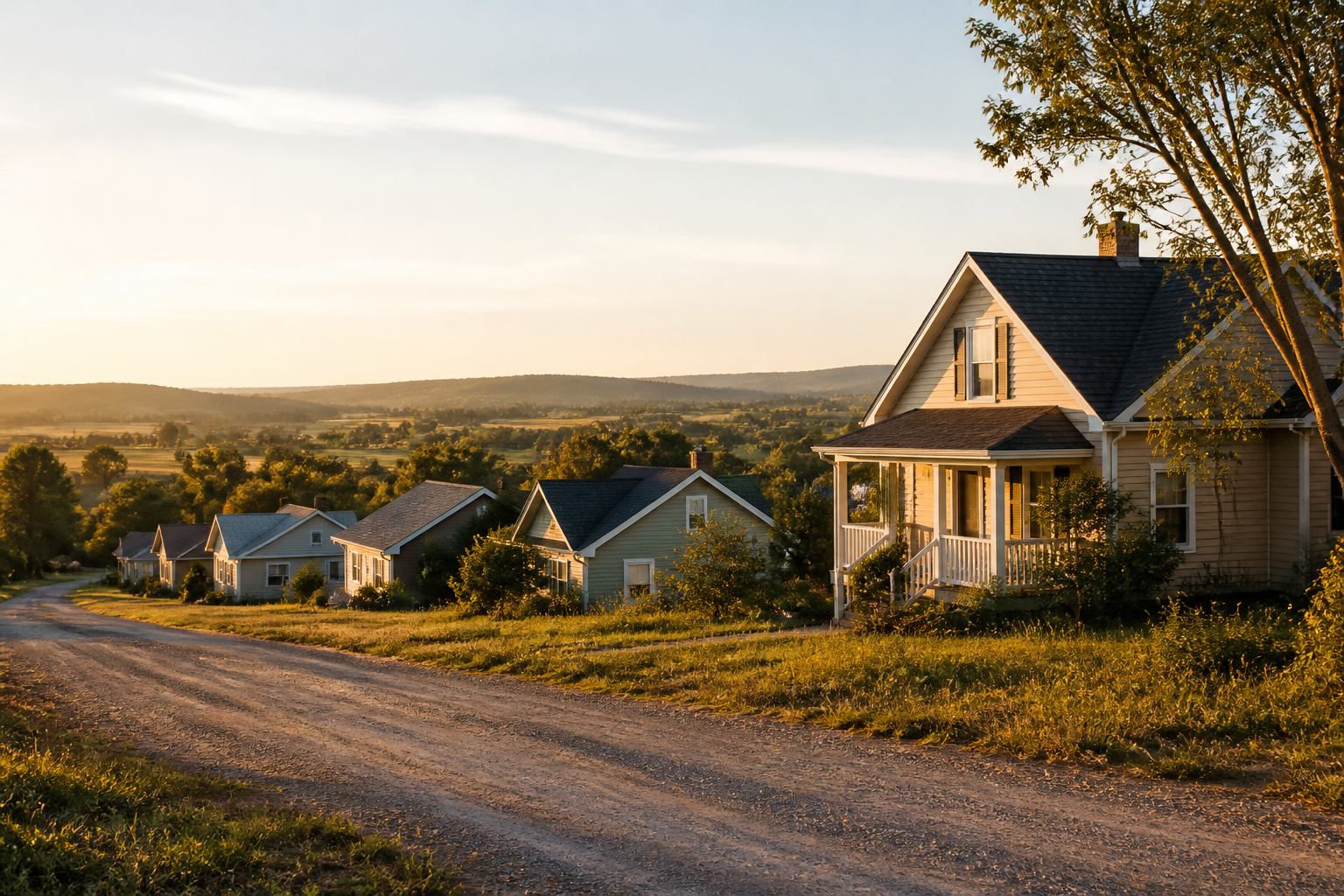
When people picture cooperative housing, they usually picture a city: a limited-equity co-op in a dense neighborhood, residents sharing ownership of a single building. But the rural housing cooperative model belongs just as much to small towns, farm regions, and tribal lands as it does to urban centers. Across rural America, families face the same pressures that drive the cooperative idea everywhere — rising costs, absentee landlords, thin housing supply, and a shortage of homes that stay affordable over time. Ownership, shared and democratic, is one durable answer. And in rural areas, the federal government has built a specific set of tools to support it through the U.S. Department of Agriculture (USDA).
This page explains how rural cooperatives work, walks through the USDA Rural Development programs that most often touch them, and describes how a recent federal law has expanded the role co-ops can play. Program rules change, funding levels shift between budget cycles, and eligibility details are administered locally. Treat what follows as an orientation, not a rulebook — verify current terms with USDA Rural Development and a qualified housing attorney before you act.
What a rural housing cooperative actually is
A housing cooperative is a corporation owned by the people who live in it. Instead of paying a landlord, members buy a share in the cooperative and, in exchange, get the right to occupy a home and a vote in how the community is run. The cooperative holds the underlying property; members hold shares and a proprietary lease or occupancy agreement.
Two structures dominate:
- Market-rate cooperatives, where share values rise and fall with the market. These behave a lot like condominiums.
- Limited-equity cooperatives (LECs), where resale prices are capped by formula so the housing stays affordable for the next member. LECs are the workhorse of the affordability world, and they are the structure most relevant to rural, lower-income communities.
In a rural context, the cooperative form solves problems that are sharper outside the city. Rural rental markets are often dominated by a small number of owners, and when one of them sells or exits, tenants can lose their homes with little recourse. A resident-owned cooperative changes the ownership question from "Will the landlord stay?" to "What do we, the members, decide?" Manufactured-home communities are a vivid example: across the country, residents have formed cooperatives to buy the land under their homes, ending the threat of a park being sold out from under them.
Why ownership matters more in rural places
Three features of rural housing make the cooperative model especially worth the effort:
- Thin supply. Fewer units means each one matters more. Preserving an existing affordable property as a co-op can be cheaper and faster than building new.
- Distance from services. Rural residents may live far from the nonprofits, lenders, and legal help that urban tenants can tap. A cooperative builds local governing capacity that lasts.
- Long horizons. Rural families often intend to stay for generations. A limited-equity structure rewards that stability by keeping homes affordable for the people who come next.
USDA Rural Development: the federal toolkit
The USDA's Rural Development mission area runs the largest set of federal housing programs aimed specifically at rural areas. These programs predate the modern cooperative-finance movement, and most were written with individual homeowners or conventional landlords in mind — but several intersect directly with cooperative and resident-owned models. The most relevant are summarized below at a general level. Program names, section numbers, income limits, and area eligibility are set by statute and regulation and are revised over time, so confirm the current version before relying on any detail here.
Section 515 Rural Rental Housing
Section 515 is USDA's long-standing program for financing multifamily rental housing in rural areas. Historically it provided low-interest loans to developers — nonprofit and for-profit — to build or rehabilitate apartments for low- and moderate-income residents, the elderly, and people with disabilities. Much of the existing rural affordable rental stock in the United States traces back to Section 515.
The program matters to cooperatives in two ways. First, the aging Section 515 portfolio is a preservation challenge: as original loans mature, properties can leave the affordable inventory, and resident or community ownership is one way to keep them affordable. Second, the financing structure has, in various forms, been usable by cooperative and mutual ownership entities. Section 515 is frequently paired with Section 521 Rental Assistance, a subsidy that helps tenants afford rent in financed properties.
Section 514 and Section 516 Farm Labor Housing
Sections 514 and 516 fund housing for farmworkers — a population that is overwhelmingly rural, often low-income, and historically underserved by mainstream housing programs. Section 514 provides loans, and Section 516 provides grants, to develop and improve housing for farm laborers and their families. Eligible applicants have included farmers, associations of farmers, nonprofit organizations, and public bodies.
Farm labor housing is a natural fit for cooperative thinking. The residents share a common employment context and a common geography, and the housing is meant to serve a community rather than generate landlord profit. Where a nonprofit or association develops Section 514/516 housing, governance structures that give residents a meaningful voice align with the cooperative spirit, even when the formal entity is not a share-issuing co-op.
Section 523 Mutual Self-Help Housing
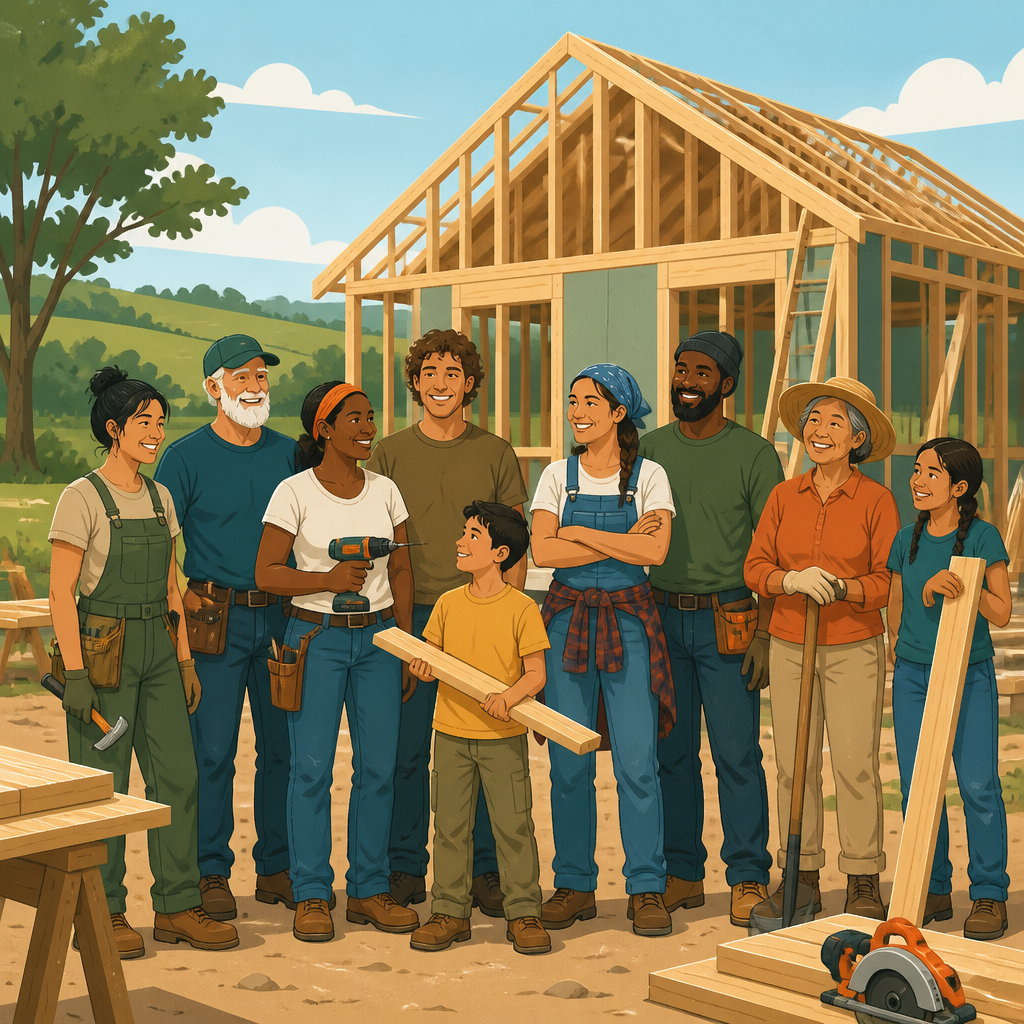
If any USDA program embodies cooperative values, it is Section 523 Mutual Self-Help Housing. Under this program, groups of families build their own homes together. Participants contribute "sweat equity" — they do much of the construction labor themselves, in groups, and no family moves in until every home in the group is finished. The sweat equity substitutes for a down payment, and the shared labor builds both homes and community bonds.
Section 523 grants typically fund the nonprofit organizations that recruit families, provide construction supervision, and administer the program. The homes themselves are usually financed through USDA's homeownership loans (see Section 502 below). While the end result is individual homeownership rather than a share in a cooperative corporation, the process is deeply cooperative: mutual aid, collective labor, and a group that succeeds or fails together. For communities exploring co-ops, self-help groups are often where the organizing muscle is built.
Section 502 loans
The Section 502 program is USDA's flagship single-family homeownership tool, available in two main forms:
- Section 502 Direct loans, made by USDA directly to low- and very-low-income rural buyers, often with payment assistance that effectively reduces the interest rate based on income.
- Section 502 Guaranteed loans, made by private lenders and backed by a USDA guarantee, serving moderate-income buyers.
Section 502 Direct loans are the financing engine behind much of Section 523 self-help housing, and they are a primary path to ownership for rural families generally. While 502 itself finances individual homes rather than cooperative shares, it is part of the same ecosystem: the same income limits, the same area eligibility maps, and the same local USDA offices that a cooperative developer will interact with.
How the pieces fit together
In practice these programs are not silos. A rural development effort might use a Section 523 grant to organize and supervise families, Section 502 Direct loans to finance their homes, Section 515 to preserve nearby rental housing, and Section 514/516 to serve farmworkers in the same county. A cooperative or community land trust can sit at the center of this, holding land or buildings, coordinating financing, and providing the governance that keeps everything affordable for the long term.
The policy shift: co-ops in federal housing programs
For decades, cooperative housing lived at the margins of federal policy. Programs were written around two assumptions — that affordable rentals are owned by landlords and that affordable ownership means a single family on a single deed. Cooperatives, which are neither, often had to be squeezed into rules that did not anticipate them.
That landscape changed with the 21st Century ROAD to Housing Act (H.R. 6644), which was passed by Congress in June 2026 (now law as of July 2026). The Act is a broad housing package, and one of its most consequential pieces for the cooperative world is a set of provisions associated with Representative Nydia Velázquez. These Velázquez provisions authorize cooperatives in federal housing programs — formally recognizing the cooperative model as an eligible structure within programs that historically treated it as an afterthought.
The practical significance is in recognition and access. When co-ops are explicitly authorized, program administrators have clearer authority to finance them, fund them, and count them. According to the framing around the bill, the cooperative provisions are oriented toward building on the 1.5 million families already living in cooperative housing through cooperative housing — a scale that signals intent to move co-ops from a niche to a mainstream tool.
For rural communities, this matters because the USDA programs above are precisely the kind of federal housing programs where cooperative authorization can change what is possible. Clearer recognition of co-ops can smooth the path for resident-owned manufactured-home communities, limited-equity rural co-ops, and preservation of aging Section 515 properties under community ownership. As with everything in this guide, the specific regulatory implementation will unfold over time through agency rulemaking — so watch for USDA and HUD guidance rather than assuming the statute is self-executing.
Common challenges in rural cooperative development
Cooperatives are powerful, but they are not easy. Rural organizers consistently run into the same friction points:
- Financing complexity. Stacking USDA loans, grants, rental assistance, and sometimes Low-Income Housing Tax Credits requires expertise that small rural communities may not have on hand.
- Governance capacity. A cooperative only works if members can govern it. That means training, bylaws, and a culture of participation — none of which appear automatically.
- Predevelopment costs. The legal, organizing, and feasibility work that happens before a single home is financed is real money, and it is the hardest money to raise.
- Thin professional networks. Fewer attorneys, accountants, and developers specialize in cooperative housing in rural regions than in major cities.
None of these is fatal. Each is a reason to plan carefully, build local capacity early, and use tools that lower the cost of doing the work right.
How Built By DAO + Blueprint fit in
Built By DAO is a venture studio focused on community-owned development — building software and structures that let communities, not outside investors, own what they build. Founded by Marquis Davis and home to brands including Urban Array and Running Start Digital, the studio's flagship product is Blueprint.
Blueprint is software to plan, finance, and launch affordable housing cooperatives. It is built to take the hardest parts of cooperative development — the financial modeling, the program stacking, the governance design, the document-heavy launch process — and make them navigable for the people who actually live in the community, not just the consultants. For rural groups weighing USDA programs and cooperative structures, that means a way to model how the pieces fit before committing scarce predevelopment dollars to find out.
If you are exploring a rural housing cooperative — preserving a Section 515 property, organizing a self-help group, or converting a manufactured-home community to resident ownership — start with Blueprint at blueprint.builtbydao.com. Plan the model, pressure-test the finances, and bring your neighbors into a structure they own.
Frequently asked questions
What is a rural housing cooperative?
A rural housing cooperative is a corporation, located in a rural area, that is owned by the people who live in it. Members buy a share, gain the right to occupy a home, and vote on how the community is governed. Limited-equity versions cap resale prices so the housing stays affordable for future members. It is the same cooperative model used in cities, applied to small towns, farm regions, and other rural places.
Which USDA programs support cooperative or community-owned housing?
Several USDA Rural Development programs intersect with cooperative and community-owned models, including Section 515 multifamily rental housing, Section 514/516 farm labor housing, Section 523 mutual self-help housing, and Section 502 homeownership loans. Some finance cooperatives or community entities directly; others, like Section 523 and 502, build the organizing capacity and individual financing that often surround a cooperative effort. Program eligibility and terms change, so confirm details with USDA.
Does the 21st Century ROAD to Housing Act help rural co-ops?
The 21st Century ROAD to Housing Act (H.R. 6644), passed by Congress in June 2026, includes Velázquez provisions that authorize cooperatives in federal housing programs. By formally recognizing co-ops as an eligible structure, the law can make it easier for federal programs — including the USDA programs that serve rural areas — to finance and support cooperative housing. The detailed effects will depend on agency rulemaking over time.
What is the difference between a market-rate and a limited-equity cooperative?
In a market-rate cooperative, the value of a member's share rises and falls with the housing market, much like a condominium. In a limited-equity cooperative (LEC), resale prices are capped by a formula so the home stays affordable for the next member. LECs are the structure most often used for permanently affordable, lower-income housing, including in rural communities.
Can manufactured-home communities become cooperatives?
Yes. Residents of manufactured-home (mobile home) communities frequently form cooperatives to buy the land beneath their homes, which protects them from the community being sold or redeveloped. This is one of the fastest-growing applications of the cooperative model in rural and exurban areas, and it pairs well with available financing and technical-assistance resources.
Where can I verify current USDA program rules?
Always confirm current program terms directly with USDA Rural Development and its state and local offices, and consult a qualified housing attorney and cooperative-development specialist. Section numbers, income limits, area eligibility maps, and funding levels are set by statute and regulation and are revised over time. The descriptions on this page are a general orientation, not legal or financial advice.