The conversation around public housing reform, RAD conversions, and federal oversight reached a new milestone this year. With the 21st Century ROAD to Housing Act (H.R.6644) passed by Congress in June 2026 (now law as of July 2026), the rules governing how troubled housing authorities are monitored, how public housing stock gets recapitalized, and how residents can move toward ownership models have all shifted. This page explains what changed, where the debates remain unsettled, and what residents, advocates, and developers should understand before the next phase of implementation.
The goal here is not to cheerlead any single approach. Public housing reform involves genuine tradeoffs, and reasonable people disagree about whether conversions and oversight reforms protect residents or expose them to new risks. We try to present those debates fairly.
The Problem: A Repair Backlog That Outpaced Funding
The starting point for almost every public housing reform debate is the physical condition of the stock itself. Public housing in the United States was largely built between the 1930s and the 1970s, and much of it is now well past the point where routine maintenance can keep it habitable.
For decades, the capital backlog — the estimated cost of bringing public housing units up to a state of good repair — has been measured in the tens of billions of dollars. The most widely cited federal study put the figure in the range of roughly $26 billion when it was conducted, and subsequent analyses by housing advocates have estimated the need has grown substantially since then as buildings aged and capital appropriations failed to keep pace. The exact number is contested and depends on methodology, but the direction is not: the backlog grew faster than Congress funded it.
The consequences are concrete. Public housing authorities (PHAs) lose units every year to obsolescence — roofs that can no longer be patched, heating systems that fail in winter, mold and lead hazards that render apartments unsafe. When a unit comes offline and there is no capital to restore it, the result is a permanent reduction in deeply affordable housing supply at a moment when waiting lists in many cities stretch for years.
This funding gap is the root cause that nearly every reform mechanism, including RAD, was designed to address.
RAD: The Rental Assistance Demonstration Explained
The Rental Assistance Demonstration (RAD) is the federal tool most central to the modern public housing reform debate. Launched by the Department of Housing and Urban Development (HUD) in 2012, RAD allows PHAs to convert public housing units from the traditional Section 9 public housing funding stream to a long-term, project-based Section 8 contract.
Why the funding stream matters
The mechanics sound technical, but the practical effect is significant. Public housing's capital and operating subsidies are appropriated annually and have been chronically underfunded. A long-term Section 8 contract, by contrast, is a more stable and predictable revenue stream that lenders and investors recognize. That stability is what lets a housing authority — or a partner — borrow against future rents, access Low-Income Housing Tax Credit equity, and finance the renovations the property needs.
In short, RAD was designed to unlock private capital for repairs that annual appropriations were never going to cover.
What RAD preserves, and what critics fear
RAD includes resident protections written into the program: the right to return after renovation, continued affordability, and one-for-one replacement of converted units. Supporters argue these protections, combined with new capital, mean residents end up in rehabilitated homes that would otherwise have deteriorated or been demolished.
Critics raise several concerns:
- Private and nonprofit ownership. Conversions frequently bring in private developers, nonprofits, or mixed partnerships. Some residents and tenant organizers worry that shifting away from direct public ownership weakens public accountability.
- Relocation risk. The "right to return" depends on rigorous enforcement. Where relocation during construction is poorly managed, residents can lose track of their right to come back.
- Long-term affordability. While contracts are long, advocates push to ensure affordability genuinely persists across renewals rather than eroding decades later.
Both the promise and the criticism are real. RAD has demonstrably moved billions in private capital into aging properties; it has also generated litigation and organizing campaigns where residents felt protections were not honored in practice. A fair reading is that RAD's outcomes depend heavily on execution, oversight, and resident voice — which is precisely where the ROAD to Housing Act enters.
The ROAD to Housing Act's Oversight Provisions
The 21st Century ROAD to Housing Act (H.R.6644), passed by Congress in June 2026, is best understood as an oversight-and-options statute rather than a single new spending program. Two strands matter most for public housing reform.
Tighter congressional oversight of troubled housing authorities
The Act establishes tighter congressional oversight of public housing authorities operating under federal monitorship. Monitorship is the arrangement under which HUD steps in to supervise — and in severe cases effectively take over — a PHA that has been designated "troubled" due to chronic financial mismanagement, failed physical inspections, or governance failures.
Historically, several large urban housing authorities have spent years under HUD receivership or administrative oversight, and residents in those jurisdictions have often complained that monitorship became open-ended with little transparency about benchmarks for exit. The ROAD to Housing Act's provisions are aimed squarely at that gap: they strengthen the reporting and accountability obligations tied to monitorship so that Congress, and by extension the public, can see how a troubled authority is performing and what the path back to local control looks like.
For residents, this is a double-edged reform. Greater oversight can mean faster correction of dangerous conditions and mismanaged funds. It can also mean residents experience their housing as something administered from Washington rather than governed locally — which is one reason the Act pairs oversight with new ownership pathways.
Velázquez provisions: authorizing co-ops in federal housing programs
The second strand is the Velázquez provisions, which authorize housing cooperatives within federal housing programs. This is the part of the law most relevant to resident control. By explicitly authorizing the co-op model in federal programs, the Act creates a recognized legal pathway for residents to collectively own and govern their housing rather than remaining tenants of a public agency or a private converter.
According to the framing of the legislation, cooperative models are aimed at a cooperative sector already home to 1.5 million families. That figure reflects the scale of opportunity the co-op authorization is meant to address, not a guaranteed outcome — converting authorization into actual cooperatives requires financing, technical assistance, and local will.
Where Residents Stand: The Core Tensions
It would be dishonest to present reform as a settled consensus. Resident organizations, legal aid groups, and tenant unions have spent years pressing concerns that remain live even after the ROAD to Housing Act.
Concern 1 — Displacement. The single most consistent fear across every reform mechanism is displacement. Whether through RAD relocation, redevelopment, or the disposition of distressed properties, residents want enforceable guarantees that "temporary" moves do not become permanent ones.
Concern 2 — Real control versus nominal participation. Resident advisory boards and required consultation are common, but residents frequently report that consultation is a formality rather than a genuine share of decision-making power. The appeal of the cooperative model is that it converts participation into actual governance and equity. Skeptics counter that ownership also transfers responsibility and risk onto residents who may lack capital reserves for major repairs.
Concern 3 — Long-term affordability and exit. Residents want assurance that today's affordability does not quietly expire. Oversight reforms help by making performance visible; co-op structures can help by embedding permanent affordability into the ownership entity itself — but only if the governing documents are written to require it.
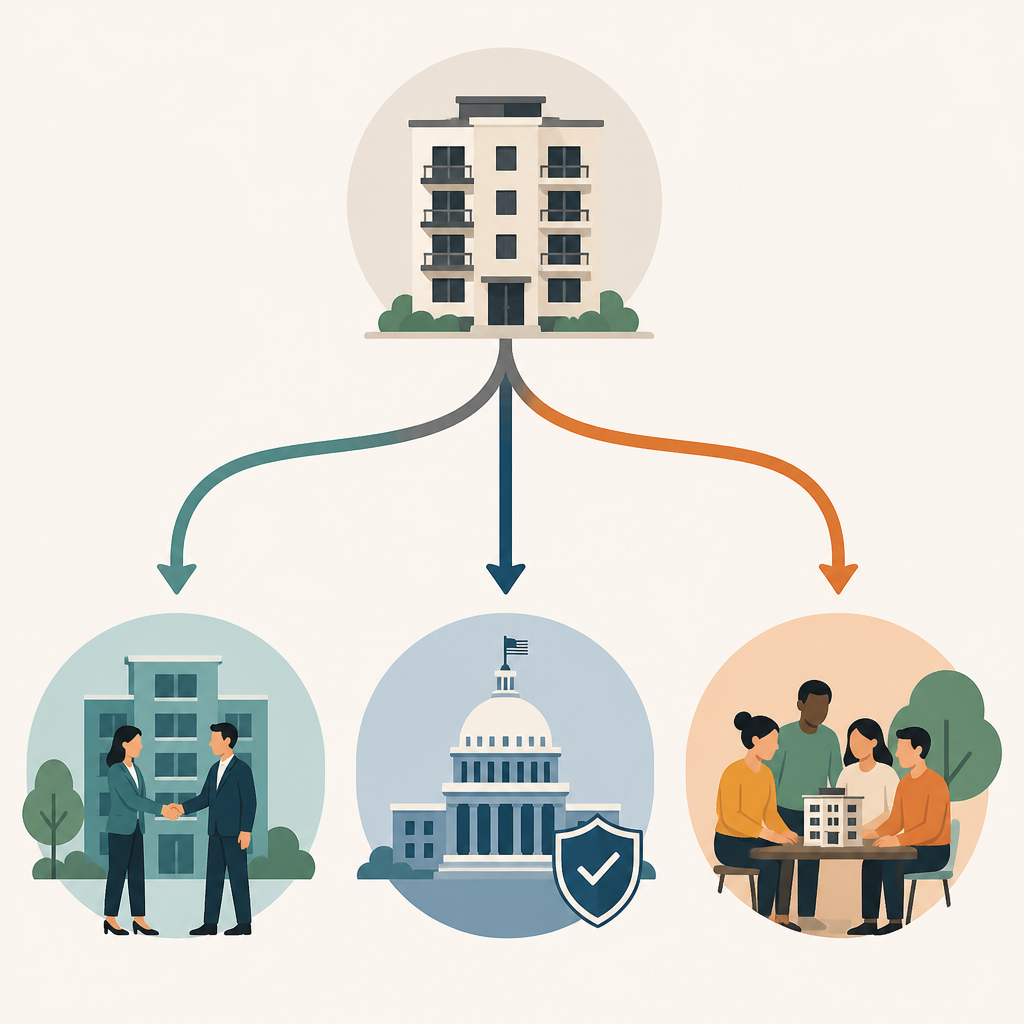
Presented fairly, the reform landscape is not a choice between "good" and "bad" but between different distributions of capital, risk, and control. RAD moves capital and risk toward private partners. Monitorship moves control toward federal supervisors. Cooperatives move both control and risk toward residents themselves. Each has defenders and critics, and the right answer is often property- and community-specific.
Pathways Toward Resident-Controlled and Co-op Models
With the Velázquez provisions now authorizing co-ops in federal programs, the practical question becomes: how does a building of public housing residents actually get from where they are to collective ownership? The path generally runs through several stages.
- Organizing and readiness. Residents form an association, build trust, and assess whether the community wants to pursue ownership.
- Feasibility and financing. A realistic plan must account for acquisition or conversion costs, the repair backlog on that specific property, ongoing operating reserves, and the blend of subsidy, debt, and tax-credit equity needed to make the numbers work.
- Legal structure. The cooperative entity — typically a limited-equity housing cooperative that caps resale prices to preserve affordability — must be formed with governing documents that lock in affordability and define member rights.
- Governance and stewardship. Residents take on real responsibilities: budgeting, maintenance planning, and democratic decision-making.
This is where most resident-ownership efforts stall. Organizing energy is rarely the bottleneck; the financial modeling, legal structuring, and ongoing stewardship are. A community can be fully committed and still be unable to translate that commitment into a financeable, durable cooperative.
How Built By DAO + Blueprint Fit In
Built By DAO is a venture studio focused on community-owned development. Our flagship platform, Blueprint, is software built to address exactly the stage where co-op efforts most often stall: turning the intent to own into a plan that can be financed, launched, and governed.
Blueprint helps residents and their partners plan, finance, and launch affordable housing cooperatives — modeling the repair and acquisition costs of a specific property, structuring the financing stack, and supporting the cooperative governance that keeps affordability permanent. As the ROAD to Housing Act's Velázquez provisions open a federal pathway for co-ops, the practical work of building those co-ops becomes the limiting factor. That is the gap Blueprint is designed to close.
If you are a resident leader, housing authority, nonprofit, or local official exploring resident-controlled housing in the wake of public housing reform, see how the platform works.
Frequently Asked Questions
What is the difference between public housing and RAD-converted housing?
Traditional public housing is funded through annual Section 9 appropriations and owned by a public housing authority. RAD-converted housing is funded through a long-term project-based Section 8 contract, which is more stable and can be leveraged for financing. RAD includes resident protections such as the right to return and continued affordability, though critics argue enforcement varies.
Did the 21st Century ROAD to Housing Act (H.R.6644) pass?
Yes. The 21st Century ROAD to Housing Act (H.R.6644) was passed by Congress in June 2026. Among other things, it strengthens congressional oversight of public housing authorities under federal monitorship and includes the Velázquez provisions authorizing housing cooperatives within federal housing programs.
What does "federal monitorship" of a housing authority mean?
Federal monitorship refers to HUD oversight of a housing authority designated as "troubled" due to financial, physical, or governance failures. In severe cases this can amount to a takeover. The ROAD to Housing Act tightens reporting and accountability requirements around these arrangements so that performance and the path back to local control are more transparent.
How can public housing residents move toward owning a cooperative?
The path generally runs through organizing, feasibility and financing analysis, forming a cooperative legal entity (often a limited-equity housing cooperative that preserves affordability), and building resident governance. The Velázquez provisions in the ROAD to Housing Act create a recognized federal pathway for co-ops, but execution still requires financing and technical support.
Is RAD good or bad for residents?
It depends on execution. RAD has moved billions in private capital into aging properties that annual appropriations could not fix, and it carries written resident protections. It has also generated concerns about private ownership, relocation, and long-term affordability where protections were poorly enforced. Outcomes hinge on oversight and genuine resident voice.
How does Built By DAO's Blueprint relate to these reforms?
Blueprint is software that helps residents and partners plan, finance, and launch affordable housing cooperatives. As the ROAD to Housing Act authorizes co-ops in federal programs, Blueprint addresses the stage where most resident-ownership efforts stall: financial modeling, financing structure, and cooperative governance.