
When a rental building goes up for sale, the people who live in it usually find out last. An opportunity to purchase law (TOPA, COPA) flips that order. These laws give tenants, or mission-driven nonprofits acting on their behalf, the legal right to be told first and the chance to buy the building before it is sold to an outside investor. In a handful of jurisdictions, that single change in sequencing has kept thousands of households housed and turned investor-bound buildings into resident-owned cooperatives.
This guide explains how the two best-known versions work, how the timelines and the assignment of rights actually function, where the limits sit, and what tenants and community developers should know before relying on either. Statutes in this area change frequently and vary by jurisdiction, so treat everything here as an orientation and verify the current text and deadlines with your local agency or counsel before acting.
What an "opportunity to purchase" law actually does
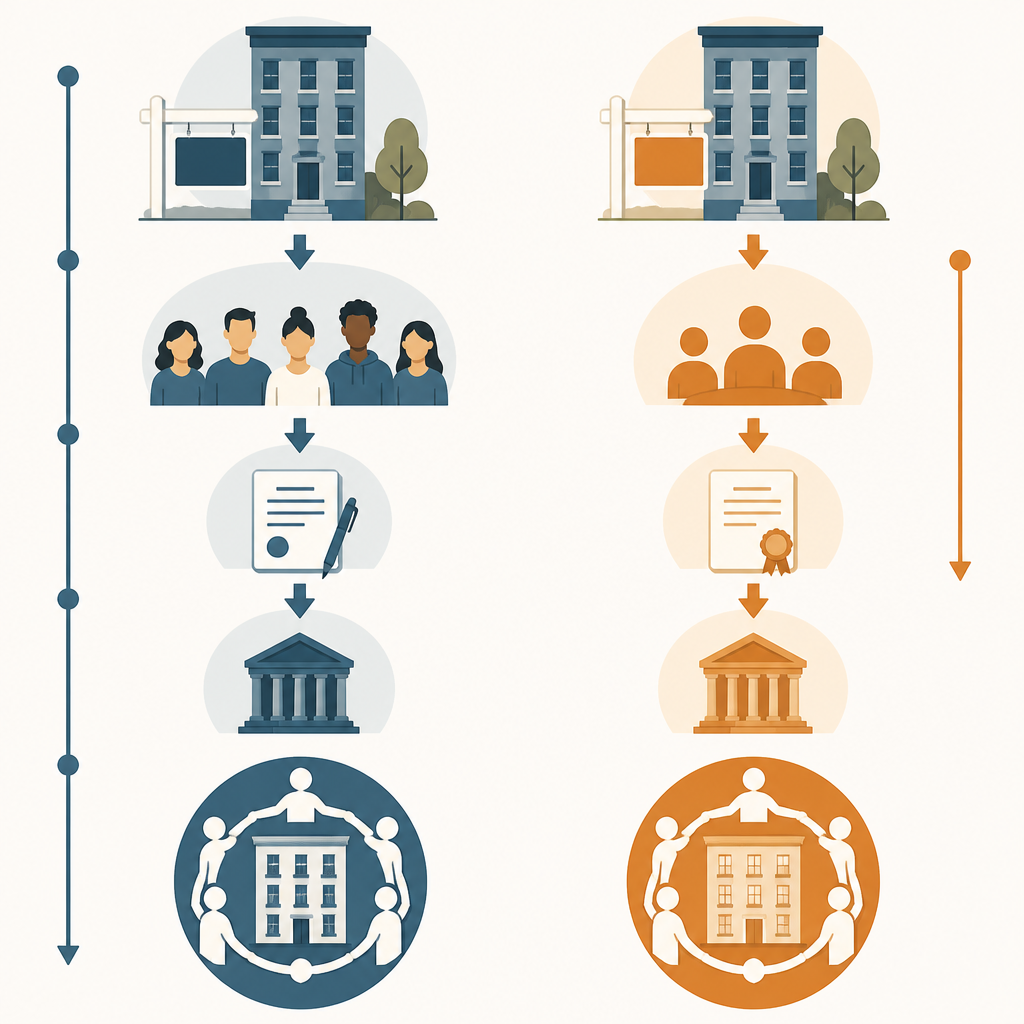
At its core, an opportunity to purchase law inserts a step between an owner's decision to sell and the closing of that sale. Before an owner can transfer a covered rental property, they must give notice to a defined group, usually the current tenants, a tenant association, or a list of qualified nonprofits, and give that group a defined window to make an offer.
Two legal mechanisms do the heavy lifting:
- Right of first offer. The covered group is notified of the owner's intent to sell and gets a set period to express interest and submit terms before the property is marketed to the open market.
- Right of first refusal. If a third-party buyer makes an offer the owner wants to accept, the covered group gets a window to match that offer and step into the deal.
Some laws use one mechanism, some use both in sequence. What they share is a goal: give the people closest to the building a real, time-limited chance to control its future instead of watching it change hands over their heads.
The two reference statutes most people mean by "TOPA and COPA" are Washington, D.C.'s Tenant Opportunity to Purchase Act and San Francisco's Community Opportunity to Purchase Act. They take different approaches, and the differences matter.
TOPA: the Tenant Opportunity to Purchase Act (Washington, D.C.)
D.C.'s TOPA, first enacted in 1980, is the oldest and most studied law of its kind in the country. It is tenant-centered: the right runs to the people who live in the building.
How TOPA works
Before an owner of a covered rental accommodation can sell, they must give tenants a formal offer of sale. What tenants can do next scales with the size of the building:
- Single-unit and small buildings historically carried simpler rights, often a right of first refusal rather than a full negotiation right.
- Buildings with five or more units carry the strongest rights. Tenants can form a tenant association, register it, and negotiate to buy the building collectively, frequently converting it into a limited-equity housing cooperative or a condominium.
The statute builds in negotiation periods and extensions that give a registered tenant association time to organize, secure financing, and conduct due diligence. These timelines are measured in months, not days, which is part of what makes D.C.'s law unusually powerful for tenants. The exact number of days for registration, negotiation, and contract and settlement extensions is set by statute and has been amended; confirm the current figures with the D.C. Department of Housing and Community Development or the Office of the Tenant Advocate before relying on them.
Recent narrowing
TOPA has been actively contested. Over the past several years the District has narrowed its scope in stages: single-family homes were largely exempted in 2018 (with carve-outs that have applied to certain elderly or disabled tenants), and more recent legislation has moved to exempt many newly constructed buildings for a period of years and to limit application to many smaller two-to-four-unit properties. These changes are recent, were the subject of significant debate, and may continue to evolve. Because the boundaries of what TOPA now covers are exactly the detail most likely to be out of date, verify the current exemptions for your building type and construction date directly.
COPA: the Community Opportunity to Purchase Act (San Francisco)
San Francisco's COPA, enacted in 2019, takes a different route to a similar end. Instead of routing the right to tenants directly, it routes it to qualified nonprofit organizations (QNPs), mission-driven groups such as community land trusts and affordable housing developers that have been certified by the city.
How COPA works
COPA applies to buildings with three or more residential rental units (and to vacant land zoned for residential use of that scale). The process combines both mechanisms in a defined sequence:
- Right of first offer. Before listing or selling a covered property, the owner must notify the qualified nonprofits. The QNPs have a short window, reported as roughly five days, to express interest.
- Right of first refusal. If a QNP expresses interest, it then has a longer window, reported as roughly 25 days, to make an offer. The owner may accept, counter, or reject it.
- Matching. If the owner later receives an offer from a private buyer, a QNP that engaged in the process generally gets the chance to match that offer before the owner can sell to the third party.
These day counts are statutory and have practical exceptions and tolling rules; confirm the current periods with the San Francisco agency administering COPA before relying on them.
The affordability trade
COPA buildings come with a permanent string attached. In exchange for the purchase right, the nonprofit owner must keep the building affordable over the long term. The city's formula has been described as requiring that average rent and utilities across all residential units not exceed 30% of 80% of Area Median Income, adjusted for household size. The nonprofit is responsible for maintaining that average for the life of the building's COPA obligation. This is the mechanism that turns a one-time purchase into durable, lasting affordability rather than a temporary reprieve.
San Francisco land trusts and mission developers have used COPA to acquire dozens of buildings and preserve hundreds of homes that were otherwise at real risk of investor purchase and displacement.
TOPA vs. COPA at a glance
| Feature | TOPA (D.C.) | COPA (San Francisco) |
|---|---|---|
| Who holds the right | Tenants / tenant associations | Qualified nonprofit organizations |
| Typical covered buildings | Multi-unit rentals (scope narrowing) | 3+ residential rental units |
| Core mechanism | Offer of sale, negotiation, refusal | First offer, refusal, and matching |
| Negotiation window | Months (with extensions) | Days (short, defined windows) |
| Permanent affordability | Not automatic; depends on financing | Built in via AMI rent cap |
Neither model is strictly better. TOPA's long timelines give tenants room to organize and self-determine but can complicate financing and sales. COPA's tight windows keep transactions moving and guarantee affordability but move the decision away from the residents themselves and toward certified nonprofits.
Assignment of rights: how mission developers enter
The single most important practical detail in both models is assignment. Most tenant groups cannot, on their own, close a multi-million-dollar real estate purchase inside a statutory window. So the laws and the practice around them generally allow the holder of the right to assign it to a capable partner.
In D.C., a tenant association will often assign its TOPA rights to a nonprofit developer, a community development corporation, or a cooperative-conversion specialist that brings financing, legal capacity, and project management, ideally under terms that preserve resident ownership or governance. In San Francisco, the right already sits with qualified nonprofits by design. In both cases the assignment is where an abstract legal right becomes an actual closed deal, and it is also where residents can lose control if the assignment terms are weak. The terms of an assignment, who governs the building afterward, what equity or rights tenants retain, what affordability is locked in, are as important as the right itself.
Emerging state and local TOPA / COPA efforts
D.C. and San Francisco are the anchors, but the model is spreading. A growing number of states and cities have studied, drafted, or piloted their own tenant or community opportunity to purchase frameworks, and advocacy organizations have published model legislation to help localities adapt the approach. Some efforts target whole states; others are city ordinances or are folded into broader anti-displacement and preservation packages.
Because this is the most fast-moving part of the landscape, specific bill numbers, statuses, and effective dates go stale quickly. If you are evaluating a TOPA or COPA effort in a particular state or city, confirm its current status with the sponsoring legislator's office, the administering agency, or a local housing attorney rather than relying on a secondhand summary.
The limits worth knowing
Opportunity to purchase laws are powerful but not magic. Real constraints include:
- Financing speed. Statutory windows can be shorter than the time it takes to raise acquisition capital, which is why pre-arranged financing and capable partners are decisive.
- Exemptions and carve-outs. Building age, size, and type can move a property in or out of coverage, and these boundaries are exactly what legislatures keep amending.
- Capacity. A right is only as good as the organization able to exercise it; thin nonprofit or tenant-association capacity is a common failure point.
- Political contestation. As D.C.'s experience shows, these laws are repeatedly revisited, so a right that exists today may be narrower next year.
- Owner workarounds. Sophisticated sellers structure transactions to minimize friction, and enforcement varies.
None of these are reasons to dismiss the tools. They are reasons to go in with a plan, a partner, and verified, current information.
How Built By DAO + Blueprint fit in
Built By DAO is a venture studio focused on community-owned development. Our flagship product, Blueprint, is software that helps tenant groups and mission developers do the hard part of an opportunity to purchase deal: plan, finance, and launch the affordable housing cooperative on the other side of the purchase. That means modeling the acquisition, structuring co-op governance and limited-equity shares, organizing the financing stack, and managing the timeline so a statutory window does not close before the deal does.
This work is gaining a powerful tailwind. The 21st Century ROAD to Housing Act (H.R.6644), passed by Congress in June 2026 (now law as of July 2026), includes the Velázquez provisions, which authorize housing cooperatives within federal housing programs and are aimed at a cooperative sector already home to 1.5 million families. Federal recognition of co-ops as eligible models makes the path from a TOPA or COPA purchase to a financed, durable cooperative meaningfully clearer.
If your tenant association or organization is staring down a sale and wants to act, explore Blueprint at blueprint.builtbydao.com to see how the planning, financing, and launch pieces fit together.
Frequently asked questions
What is the difference between TOPA and COPA?
TOPA (D.C.) gives the right to buy primarily to tenants and tenant associations, with relatively long negotiation windows. COPA (San Francisco) gives the right to certified qualified nonprofits, with short defined windows and a built-in permanent affordability requirement. Both aim to keep rental buildings out of speculative ownership.
Can tenants actually afford to buy their building?
Rarely with cash alone. In practice tenants assign or partner their rights to a mission developer, nonprofit, or cooperative specialist that brings financing and capacity, while the residents retain ownership, governance, or both. Pre-arranged financing is often the deciding factor in whether a deal closes inside the legal window.
Does my city have an opportunity to purchase law?
Maybe. D.C. and San Francisco are the established examples, and a growing number of states and cities are studying or piloting their own versions. Because bill numbers and statuses change quickly, confirm with your local housing agency, a legislator's office, or a housing attorney rather than relying on a general summary.
How long do tenants have to respond?
It varies sharply by jurisdiction and building size, from a few days in COPA's first-offer window to several months under TOPA's negotiation and extension periods. The exact deadlines are set by statute, have been amended, and should be verified for your specific situation before you rely on them.
What happens to the building after a TOPA or COPA purchase?
Often it becomes a limited-equity housing cooperative or a permanently affordable, nonprofit-owned building. Under COPA, an AMI-based rent cap locks in affordability. Under TOPA, the long-term structure depends on how the purchase is financed and governed, which is why the assignment and conversion terms matter.
Where can I verify the current rules?
Go to the source: the D.C. Department of Housing and Community Development and Office of the Tenant Advocate for TOPA, the San Francisco agency administering COPA, and the sponsoring legislator or administering agency for any emerging state or local effort. Statutes in this area are amended frequently, so always confirm current text, exemptions, and deadlines.