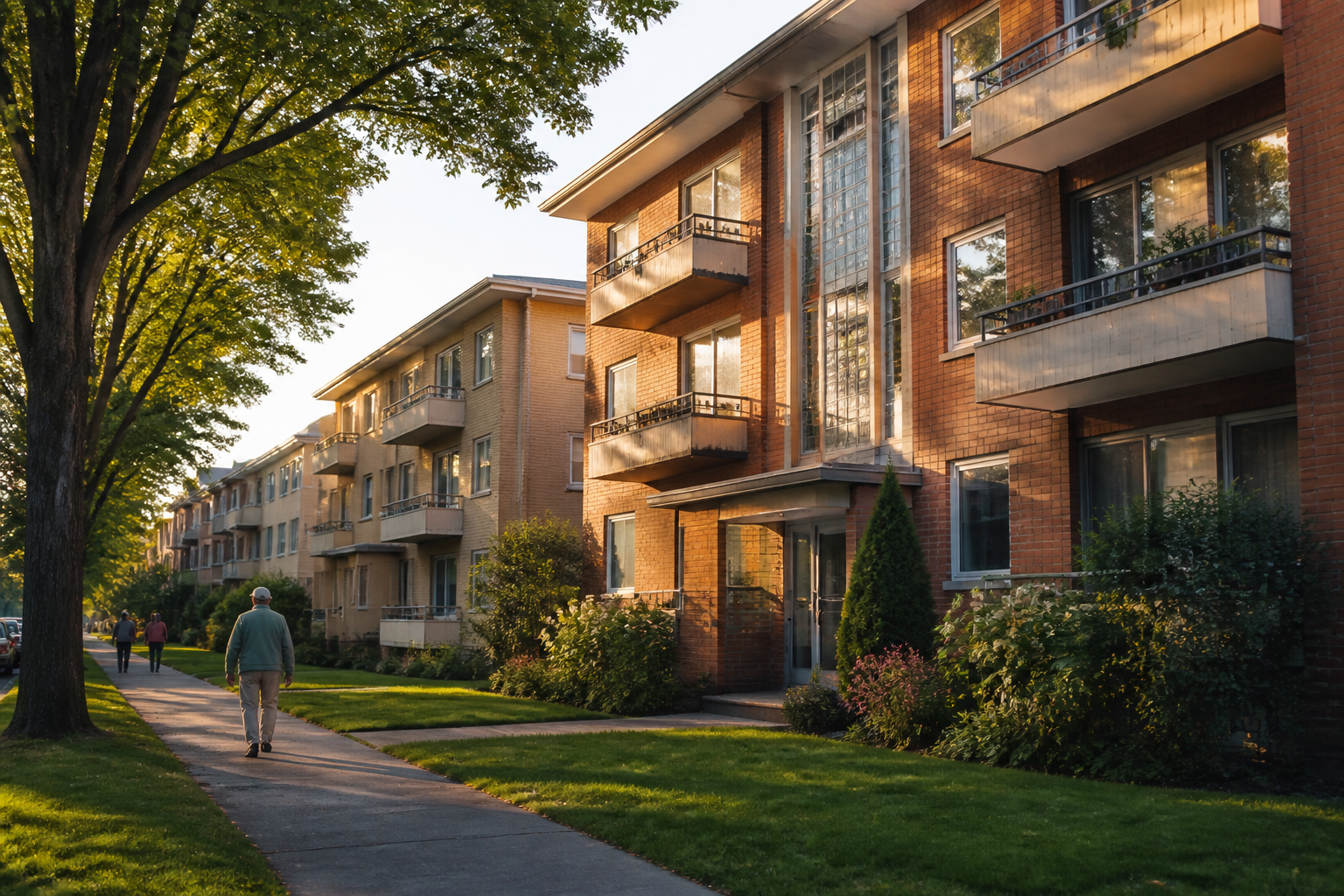
Naturally occurring affordable housing is one of the largest and least understood sources of affordability in the United States. These are homes that rent at prices working families can afford without any government subsidy attached to the building. Most renters living in these units have never heard the term, and many policymakers spend far more attention on subsidized programs. Yet naturally occurring affordable housing quietly shelters a substantial share of low- and moderate-income households, and it is disappearing faster than new affordable units can be built to replace it.
This page explains what naturally occurring affordable housing is, why it is at risk, why it matters for housing stability and community wealth, and the concrete strategies, especially community and cooperative acquisition, that can keep it affordable for the long term.
What is naturally occurring affordable housing?
Naturally occurring affordable housing, often abbreviated NOAH, refers to rental housing that is affordable to lower-income households because of market conditions rather than because of a public subsidy, tax credit, or regulatory restriction. No one designated these buildings as "affordable." They simply rent at modest prices because of their age, location, condition, or the segment of the market they serve.
A few characteristics commonly define NOAH:
- No subsidy or affordability covenant. Unlike Low-Income Housing Tax Credit (LIHTC) properties, public housing, or project-based Section 8, NOAH has no contract or deed restriction requiring rents to stay low. Affordability is incidental, not guaranteed.
- Older building stock. Much NOAH was built decades ago, before current construction costs and amenity expectations. Older garden apartments, small two-to-four unit buildings, and mid-century walk-ups are typical.
- Class B and Class C properties. In real estate terms, NOAH usually sits in the middle and lower tiers of the rental market, below newly built Class A apartments.
- Modest rents relative to local income. Rents typically fall within reach of households earning between roughly 50 and 80 percent of area median income, and sometimes lower.
Because affordability here is a byproduct of the market, it is fragile. The same forces that made these units affordable, age and modest finish levels, are precisely what make them attractive targets for upgrading and repricing.
NOAH versus subsidized affordable housing
It helps to distinguish NOAH from the housing most people picture when they hear "affordable housing."
| Feature | Subsidized affordable housing | Naturally occurring affordable housing |
|---|---|---|
| Affordability source | Public subsidy or tax credit | Market conditions |
| Rent restrictions | Legally required for a set term | None |
| Tenant protections | Often built in | Limited or none |
| Risk of rent increases | Low during compliance period | High, can happen anytime |
| Public visibility | Tracked and reported | Largely invisible in data |
The invisibility matters. Subsidized units are counted, monitored, and protected by compliance rules. NOAH is scattered across millions of privately owned buildings with no central registry, which makes losses hard to see until they have already happened.
Why naturally occurring affordable housing is at risk
The core vulnerability is simple: nothing legally keeps NOAH affordable. When ownership changes or capital flows in, rents can rise to whatever the market will bear. Several pressures are accelerating these losses.
Investor acquisition and repositioning
Over the past decade, institutional and private-equity investors have increasingly targeted older, moderately priced apartment buildings. The business model is straightforward. An investor buys a Class B or C property at a relatively low price, makes cosmetic or systems upgrades, raises rents to "market," and either holds the property for higher cash flow or sells it at a profit. This is sometimes called "value-add" investing.
For the investor it is a rational strategy. For the existing tenants it often means displacement. A renter paying a modest rent for years may face an increase they cannot absorb, with no relocation assistance and no right to stay. Because NOAH carries no affordability covenant, none of this is illegal; it is simply how an unregulated asset behaves when capital sees an opportunity.
Upgrades, renovation, and "premiumization"
Even without a sale, owners can renovate units as they turn over, add amenities, and reposition a building toward higher-income renters. New flooring, updated kitchens, in-unit laundry, and a fresh leasing brand can move a building from affordable to unaffordable one apartment at a time. The physical housing remains, but the affordability does not.
Rising operating costs
Insurance premiums, property taxes, utilities, and maintenance costs have climbed significantly. For small, mission-aligned owners who would prefer to keep rents low, these cost increases can make it financially impossible to do so. Some sell to better-capitalized buyers simply to exit, and those buyers are often the value-add investors described above.
Aging stock and deferred maintenance
The same age that makes NOAH affordable also means many buildings need significant capital investment. When a long-time owner cannot fund roof, plumbing, or electrical work, the building may deteriorate until it is either condemned or sold to an investor who will renovate and reprice. Either outcome removes affordable units from the market.
The replacement math does not work
Here is why these losses are so consequential: it is far cheaper to preserve an existing affordable unit than to build a new one. New construction of subsidized affordable housing is expensive and slow, often taking years and requiring layered financing. When NOAH units are lost to the market, the public system cannot build replacements fast enough to keep up. Every preserved unit is a unit that did not have to be rebuilt from scratch.
Why naturally occurring affordable housing matters
It is a large share of the affordable stock
NOAH represents a major portion of the homes available to lower-income renters who do not live in subsidized housing. Because the subsidized system reaches only a fraction of eligible households, NOAH fills much of the gap. Protecting it is one of the highest-leverage things a community can do for housing stability.
It anchors neighborhoods and reduces displacement
Long-term affordability keeps families, workers, and seniors rooted in their communities. When NOAH is lost, the people displaced are often essential workers, retirees on fixed incomes, and families with children, the residents who give a neighborhood its continuity. Preserving affordability preserves the social fabric, school enrollments, and local businesses that depend on stable residents.
It is a path to community wealth
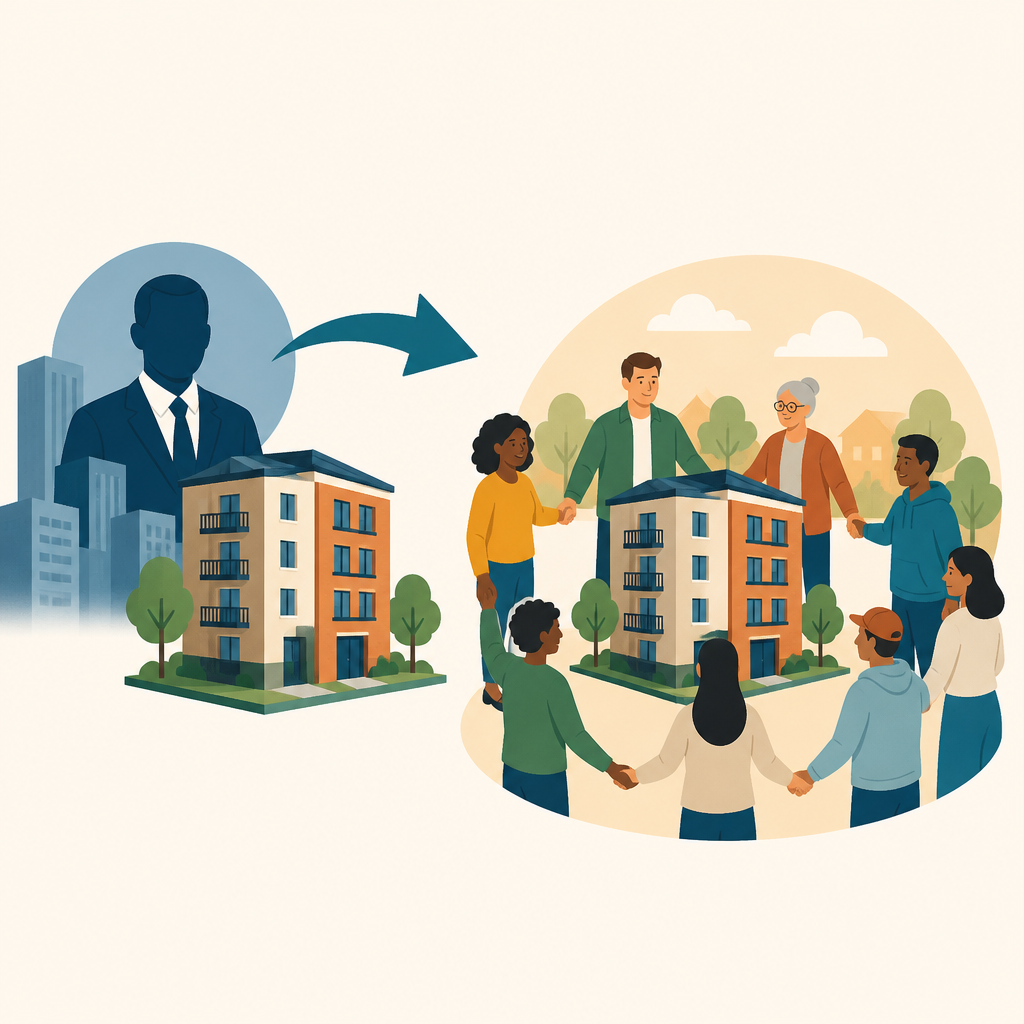
NOAH is not only at risk; it is also an opportunity. When residents or community organizations acquire these buildings, affordability can be locked in permanently, and the value that would have flowed to outside investors instead stays in the community. This is the core idea behind community-owned development: housing that builds wealth for the people who live in it rather than extracting it.
Strategies to protect naturally occurring affordable housing
Protecting NOAH requires getting ahead of the market. Because there is no covenant to enforce, preservation depends on changing who owns the building and on what terms. The most durable strategies move properties out of the speculative market entirely.
Community and cooperative acquisition
The most permanent way to protect affordability is for the community to own the asset. When a mission-driven entity, residents, a nonprofit, a community development corporation, or a housing cooperative, acquires a NOAH building, it can commit to keeping rents affordable indefinitely.
A housing cooperative is a particularly powerful model. In a co-op, residents collectively own and govern the building. Instead of paying rent to a distant landlord whose incentive is to raise it, members pay to cover actual operating costs and democratically control decisions about the property. This structure removes the profit-extraction motive that drives most NOAH losses. Limited-equity cooperatives go further by capping resale prices, ensuring the housing stays affordable for the next generation of residents, not just the current one.
Tenant and community opportunity to purchase
Some jurisdictions have adopted Tenant Opportunity to Purchase Act (TOPA) and Community Opportunity to Purchase Act (COPA) laws. These give residents or qualified community organizations the first chance to buy a building when it goes up for sale, often with time to organize financing. These policies convert a moment of risk, a pending sale, into a moment of opportunity. Pairing a right of first refusal with a cooperative ownership plan is one of the most effective preservation tools available.
Acquisition funds and patient capital
Speed and certainty win deals. Investors can close quickly with cash. To compete, communities need acquisition funds, pools of patient, lower-cost capital that let mission-driven buyers move at market speed and refinance into permanent affordability later. Public agencies, philanthropy, and mission lenders increasingly support these funds.
Light-touch regulation and incentives
Property tax abatements, low-interest rehabilitation loans, and density bonuses can make it financially viable for an owner to keep rents affordable. These tools work best as a complement to ownership change, helping community buyers operate sustainably after acquisition.
Policy support at the federal level
National policy is beginning to recognize cooperative and community ownership as legitimate tools for affordability. The 21st Century ROAD to Housing Act (H.R. 6644), passed by Congress in June 2026 (now law as of July 2026), is a notable step. Its Velázquez provisions explicitly authorize cooperatives within federal housing programs and are aimed at a cooperative sector already home to roughly 1.5 million families. For NOAH preservation, this matters because it opens federal pathways for resident- and community-owned acquisition of the kind that locks affordability in for good.
How Built By DAO + Blueprint fit in
Built By DAO is a venture studio for community-owned development. We build the tools, financing pathways, and operating models that let communities own the housing they live in, rather than watching it sell to the highest bidder. Across our brands, Built By DAO, Urban Array, and Running Start Digital, the throughline is the same: keep ownership and the wealth it generates in the community.
Our flagship platform, Blueprint, is software that helps groups plan, finance, and launch affordable housing cooperatives. For NOAH specifically, the hardest part of preservation is not the idea, it is execution: assembling residents, modeling the deal, lining up financing, and moving fast enough to compete with investors. Blueprint is built to compress that work, walking a community group from "this building is for sale" to a viable cooperative acquisition plan. With federal pathways now expanding under the 21st Century ROAD to Housing Act, the tools to act on those pathways matter more than ever.
If your community is facing the loss of affordable buildings, or you want to get ahead of it, see how Blueprint can help you plan and finance a cooperative acquisition.
Frequently asked questions
What does NOAH stand for in housing?
NOAH stands for naturally occurring affordable housing. It describes rental housing that is affordable to lower-income households because of market conditions, age, and location, rather than because of any government subsidy or affordability restriction.
How is NOAH different from Section 8 or LIHTC housing?
Section 8 and Low-Income Housing Tax Credit (LIHTC) properties are affordable because of public subsidies and legally binding affordability requirements. NOAH has no such contract. Its affordability is incidental to the market, which means rents can rise at any time, with no protections for tenants and no compliance monitoring.
Why is naturally occurring affordable housing disappearing?
NOAH is most often lost when investors acquire older, moderately priced buildings, renovate them, and raise rents to market rates. Rising operating costs, aging buildings that need expensive repairs, and the absence of any rule keeping rents low all accelerate these losses. Because nothing legally protects the affordability, it can vanish whenever ownership or capital changes.
Can communities really afford to buy these buildings?
Yes, with the right tools. Cooperative ownership spreads cost and control across residents, acquisition funds provide patient capital so community buyers can move at market speed, and policies like Tenant or Community Opportunity to Purchase laws give residents a real chance to buy. Federal support, including the cooperative provisions in the 21st Century ROAD to Housing Act, is expanding the financing pathways available.
What is a limited-equity housing cooperative?
A limited-equity cooperative is a building owned and governed collectively by its residents, with resale prices capped so the housing stays affordable over time. Members pay to cover real operating costs rather than to enrich an outside landlord, and the cap ensures that affordability is preserved for future residents, not cashed out by current ones.
How does Blueprint help with NOAH preservation?
Blueprint is software from Built By DAO that helps community groups plan, finance, and launch affordable housing cooperatives. It guides users through deal modeling, financing, and the steps required to acquire and convert a building into a resident-owned cooperative, making it possible to compete with investors and lock in affordability permanently.