
A mutual housing association is a nonprofit organization that develops, owns, and operates rental housing designed to stay affordable for the long term while giving residents a meaningful voice in how their community is run. Unlike conventional affordable-housing developments, where affordability often expires after a set number of years, a mutual housing association builds permanence into its legal and governance structure from the start. The result is a model that combines the stability of nonprofit ownership with the participation and accountability usually associated with cooperatives.
For communities that have lived through cycles of disinvestment, speculative buying, and displacement, that durability matters. A building does not flip to market rate when a tax credit period ends. A landlord does not sell out from under residents during a hot real-estate market. Instead, the housing is held in trust by a mission-driven organization whose entire purpose is to keep it affordable and well-maintained for generations.
This guide explains how mutual housing associations work, how they differ from housing cooperatives and community land trusts, the tradeoffs involved, and where they fit in a broader strategy for community-owned development.
What Is a Mutual Housing Association?
A mutual housing association (often shortened to MHA) is a private, nonprofit corporation that acquires or develops housing and commits to operating it as permanently affordable. The "mutual" in the name signals the central idea: residents are not simply tenants of a distant owner, and they are not individual property owners either. They are members of an association that exists to serve them collectively.
Three features define the model:
- Nonprofit sponsorship. The association is created and backed by a nonprofit sponsor — sometimes a community development corporation, a faith institution, a labor organization, or a coalition of residents and civic groups. The sponsor provides organizational capacity, financing relationships, and a long-term commitment to mission.
- Perpetual affordability. Affordability is not a temporary condition tied to a single subsidy. It is embedded in the organization's bylaws, its financing covenants, and often deed restrictions or ground leases. Rents are set to cover operating costs and reserves, not to maximize profit.
- Resident participation without individual ownership shares. Residents join the association as members and typically gain seats on the governing board, a vote in major decisions, and a real role in setting policies. But they do not buy a share that appreciates in value, and they do not hold individual title to their unit.
That last point is what most distinguishes the MHA from a housing cooperative. In a co-op, members purchase a share that gives them the right to occupy a unit and, in many cases, the ability to sell that share later. In a mutual housing association, there is no individual equity stake to buy or sell. Members participate in governance and enjoy secure, affordable occupancy, but the association — not the individual — holds the underlying value.
Why "no individual ownership shares" is a feature, not a flaw
At first glance, the absence of individual equity sounds like a drawback. Homeownership is the dominant American wealth-building story, and any model that does not offer it invites skepticism. But the design choice solves real problems.
First, it removes the barrier to entry. In a market-rate cooperative, a prospective member often needs thousands of dollars for a share purchase plus the ability to qualify for share financing. In an MHA, a household that can afford modest rent can become a member. That opens the model to lower-income families who would be priced out of equity cooperatives.
Second, it protects long-term affordability. When members hold appreciating shares, there is constant pressure to let prices rise so existing members can cash out. Limited-equity cooperatives manage this with resale formulas, but the tension never fully disappears. An MHA sidesteps it entirely: because no one is building individual equity in the units, no one has a financial incentive to push affordability out of reach for the next family.
Third, it stabilizes governance. Members are invested in the health of their community and the quality of management, not in the resale value of an asset. Decisions tend to center on maintenance, services, and fairness rather than on protecting property values.
How Mutual Housing Associations Work in Practice
A typical mutual housing association manages a portfolio of properties rather than a single building. The nonprofit develops or acquires housing using a blend of financing — government programs, low-cost loans, philanthropic capital, and sometimes equity from tax-credit investors — and then operates it on a break-even basis.
Members pay a monthly charge comparable to rent. Those payments fund operations, debt service, maintenance, and reserves for future repairs. Because the association is not extracting profit and is committed to reinvestment, the housing can be maintained over decades without the deferred-maintenance crises that plague underfunded rental stock.
Governance is where the "mutual" character shows up day to day. Residents elect representatives to the board, participate in committees, and weigh in on budgets, policies, and capital plans. The board usually combines resident members with community and sponsor representatives, balancing resident voice with the financial and technical stewardship that long-term ownership demands.
Security of tenure is a defining benefit. As long as a member meets the obligations of membership — paying the monthly charge, following community rules — they have the right to remain indefinitely. There is no lease expiration that exposes them to eviction so the owner can raise rents or sell. That security is precisely what is missing for most renters, and it is one of the strongest arguments for the model.
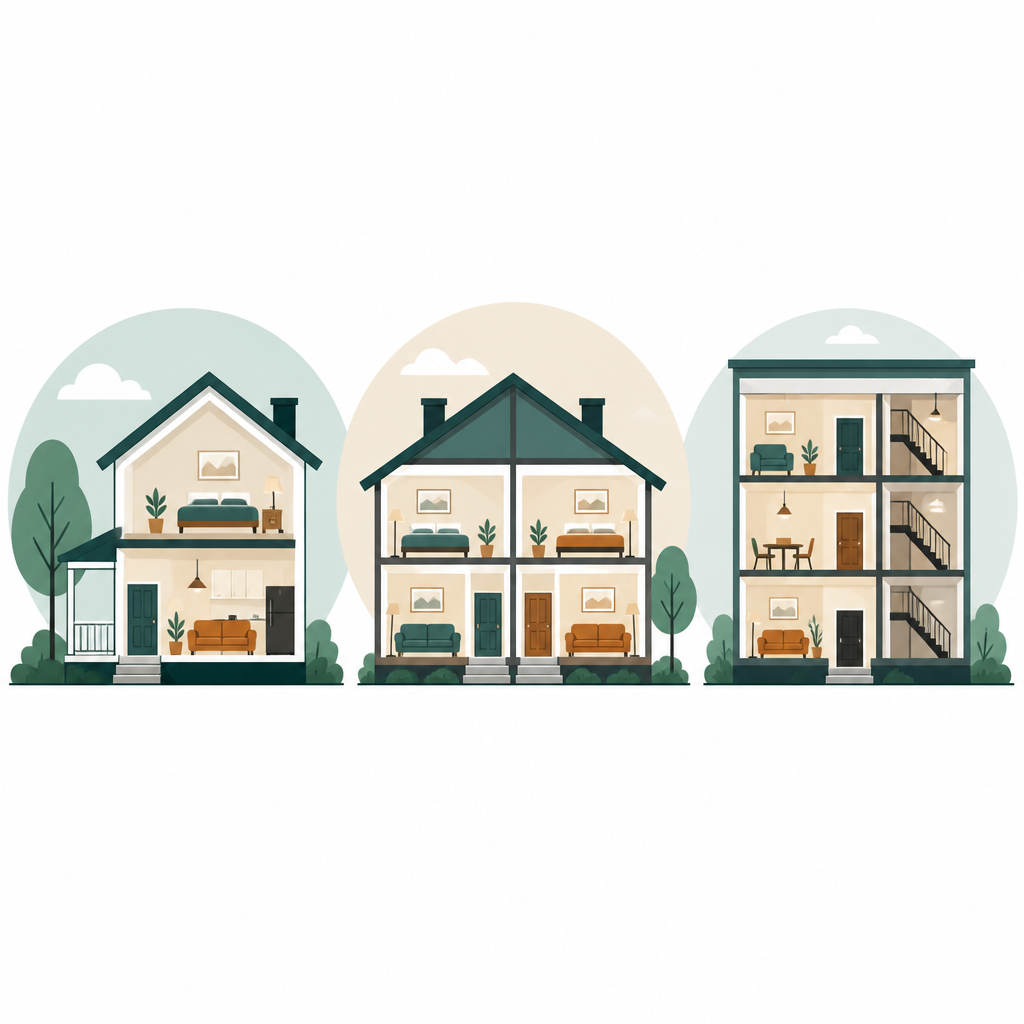
Mutual Housing Associations vs. Cooperatives vs. Community Land Trusts
Mutual housing associations, housing cooperatives, and community land trusts are often grouped together as "shared-equity" or "permanently affordable" housing. They share goals but differ in structure. Understanding the distinctions helps communities choose the right tool.
Housing cooperatives
In a housing cooperative, residents collectively own the corporation that owns the building, and each member holds a share. Co-ops range from market-rate (shares can be sold at whatever the market bears) to limited-equity (resale prices are capped by a formula to preserve affordability). The defining feature is individual ownership of a transferable share. Members typically have strong control — they elect the board and often run the cooperative directly.
The tradeoff: co-ops require members to buy in, which can exclude lower-income households, and they demand a level of member capacity and engagement that not every community can sustain. Limited-equity co-ops preserve affordability well but still carry the administrative complexity of share purchases, financing, and resale calculations.
Community land trusts
A community land trust (CLT) separates ownership of the land from ownership of the buildings on it. A nonprofit holds the land in trust permanently, while homeowners own the structures and lease the land through a long-term ground lease. Resale formulas keep homes affordable as they change hands. CLTs are especially common for single-family homeownership, letting families build modest equity while the trust ensures the next buyer can still afford the home.
The tradeoff: CLTs are oriented toward individual homeownership of the building, with the land removed from speculation. They deliver a homeownership pathway but require homebuyers who can finance and maintain a home.
Where the mutual housing association fits
The mutual housing association occupies a distinct position. Like a CLT, it relies on a nonprofit steward to guarantee permanence. Like a co-op, it gives residents real governance power. But unlike both, it does not ask residents to purchase anything or take on the responsibilities of individual ownership. It is, in effect, permanently affordable rental housing with cooperative-style governance and nonprofit stewardship.
| Model | Who owns the home | Resident buy-in | Resident control | Affordability mechanism |
|---|---|---|---|---|
| Mutual housing association | Nonprofit association | None (membership, not a share) | Board seats, voting membership | Bylaws, covenants, mission |
| Housing cooperative | Members, via shares | Share purchase required | High (member-elected board) | Limited-equity resale formula |
| Community land trust | Homeowner owns building; trust owns land | Home purchase required | Trust board, often shared | Ground lease + resale formula |
No single model is best for every situation. A community with members ready to buy in and self-govern may thrive as a limited-equity co-op. A neighborhood focused on homeownership may favor a CLT. A community that needs deep affordability, low barriers to entry, and durable nonprofit stewardship — particularly in disinvested areas where households cannot front a buy-in — is often best served by a mutual housing association.
Why MHAs Matter Now
The policy environment in 2026 has shifted in favor of these models. The 21st Century ROAD to Housing Act (H.R.6644) was passed by Congress in June 2026 (now law as of July 2026) and stands as the most significant housing affordability law since 1990. Among its provisions, language championed by Representative Nydia Velázquez explicitly authorizes cooperatives within federal housing programs, opening federal financing and program pathways that cooperative and mutual housing developers have long sought. Cooperative housing is aimed at a cooperative sector already home to roughly 1.5 million families.
For nonprofit sponsors and community organizations, this is a meaningful opening. Federal recognition of cooperative ownership within mainstream housing programs reduces a long-standing barrier: the difficulty of fitting community-owned models into financing systems designed for conventional rentals and single-family ownership. As that infrastructure matures, mutual housing associations — which already align with the goals of permanence and resident participation — stand to benefit from clearer pathways to capital and program support.
How Built By DAO + Blueprint Fit In
Built By DAO is a venture studio focused on community-owned development. Through brands like Urban Array, which develops cooperative housing in disinvested communities, and Running Start Digital, the studio works to put durable, resident-centered housing within reach of the neighborhoods that need it most. The thesis is simple: communities should own the assets that shape their future.
The studio's flagship product, Blueprint, is software built to plan, finance, and launch affordable housing cooperatives. Standing up a mutual housing association or a cooperative is hard precisely because it sits at the intersection of legal structuring, financing, governance design, and community organizing. Blueprint is designed to make that process navigable — helping sponsors model the finances, structure the entity, and move from idea to launch without reinventing the playbook each time.
If you are exploring a mutual housing association, a cooperative, or another community-owned model for your neighborhood, Blueprint can help you go from concept to a financeable plan.
Plan your housing cooperative with Blueprint →
Frequently Asked Questions
What is the difference between a mutual housing association and a housing cooperative?
In a housing cooperative, each member buys a share that gives them the right to occupy a unit and, in many cases, to sell that share later. In a mutual housing association, residents are members of a nonprofit association but do not purchase or hold individual ownership shares. They get governance rights and secure, affordable occupancy, while the association holds the underlying value. This keeps barriers to entry low and affordability durable.
Do residents build equity in a mutual housing association?
No. Residents in a mutual housing association do not accumulate individual home equity, because they do not own a share or the unit. The tradeoff is meaningful: in exchange for forgoing individual equity, members gain secure, indefinitely affordable housing, low or no buy-in costs, and a real voice in governance. Households seeking to build housing equity may be better served by a limited-equity cooperative or a community land trust.
Is a mutual housing association the same as a community land trust?
No. A community land trust separates land from buildings — a nonprofit owns the land while individual homeowners own and finance their homes on leased land. A mutual housing association owns the housing outright as a nonprofit and operates it as permanently affordable rental housing with resident governance. CLTs center individual homeownership; MHAs center collective stewardship without individual ownership.
How do mutual housing associations stay affordable permanently?
Affordability is embedded in the organization's legal and financial structure rather than tied to a single, expiring subsidy. The nonprofit operates on a break-even basis, setting monthly charges to cover operations, debt, and reserves instead of maximizing profit. Bylaws, financing covenants, and often deed restrictions or ground leases lock in the affordability commitment, so the housing does not convert to market rate when a subsidy period ends.
Who governs a mutual housing association?
Governance is shared. Residents elect representatives to the board and participate as voting members, while the board typically also includes community and sponsor representatives who provide financial and technical stewardship. This balance gives residents genuine control over the policies that affect their daily lives while ensuring the long-term financial health of the housing.
Can mutual housing associations use federal housing programs?
Increasingly, yes. The 21st Century ROAD to Housing Act, passed by Congress in June 2026, includes provisions authorizing cooperatives within federal housing programs. As that framework is implemented, community-owned models — including mutual housing associations and cooperatives — are expected to gain clearer access to federal financing and program support.