
Housing cooperatives generational wealth is more than a policy phrase — it describes a practical path to ownership for families who have been locked out of the traditional housing market for generations. In neighborhoods shaped by decades of disinvestment, redlining, and predatory lending, a housing cooperative offers something rare: a way to convert monthly housing costs into a durable, shared asset that stays in the community. With the passage of the 21st Century ROAD to Housing Act (H.R.6644) in June 2026, the cooperative model now has explicit federal backing for the first time in a generation.
This guide explains how cooperatives create wealth, why they work in communities that conventional development has overlooked, and how new federal law makes the model easier to launch.
What Is a Housing Cooperative?
A housing cooperative is a corporation owned and democratically governed by the people who live in it. Instead of paying rent to an outside landlord, residents become members of the co-op. They collectively own the building (or buildings) through the cooperative entity and elect a board to manage it.
There are a few common structures:
Limited-Equity Cooperatives (LECs)
In a limited-equity cooperative, members buy a share at an affordable price and agree to resale price caps when they leave. The cap keeps units affordable for the next family while still letting departing members recover their share plus modest, formula-based appreciation. LECs are the workhorse of community-owned affordable housing because they balance individual wealth-building with permanent affordability.
Market-Rate and Shared-Equity Cooperatives
Market-rate co-ops let shares appreciate with the market, which can build more individual wealth but reduces affordability over time. Shared-equity models sit in between — they split appreciation between the member and the cooperative or a sponsoring trust, preserving affordability while still rewarding members.
How Co-ops Differ From Condos and Rentals
In a condo, you own your individual unit and a slice of common areas. In a rental, you own nothing. In a cooperative, you own a share of the whole entity and hold an exclusive right to occupy your unit. That collective ownership is what turns a group of neighbors into a wealth-building institution — and what keeps decision-making local.
How Cooperatives Build Generational Wealth
Wealth is not the same as income. Income is what you earn; wealth is what you own and can pass on. The central problem in underinvested communities is not only low income but the near-total absence of appreciating, transferable assets. Housing cooperatives attack that problem directly.
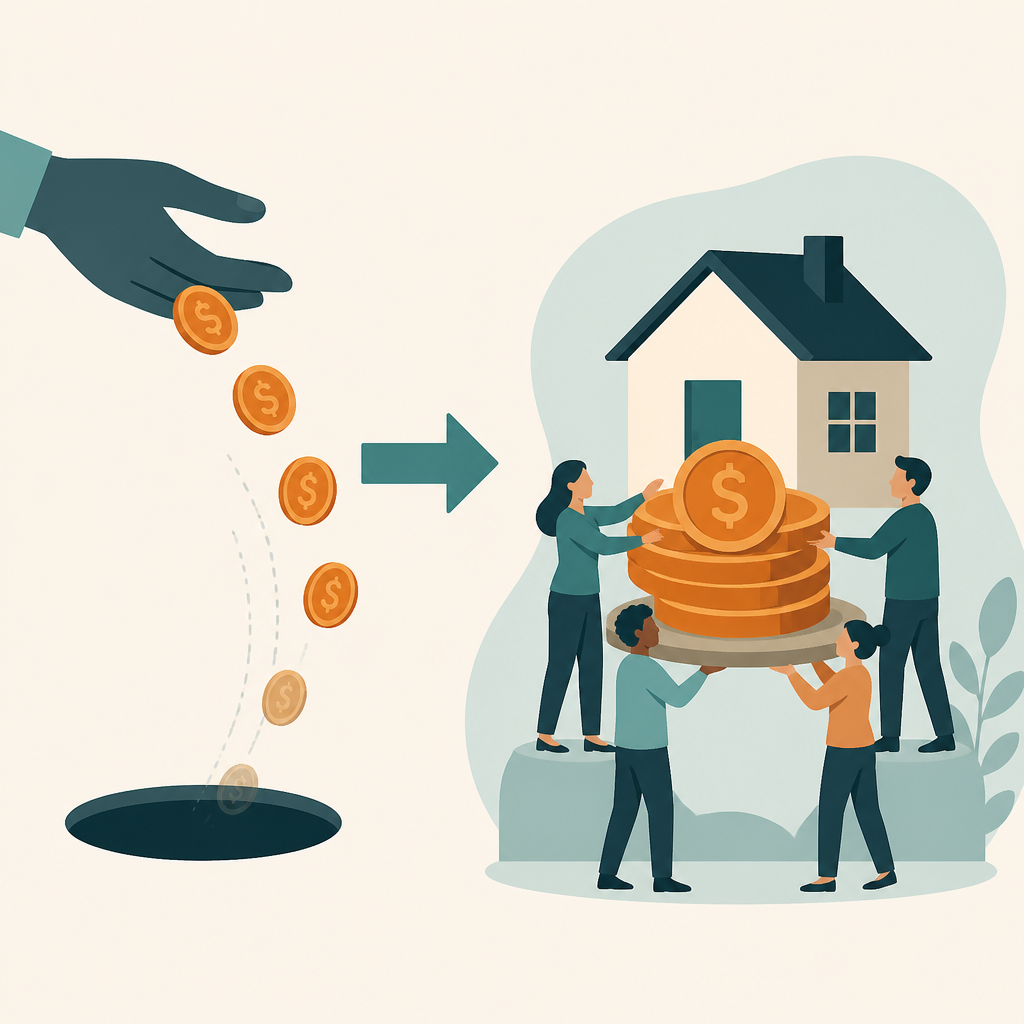
1. They convert rent into equity. A renter's monthly payment disappears. A co-op member's monthly carrying charge builds equity in a shared asset and, in limited-equity models, returns a share value when they move. Over years, that share becomes something to sell, borrow against, or pass to an heir.
2. They stabilize housing costs. Because the cooperative — not a profit-seeking landlord — controls carrying charges, costs tend to track actual operating expenses rather than market speculation. Predictable housing costs let families save and plan, which is the precondition for any wealth accumulation.
3. They keep appreciation in the community. When a conventional landlord sells a gentrifying building, the gains leave the neighborhood. In a cooperative, value created by the community stays with the community's members rather than flowing to absentee owners.
4. They build assets families can pass down. Cooperative shares are inheritable. A parent who holds a co-op share can transfer it to a child, giving the next generation a stable, affordable home and a foothold in the asset economy. That intergenerational transfer is the essence of generational wealth.
5. They create civic and financial literacy. Members govern budgets, vote on capital projects, and manage reserves. This hands-on experience builds the financial confidence and credit history that open doors to other forms of ownership.
Why This Matters for the Racial Wealth Gap
The racial wealth gap in the United States is large, persistent, and deeply tied to housing. According to the Federal Reserve's Survey of Consumer Finances, the typical white family holds substantially more wealth than the typical Black or Hispanic family — a gap measured not in percentages but in multiples. Homeownership is the single largest source of wealth for most American households, which means that any historical barrier to homeownership becomes a barrier to wealth itself.
Those barriers were not accidental. Federal redlining maps from the 1930s, decades of discriminatory mortgage lending, exclusionary zoning, and disinvestment systematically denied generations of families the chance to build housing equity. The consequences compound: a family that could not buy a home in 1960 had nothing to pass to children in 1990, who in turn had less of a down payment for their own children today.
Housing cooperatives do not erase this history, and it is important not to overstate what any single model can do. But they offer a structurally different on-ramp to ownership — one that requires far less upfront capital than a traditional mortgage, shares risk across members, and is well-suited to the multifamily buildings common in historically disinvested urban neighborhoods. For families who have been shut out of single-family homeownership, a co-op share can be the first appreciating asset they have ever held.
That is why community ownership sits at the center of the work that Urban Array and Built By DAO do: building wealth where wealth has been extracted for decades.
The 2026 ROAD to Housing Act: A Turning Point for Co-ops
The 21st Century ROAD to Housing Act (H.R.6644), became law in July 2026, is the most significant housing affordability legislation since the National Affordable Housing Act of 1990. For the cooperative movement, its importance is hard to overstate.
The law includes provisions — championed by Rep. Nydia Velázquez — that explicitly authorize housing cooperatives within federal housing programs. Before this, co-ops often had to fit themselves awkwardly into program rules written for rental or single-family ownership. Recognizing cooperatives as a distinct, eligible form of housing removes ambiguity, opens financing pathways, and signals to lenders, agencies, and developers that the model is here to stay.
Cooperatives in the United States already support roughly 1.5 million families. By validating and expanding the model federally, the ROAD to Housing Act creates room for that number to grow — and for new co-ops to launch in exactly the communities that need them most.
What the Law Changes in Practice
- Eligibility clarity. Cooperatives are named as an authorized housing form, reducing the legal and administrative friction of organizing one.
- Financing access. Clearer federal recognition makes it easier to align co-op projects with public financing and credit enhancement.
- Validation for community ownership. Federal endorsement de-risks the model for local governments, lenders, and community sponsors who were previously hesitant.
For organizations that have spent years operationalizing the co-op model, the law turns an uphill experiment into a supported, scalable strategy.
How Built By DAO + Blueprint Fit In
Built By DAO is a venture studio for community-owned development. Our ecosystem includes Urban Array, which develops cooperative housing in disinvested communities, and Running Start Digital. The flagship product tying it together is Blueprint — software to plan, finance, and launch affordable housing cooperatives.
Forming a cooperative has historically been hard not because the model is flawed, but because the work is complex: structuring the entity, modeling carrying charges, assembling financing, navigating program eligibility, and onboarding members. Blueprint exists to compress that complexity. It gives community sponsors, organizers, and emerging developers a guided path from a vacant building or empty lot to a launched, member-owned cooperative.
With the ROAD to Housing Act now recognizing co-ops in federal programs, the timing is unusually good. The policy headwind that slowed cooperative development for decades has shifted into a tailwind — and Blueprint is built to help communities catch it.
Ready to plan a housing cooperative in your community? Explore Blueprint to see how Built By DAO helps you plan, finance, and launch.
Frequently Asked Questions
How does a housing cooperative actually build wealth for members?
Members buy a share in the cooperative and pay a monthly carrying charge that covers operating costs and debt service. Over time, the share accrues value (modestly in limited-equity co-ops, more in market-rate ones), and that share can be sold or inherited. Compared with renting — where monthly payments build no equity — a co-op turns housing costs into a transferable asset.
Are housing cooperatives only for low-income families?
No. Cooperatives exist across the income spectrum, from market-rate co-ops in expensive cities to limited-equity co-ops designed for affordability. The model is especially valuable in underinvested communities because it lowers the capital barrier to ownership, but it is not limited to any one income group.
What is the difference between a housing cooperative and a community land trust?
A community land trust (CLT) typically owns the land beneath homes and leases it to residents or organizations to keep housing affordable. A housing cooperative is owned by its residents through shares in a corporation. The two are complementary — a co-op can sit on land owned by a CLT — but they are distinct ownership structures.
How does the 2026 ROAD to Housing Act help cooperatives?
The 21st Century ROAD to Housing Act (H.R.6644), passed in June 2026, includes Velázquez provisions that explicitly authorize housing cooperatives within federal housing programs. This clarifies eligibility, improves access to financing, and validates the model for lenders and local governments — making new co-ops easier to launch.
Can a cooperative share be passed down to children?
Yes. Cooperative shares are generally inheritable, subject to the co-op's bylaws and any resale or income rules. This inheritability is a core reason cooperatives can contribute to generational wealth: a family can pass both a stable, affordable home and an appreciating asset to the next generation.
How do I start a housing cooperative?
Starting a co-op involves forming the legal entity, securing a property, assembling financing, setting carrying charges, and recruiting member-owners. Tools like Blueprint from Built By DAO are designed to guide community sponsors through each of these steps — and with the new federal recognition of co-ops, the path is more navigable than ever.