
If you are weighing a housing cooperative vs condo, you are really choosing between two different ideas about what it means to "own your home." A condo gives you outright title to a specific unit. A housing cooperative gives you a share in a corporation that owns the whole building, plus the right to live in your unit. Both can be excellent paths to stable, long-term housing — but they behave differently when it comes to financing, monthly costs, who approves your purchase, what you can sell for, and how much affordability a community can protect over time.
This guide breaks down the practical differences so buyers can make an informed decision, and so community groups, nonprofits, and local developers can understand why the cooperative model has become a renewed focus in U.S. housing policy.
What Is a Condominium?
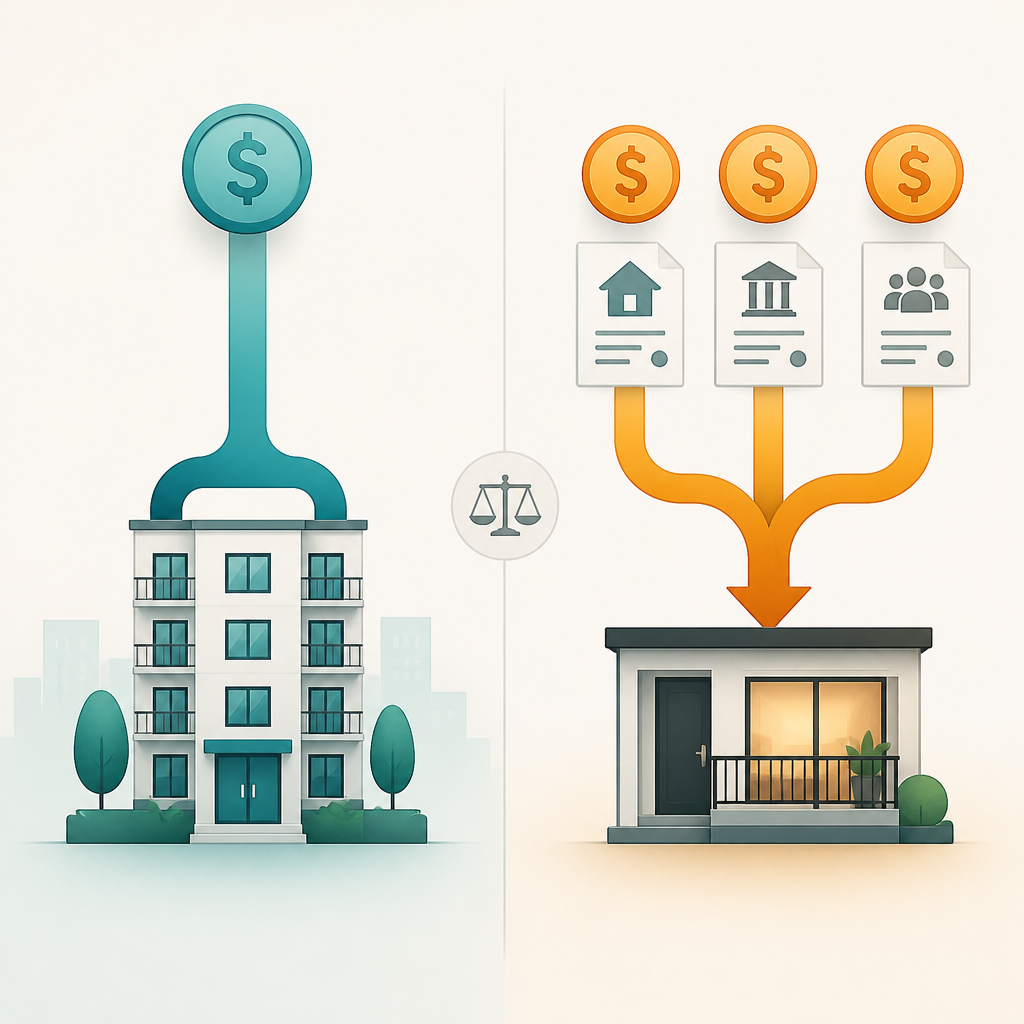
A condominium is a form of real property ownership. When you buy a condo, you receive a deed to your individual unit and a fractional interest in the building's common areas — lobbies, hallways, roofs, elevators, and grounds. You hold title the same way you would with a single-family house, and you typically finance the purchase with a standard residential mortgage.
A condo association (run by an elected board) manages the shared property and charges monthly fees, often called HOA dues, to cover maintenance, insurance on common areas, reserves, and amenities. You are responsible for your own unit's mortgage, property taxes, and interior upkeep. Because you hold a deed, you generally have broad freedom to sell, rent, or refinance, subject to the association's rules.
What Is a Housing Cooperative?
A housing cooperative is a corporation that owns the entire property. Instead of buying a unit, you buy shares (or a membership) in that corporation. Those shares come with a proprietary lease or occupancy agreement that gives you the exclusive right to live in a specific unit. You become both a part-owner of the cooperative and one of its residents.
Because the co-op corporation owns the building as a whole, residents share collective responsibility for the property. They elect a board, set house rules, and approve new members. Most co-ops carry a single "blanket" or "underlying" mortgage on the whole building, and residents pay a monthly carrying charge (sometimes called maintenance) that covers their share of that mortgage, property taxes, insurance, staffing, and reserves.
Cooperatives come in a few flavors:
Market-Rate Co-ops
Shares are bought and sold close to market value. These are common in cities like New York, where co-ops historically make up a large share of the owner-occupied housing stock.
Limited-Equity Co-ops (LECs)
The price you can resell your shares for is capped by a formula written into the co-op's bylaws. This deliberately trades large appreciation for permanent affordability — each new resident buys in at a price tied to incomes rather than the open market. LECs are the backbone of the affordable cooperative movement.
Mutual Housing and Zero-Equity Models
Residents control the housing democratically but build little or no individual equity; the focus is secure, affordable tenancy and community governance.
Housing Cooperative vs Condo: Side-by-Side Comparison
The table below summarizes how the two models differ across the factors buyers ask about most.
| Factor | Housing Cooperative | Condominium |
|---|---|---|
| Ownership structure | You own shares in a corporation that owns the building, plus a proprietary lease to your unit. Ownership is collective. | You own a deed to your individual unit plus a fractional share of common areas. Ownership is individual. |
| Financing | A "share loan" (co-op loan) backed by your shares and lease; the building often also carries a single blanket mortgage. Fewer lenders offer share loans. | A standard residential mortgage on your unit. Widely available from most banks and federally backed programs. |
| Monthly costs | One monthly carrying charge bundles your share of the building mortgage, property taxes, insurance, maintenance, and reserves. Often includes more. | HOA/condo dues for common areas, paid on top of your own separate mortgage and property tax bills. |
| Approval process | The co-op board interviews and approves buyers; financial and sometimes personal review is common. Can be slower and more selective. | Association review is typically lighter; most condos cannot reject a qualified buyer outright, only exercise limited rights. |
| Resale | Subject to board approval; limited-equity co-ops cap resale price by formula. Market-rate co-ops resell near market value. | You set the price and sell on the open market with fewer restrictions, subject only to standard association rules. |
| Affordability potential | High and durable, especially in limited-equity structures that lock in affordability across generations of residents. | Moderate; affordability tracks the open market and tends to rise with local prices over time. |
Costs and Financing: Where Buyers Feel the Difference
The financing picture is often the deciding factor. With a condo, you walk into almost any lender and apply for a conventional, FHA, VA, or other standard mortgage on your unit. The process is familiar and competitive.
With a cooperative, you apply for a share loan — a loan secured by your co-op shares and proprietary lease rather than by real estate title. Fewer institutions offer share loans, and terms can vary by region and by the financial health of the co-op itself. At the same time, the building's underlying blanket mortgage spreads some costs across all residents, which is one reason monthly carrying charges in co-ops can look high — they frequently bundle property taxes and the building's debt service into a single payment.
A practical implication: comparing a condo's HOA dues directly against a co-op's carrying charge is misleading. The carrying charge usually covers more (often including property taxes), so you have to itemize what each number actually pays for before deciding which is "cheaper."
Approval, Resale, and Control
Cooperatives are more selective by design. Because every resident is a co-owner of the whole corporation, the board has a strong interest in financial stability, so it reviews and approves incoming members. This can make purchases slower and occasionally feel personal. The upside is a community with aligned incentives and a real say in how the building is run.
On resale, condos give owners maximum flexibility: you list, you price, you sell. Co-ops add board approval and, in the limited-equity model, a resale formula that caps your gain. For a buyer chasing maximum appreciation, that cap is a drawback. For a community trying to keep homes affordable for the next family, that cap is the entire point.
Why Cooperatives Matter for Communities
Condos and co-ops both turn renters into owners, but they distribute the long-term benefits differently. In a rising market, condo prices climb, which rewards early owners but pushes the next generation of buyers further out of reach. Limited-equity cooperatives interrupt that cycle: the resale formula keeps each unit attainable for households at a target income level, decade after decade. The community — not the market — captures the appreciation in the form of lasting affordability.
That is why cooperatives are central to a community-ownership approach to housing. They keep decision-making local, build modest wealth for residents, and protect neighborhoods from displacement. They also pair naturally with nonprofit sponsors, community land trusts, and mission-driven developers who want housing that stays affordable permanently rather than for a fixed compliance period.
A Policy Tailwind: The 21st Century ROAD to Housing Act
Cooperatives recently gained meaningful federal momentum. The 21st Century ROAD to Housing Act (H.R. 6644) was passed by Congress in June 2026 (now law as of July 2026). The legislation includes provisions championed by Representative Nydia Velázquez that authorize and strengthen the role of housing cooperatives within federal housing programs. Supporters of the cooperative provisions have pointed to the roughly 1.5 million families that cooperative housing already supports across the country as evidence of the model's reach and durability.
For communities and developers, the significance is straightforward: cooperatives are no longer a niche workaround. They are an explicitly recognized tool inside the federal housing toolkit, which can make financing, technical assistance, and program alignment easier to access for new co-op projects.
How Built By DAO + Blueprint Fit In
Built By DAO is a venture studio focused on community-owned development — housing and infrastructure that neighborhoods help finance, govern, and benefit from. Across our brands, including Urban Array and Running Start Digital, the through-line is the same: give communities the tools to own what gets built where they live.
Our flagship software, Blueprint, is built specifically for the hard part of standing up a housing cooperative. Forming a co-op means modeling carrying charges, structuring a blanket mortgage and share loans, designing limited-equity resale formulas, lining up financing, and navigating the approval and governance steps that make a co-op viable. Blueprint helps mission-driven developers, nonprofits, and resident groups plan, finance, and launch affordable housing cooperatives in one place — turning the complexity described in this guide into a guided, repeatable process. With federal recognition of cooperatives expanding, the path from idea to occupancy is more attainable than it has been in a generation.
If you are exploring whether a cooperative is right for your community, see how Blueprint can help you plan and launch one: Get started with Blueprint.
Frequently Asked Questions
Is a housing cooperative cheaper than a condo?
Not automatically. A co-op's monthly carrying charge often bundles property taxes and the building's mortgage, so it can look higher than condo HOA dues even when the total cost of ownership is comparable or lower. Limited-equity co-ops are typically far more affordable to buy into because share prices are capped, but you give up most market appreciation in exchange. Always compare what each monthly payment actually covers before deciding.
Can I get a regular mortgage to buy into a co-op?
You generally cannot use a standard real-estate mortgage, because you are buying shares, not titled property. Instead you apply for a "share loan" secured by your co-op shares and proprietary lease. Fewer lenders offer share loans than conventional mortgages, so financing can take more shopping around, and terms may depend on the co-op's own financial health.
Why do co-op boards interview buyers?
Because every resident co-owns the whole corporation, the board has a financial stake in approving members who can meet their carrying charges and contribute to a stable building. The interview and financial review protect existing residents from the risks of a co-owner defaulting. It can make buying slower and more selective than a condo purchase, which is the main tradeoff for the shared-ownership benefits.
What is a limited-equity cooperative?
A limited-equity co-op caps how much you can resell your shares for using a formula in its bylaws. This keeps each unit affordable for the next moderate-income household instead of letting prices rise to whatever the open market will bear. You build modest equity and enjoy stable housing, while the community preserves long-term affordability across many generations of residents.
Which is better for building wealth, a co-op or a condo?
For pure financial appreciation, a condo usually wins, because you own deeded property that tracks the open market. Market-rate co-ops can appreciate similarly. Limited-equity co-ops intentionally trade large gains for permanent affordability, so they build wealth more modestly. The "better" choice depends on whether your priority is maximum resale value or durable, attainable housing for yourself and your community.
Does the 21st Century ROAD to Housing Act change anything for buyers?
The Act, passed by Congress in June 2026, strengthens the role of cooperatives within federal housing programs through provisions championed by Rep. Velázquez. For individual buyers, the most likely near-term effect is more co-op options and clearer program support as developers and nonprofits use the new framework to launch projects. It signals that cooperatives are a recognized, supported path to homeownership.