
This housing cooperative terms glossary exists to demystify the language of community-owned housing. Whether you are a prospective member reviewing a subscription agreement, a board director reading a blanket mortgage statement, or a founder planning a new development, the vocabulary of cooperatives can feel like a barrier. Co-ops blend real estate, corporate governance, and consumer finance, so the terms borrow from all three. Below are 35-plus alphabetized definitions written in plain language, each two to four sentences long, so you can find a word, understand it, and get back to the work of building or sustaining your community.
A housing cooperative is a corporation that owns residential property, where residents buy shares (or a membership) rather than buying real estate directly. Those shares give them the right to occupy a specific unit and a vote in how the building is run. Understanding the terms in this glossary helps members participate meaningfully, protect their equity, and hold their boards accountable.
A
Affordable Housing. Housing whose cost—rent or carrying charge plus utilities—does not exceed a set share of a household's income, conventionally 30 percent. Affordability is usually defined relative to Area Median Income and is often sustained through subsidy, regulation, or a limited-equity structure.
Amortization. The gradual repayment of a loan's principal over time through scheduled payments. In a cooperative, the blanket mortgage amortizes over many years, and a portion of each member's monthly carrying charge goes toward paying it down, slowly building the co-op's equity in the property.
Area Median Income (AMI). The midpoint household income for a metropolitan area or county, published annually by HUD and adjusted for household size. Eligibility for many affordable housing and cooperative programs is expressed as a percentage of AMI, such as households earning at or below 60 percent or 80 percent of AMI.
Assessment. A charge levied on members in addition to the regular carrying charge, usually to fund a specific or unexpected expense such as a roof replacement or a shortfall in reserves. Assessments can be one-time or spread over several months and typically require board approval.
B
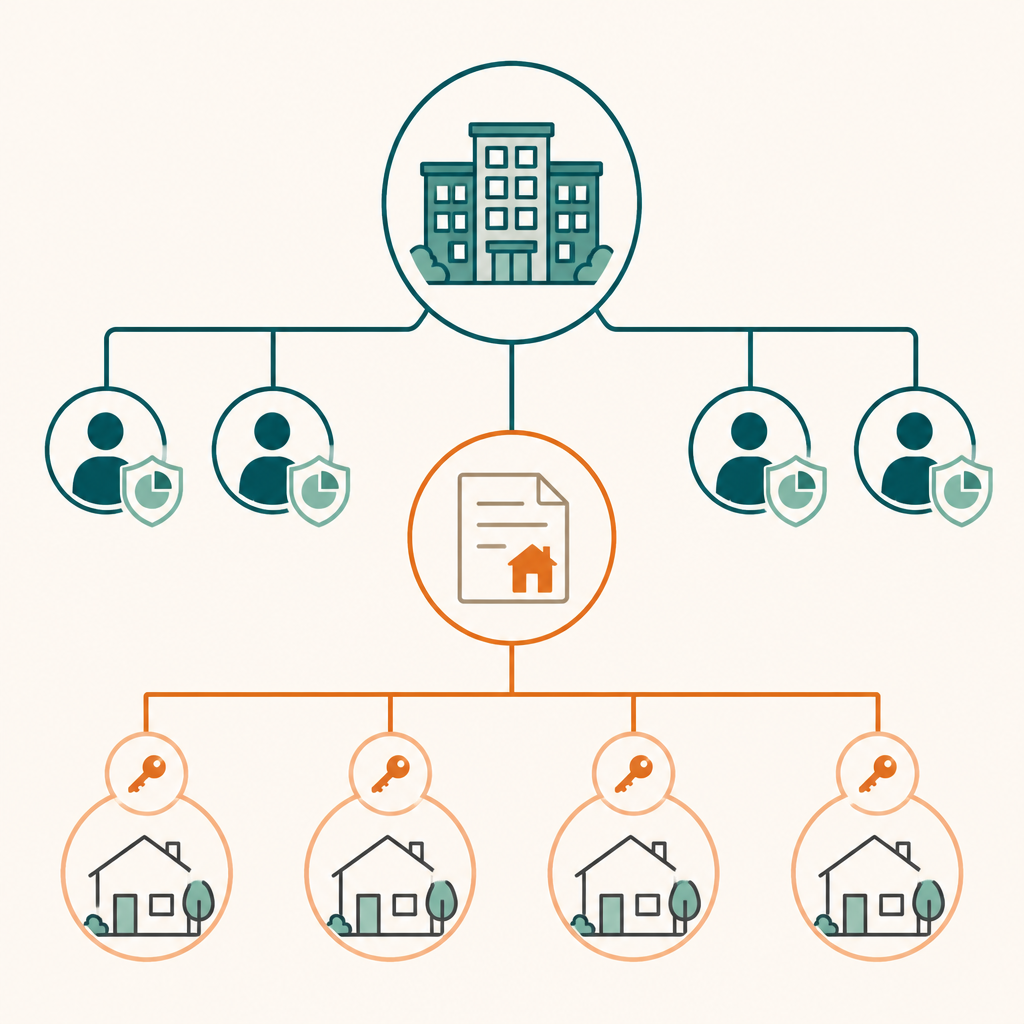
Blanket Mortgage. A single mortgage covering the entire cooperative property rather than individual units. The co-op corporation, not the individual member, is the borrower, and the loan is repaid collectively through carrying charges. A member's share loan is separate from and subordinate to the blanket mortgage.
Board of Directors. The members elected by the cooperative's shareholders to govern the corporation between membership meetings. The board sets carrying charges, approves new members, oversees the budget, and hires management, all while owing fiduciary duties to the membership as a whole.
Bylaws. The internal rules that govern how the cooperative operates—how directors are elected, how meetings are held, how votes are counted, and how members are admitted or removed. Bylaws sit alongside the certificate of incorporation and proprietary lease as core governing documents.
C
Carrying Charge. The monthly payment each member pays to the cooperative, comparable to rent in a rental building but structured as a member's share of the co-op's total operating costs. It covers the blanket mortgage, property taxes, insurance, maintenance, staff, utilities, and reserve contributions, divided among members according to their shares.
Certificate of Incorporation. The founding legal document, filed with the state, that creates the cooperative corporation and establishes its basic structure and purpose. It is sometimes called the articles of incorporation and works together with the bylaws to govern the entity.
Community Land Trust (CLT). A nonprofit that owns land permanently and leases it to homeowners, cooperatives, or other users through a long-term ground lease, keeping the land off the speculative market. CLTs and limited-equity co-ops are often paired to lock in long-term affordability—the trust holds the land while the co-op owns the building.
Co-op (Cooperative). A member-owned and member-governed organization operated for the benefit of its members rather than to generate profit for outside investors. A housing cooperative applies this model to a residence: members collectively own the corporation that owns the building and share in its governance.
D
Default. Failure to meet an obligation under a loan or lease, such as missing carrying-charge payments or violating the proprietary lease. A member's default can lead to loss of occupancy rights; the co-op's default on its blanket mortgage can threaten the entire building.
Down Payment. The upfront cash a buyer pays to purchase cooperative shares, with the remainder typically financed by a share loan. In limited-equity co-ops the share price is kept low, so down payments are usually far smaller than those required to buy a comparable condominium.
E
Equity. The portion of a property's value a member actually owns, equal to the value of their shares minus any outstanding share loan. In a market-rate co-op equity can grow with the market; in a limited-equity co-op, resale formulas cap how much equity a member can accumulate.
Escrow. Money held by a neutral third party until specified conditions are met. In housing, lenders often collect escrow within monthly payments to cover property taxes and insurance, and co-ops may hold escrow at closing to ensure obligations are funded.
F
Flip Tax. A transfer fee the cooperative charges when a member sells their shares, paid to the co-op rather than to a government. Despite the name it is not a tax; it is a revenue tool that funds reserves and capital improvements, often calculated as a percentage of the sale price or a flat per-share amount.
G
Ground Lease. A long-term lease of land, frequently 99 years, that lets a cooperative or homeowner own a building while another party owns the land beneath it. Ground leases are central to the community land trust model and to many affordable cooperatives built on publicly owned land.
H
Housing Assistance Payment (HAP). A subsidy paid on behalf of an eligible low-income household, typically by HUD through a public housing agency, to cover the gap between what the household can afford and the actual housing cost. HAP contracts can support residents within cooperatives, helping lower-income members afford their carrying charges.
HDFC (Housing Development Fund Corporation). A New York affordable housing structure, often organized as a limited-equity cooperative, created to develop and own housing for lower-income households. HDFC co-ops carry income restrictions on buyers and resale limits in exchange for tax benefits, keeping units affordable across generations.
L
Limited-Equity Cooperative (LEC). A cooperative that caps the resale price of members' shares using a formula, so units stay affordable to future buyers instead of rising to full market value. Members build modest, predictable equity and gain stable, secure housing; the trade-off is that they forgo speculative appreciation in exchange for permanent affordability.
LIHTC (Low-Income Housing Tax Credit). The largest federal program for financing affordable rental and cooperative housing, administered through the IRS and allocated by state agencies. Developers receive tax credits, which they sell to investors to raise equity, in exchange for keeping rents or carrying charges affordable to income-qualified households for a set compliance period.
M
Market-Rate Cooperative. A cooperative in which members may resell their shares at whatever price the market will bear, with no resale cap. Members can build full equity and benefit from appreciation, but units become progressively less affordable, which is the opposite trade-off from a limited-equity co-op.
Member. A person who holds shares or a membership interest in the cooperative, giving them the right to occupy a unit, a vote in governance, and a share of responsibility for the co-op's finances. Membership, not just occupancy, distinguishes a co-op resident from a renter.
Mutual Housing Association. A nonprofit that develops and manages affordable housing where residents have long-term security and a voice in governance, though they may not hold individual equity shares as in a traditional co-op. The model blends cooperative participation with nonprofit ownership.
P
Par Value. The nominal face value assigned to a cooperative share, set in the governing documents. Par value matters most in limited-equity co-ops, where resale formulas may tie a member's return to par value plus limited, formula-based appreciation rather than market price.
Patronage. The principle that a cooperative's surplus is returned to members in proportion to their use of the co-op rather than their investment. (In housing co-ops, the better-known pass-through is a separate mechanism: under IRC Section 216, members deduct their allocated share of the building's mortgage interest and property taxes.)
Proprietary Lease. The contract between the cooperative corporation and a member that grants the exclusive right to occupy a specific unit. Unlike a deed, it is a lease tied to share ownership; it spells out the member's rights, the carrying-charge obligation, and the rules of occupancy, and it remains in force as long as the member holds their shares and meets their obligations.
R
Recognition Agreement. A three-party agreement among the cooperative, a member, and the member's share-loan lender that defines each party's rights if the member defaults. It "recognizes" the lender's security interest in the shares and proprietary lease and sets out notice and cure procedures, making share loans possible by protecting the lender.
Reserve Fund. Money the cooperative sets aside for major future repairs and replacements—roofs, boilers, elevators—so the co-op does not have to borrow or levy a large assessment when systems wear out. Healthy reserves are a key indicator of a well-managed, financially sound cooperative.
Resident-Owned Community (ROC). A manufactured-home (mobile-home) community that the residents collectively purchase and own through a cooperative, gaining control of their land and lot rents instead of paying an outside landlord. ROCs are a fast-growing form of limited-equity cooperative, particularly in manufactured-housing parks.
ROAD to Housing Act (21st Century ROAD to Housing Act, H.R.6644). Federal legislation passed by Congress in June 2026 (now law as of July 2026) that reforms and modernizes federal housing programs. Its Velázquez provisions explicitly authorize cooperatives within federal housing programs, building on the roughly 1.5 million families already living in cooperative housing and creating clearer pathways for co-op development with federal support.
S
Share Loan. A loan a member uses to finance the purchase of cooperative shares, analogous to a mortgage but secured by the shares and proprietary lease rather than by real estate. Because the collateral is personal property rather than a deed, share loans rely on a recognition agreement with the co-op to protect the lender.
Shares (Stock). The units of ownership in the cooperative corporation that a member buys to join. The number of shares tied to a unit is usually proportional to the unit's size or value and determines both the member's carrying-charge share and the price they pay to buy in.
Sponsor. The developer or organization that creates a cooperative and may retain ownership of unsold units, especially in newly converted buildings. Sponsors carry specific responsibilities and disclosure obligations and may hold significant voting power until they have sold down their stake.
Subscription Agreement. The contract a prospective member signs to purchase shares in the cooperative, committing them to buy and the co-op to sell on agreed terms. It is the cooperative equivalent of a purchase-and-sale agreement and typically accompanies disclosure documents and the proprietary lease.
Sweat Equity. Value a member contributes through their own labor—renovation, maintenance, or development work—rather than cash, which can reduce the cost of buying in or maintaining the property. Sweat-equity programs are common in self-help and limited-equity cooperatives where keeping costs low is a priority.
U
Underlying Mortgage. Another term for the blanket mortgage—the loan on the entire cooperative property held by the corporation. Prospective buyers should review its balance, interest rate, and maturity, since it directly affects carrying charges and the co-op's long-term financial health.
V
Vacancy. A unit not currently occupied by a member, which the cooperative must still cover the carrying costs for until it is filled. Persistent vacancies strain a co-op's budget, so boards watch vacancy rates and resale activity closely.
How Built By DAO + Blueprint Fit In
Built By DAO is a venture studio for community-owned development. Through our brands—Urban Array, and Running Start Digital—and under founder Marquis Davis, we build tools that put ownership back in the hands of communities. Our flagship product, Blueprint, is software that helps founders, organizers, and nonprofits plan, finance, and launch affordable housing cooperatives.
The terms in this glossary are not abstract to us. Blueprint walks you through the real mechanics—structuring a limited-equity cooperative, modeling carrying charges against a blanket mortgage, mapping share loans and recognition agreements, and checking eligibility against Area Median Income—so the vocabulary on this page becomes a working plan. With the ROAD to Housing Act now passed by Congress and its Velázquez provisions opening federal housing programs to cooperatives, the path to launching a co-op is clearer than it has been in a generation.
If you are ready to turn these concepts into a real cooperative, start with Blueprint: blueprint.builtbydao.com.
Frequently Asked Questions
What is the difference between a housing cooperative and a condominium? In a condominium you own your individual unit outright as real estate and receive a deed. In a cooperative you own shares in a corporation that owns the whole building, and those shares give you a proprietary lease on your unit. Co-ops govern membership and finances collectively, while condos are closer to individual real estate ownership.
What is a limited-equity cooperative? A limited-equity cooperative caps the resale price of members' shares using a set formula, so units stay affordable for future buyers. Members build modest, predictable equity and enjoy secure housing, but they give up the chance to sell at full market value. It is one of the most durable tools for permanent affordability.
What is the difference between a carrying charge and rent? Rent is a payment to a landlord who owns the property and keeps any surplus. A carrying charge is your share of the cooperative's actual operating costs—mortgage, taxes, insurance, maintenance, and reserves—paid to an entity you collectively own. As a member, you help set it and benefit from sound management.
Do I need a special loan to buy into a co-op? Usually yes. Because co-op shares are personal property rather than real estate, buyers typically use a share loan rather than a conventional mortgage. The loan is secured by your shares and proprietary lease, and it relies on a recognition agreement between you, the co-op, and your lender.
How does the ROAD to Housing Act affect cooperatives? The 21st Century ROAD to Housing Act (H.R.6644), passed by Congress in June 2026, includes Velázquez provisions that explicitly authorize cooperatives within federal housing programs. This supports an estimated 1.5 million families and creates clearer, better-supported pathways for developing co-ops with federal participation.
Where can I learn to actually start a housing cooperative? Built By DAO's Blueprint software guides you through planning, financing, and launching an affordable housing cooperative step by step. You can explore it at blueprint.builtbydao.com.