
An HDFC co-op is one of New York City's most distinctive forms of permanently affordable homeownership. Short for Housing Development Fund Corporation cooperative, an HDFC co-op lets working- and moderate-income New Yorkers buy into a building at prices far below the open market, in exchange for income limits and resale restrictions designed to keep those apartments affordable for the next buyer. If you have ever seen a listing that looked too good to be true for a Manhattan or Brooklyn neighborhood, there is a good chance it was an HDFC unit.
This guide explains what HDFC co-ops are, where they came from, how income caps and low buy-ins actually work, the rules that govern resale, and how this model connects to the broader push for community-owned housing in 2026.
What Is an HDFC Co-op?
A Housing Development Fund Corporation is a type of nonprofit housing corporation organized under Article XI of New York State's Private Housing Finance Law. When people say "HDFC co-op," they are usually talking about a residential cooperative that was incorporated as an HDFC for the express purpose of providing housing to people of low income.
Like any housing cooperative, an HDFC co-op is owned collectively by a corporation. When you "buy" into the building, you are not purchasing real estate the way a condo owner does. Instead, you purchase shares in the cooperative corporation, and those shares come with a proprietary lease that gives you the exclusive right to occupy a specific apartment. The shareholders elect a board of directors that governs the building, sets the monthly maintenance charges, and approves new buyers.
What makes the HDFC version different from a market-rate co-op is the public mission baked into its legal structure. HDFCs were created to serve households of limited means, and in exchange for tax benefits and discounted acquisition, they accept ongoing affordability obligations.
A Brief History: How NYC Ended Up With HDFC Co-ops
Most HDFC co-ops trace back to the fiscal crisis of the 1970s and 1980s. As landlords abandoned buildings and stopped paying property taxes, New York City took ownership of thousands of distressed properties through tax foreclosure, a process known as in rem. The city suddenly found itself the reluctant landlord of a vast, deteriorating housing stock.
Rather than manage these buildings indefinitely, the city created programs, most notably the Tenant Interim Lease (TIL) program, that allowed the existing tenants to take over management and eventually buy their buildings as cooperatives. Tenants who had often been keeping their buildings alive through sweat equity were given the chance to purchase their apartments for a nominal price, frequently just $250 per unit. The buildings were then incorporated as HDFCs.
The result is a stock of roughly a thousand-plus HDFC co-op buildings across the city, concentrated in neighborhoods that were disinvested decades ago and have since seen dramatic changes in market value. That history is central to understanding both the promise and the tension in the model: HDFC residents are sitting on apartments that were preserved through community effort, in neighborhoods where market prices have since climbed far beyond what the original buyers could afford today.
How Income Limits Work
The defining feature of an HDFC co-op for prospective buyers is the income restriction. Because these buildings exist to serve lower-income households, you generally cannot buy into one unless your household income falls below a defined cap.
Income limits are typically expressed as a percentage of Area Median Income (AMI), a benchmark calculated annually for the New York metro region. Many HDFCs cap buyer income at a multiple of AMI, with common thresholds set at percentages such as 120%, 165%, or higher depending on the building's governing documents and any regulatory agreement attached to it. The exact cap varies building to building, because it depends on what the co-op's certificate of incorporation, bylaws, and any agreement with the city specify.
A few practical points buyers should understand:
- Income is assessed at purchase. The cap generally applies when you buy in. Most HDFCs do not force you out if your income later rises above the limit, though you should always read the specific building's rules.
- Household size matters. Limits are frequently adjusted for the number of people in the household, so a family of four may qualify under a higher dollar figure than a single buyer.
- Documentation is required. Boards typically ask for tax returns, pay stubs, and a financial package to verify eligibility before approving a sale.
Because the rules are set at the building level, two HDFC co-ops on the same block can have meaningfully different income caps. Always request the specific building's offering plan and house rules.
Low Buy-Ins, Real Trade-Offs
The headline appeal of HDFC co-ops is price. Because the underlying mission is affordability, sale prices are often a fraction of comparable market-rate apartments in the same neighborhood. For a first-time buyer priced out of New York, an HDFC unit can be the only realistic path to ownership.
But the low entry price comes with trade-offs that buyers must weigh honestly:
- Higher maintenance relative to price. Many HDFC buildings are older and carry deferred maintenance. Monthly charges can feel high relative to the modest purchase price, and special assessments for major repairs are not uncommon.
- Limited financing options. Not every lender is comfortable underwriting HDFC purchases given the resale restrictions, so buyers may face a narrower set of mortgage products.
- Strict board review. HDFC boards often scrutinize buyers carefully, both for income eligibility and financial stability.
- Tax obligations through the building. Many HDFCs operate under a regulatory agreement that caps the building's property taxes in exchange for affordability restrictions, and most charge a flip tax on apartment sales that funds building reserves.
None of these are reasons to avoid an HDFC co-op. They are reasons to go in informed, with a clear-eyed reading of the building's finances and house rules.
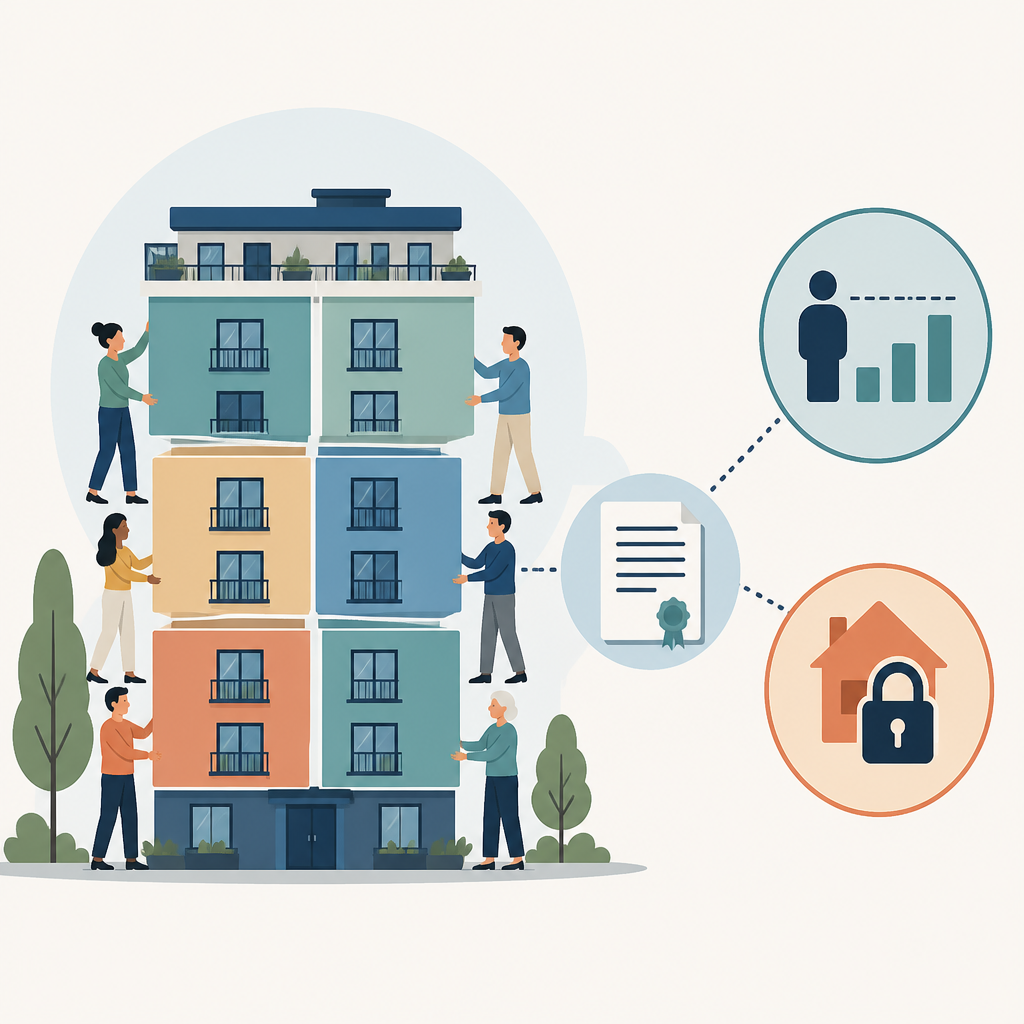
Resale Restrictions and the Flip Tax
If income limits protect affordability on the way in, resale restrictions protect it on the way out. This is the part of the HDFC model that most distinguishes it from ordinary homeownership, and the part most often misunderstood.
Many HDFC co-ops are structured as limited-equity cooperatives, meaning the amount a shareholder can profit when selling is capped by formula. The idea is straightforward: if every seller could capture the full market appreciation, the apartments would quickly become unaffordable to the next generation of buyers, defeating the entire purpose. Limited-equity rules slow or cap that escalation.
Where resale prices are not strictly capped, HDFCs frequently impose a substantial flip tax, a transfer fee paid to the cooperative when shares are sold. Flip taxes on HDFC sales can be significant, sometimes a large percentage of the sale price or the gain, and the proceeds typically go back into the building's reserves. The flip tax serves two purposes at once: it dampens speculative resale and it funds the long-term maintenance the building needs.
The combination of income limits and resale or flip-tax restrictions is the engine of permanent affordability. It is also a live policy debate, because some long-time shareholders want more freedom to capture appreciation, while housing advocates want to preserve the affordability the model was built to deliver.
The Velázquez and NYC Context in 2026
HDFC co-ops sit at the center of a renewed national conversation about cooperative housing. In June 2026, the 21st Century ROAD to Housing Act (H.R.6644) was passed by Congress — becoming law that July — and is described as the largest housing affordability law since 1990. Within that legislation, provisions associated with Representative Nydia Velázquez explicitly authorize housing cooperatives within federal housing programs. Supporters point to the roughly 1.5 million families already living in cooperative housing nationwide.
Why does this matter for HDFC co-ops specifically? Velázquez represents a New York City district where cooperative and limited-equity housing has deep roots, and the model that HDFCs pioneered, community ownership of permanently affordable homes, is precisely the kind of structure the new federal provisions aim to recognize and expand. For decades, co-ops occupied an awkward position in federal housing policy, which was largely designed around rental units and single-family ownership. Explicit authorization in federal programs gives cooperatives, including limited-equity and HDFC-style structures, a clearer footing to access financing and support.
For New Yorkers, the practical takeaway is that a model the city improvised out of fiscal crisis in the 1970s is now being treated as a national template for affordable homeownership. The next several years are likely to bring more attention, and potentially more resources, to cooperative housing of exactly the kind HDFCs represent.
How Built By DAO + Blueprint Fit In
Built By DAO is a venture studio for community-owned development. We exist because the lesson of the HDFC co-op, that residents can collectively own permanently affordable homes, deserves better tools than a 1970s improvisation. Through our brands, including Urban Array, which focuses on cooperative housing in disinvested communities, we work to make community ownership repeatable rather than accidental.
Our flagship product, Blueprint, is software that helps people plan, finance, and launch affordable housing cooperatives. The HDFC story shows what is possible when a community organizes around shared ownership; Blueprint exists to make that organizing faster, more transparent, and more financeable, so the next generation of co-ops does not have to wait for a fiscal crisis to start. With cooperative housing now explicitly recognized in federal law, the tooling to actually stand up new co-ops matters more than ever.
If you are exploring whether a cooperative is right for your building, your block, or your community, start with the platform built for exactly this work.
Explore Blueprint to plan and launch your housing cooperative →
Frequently Asked Questions
What does HDFC stand for in an HDFC co-op?
HDFC stands for Housing Development Fund Corporation, a type of nonprofit housing corporation organized under Article XI of New York State's Private Housing Finance Law. An HDFC co-op is a residential cooperative incorporated as an HDFC to provide affordable housing to lower-income households.
Who is eligible to buy an HDFC co-op apartment?
Eligibility depends on household income, which generally must fall below a cap set as a percentage of Area Median Income (AMI). The exact limit varies by building because it is defined in each co-op's governing documents, and limits are often adjusted for household size. Buyers must usually submit financial documentation for board review.
Why are HDFC co-ops so much cheaper than market-rate apartments?
HDFC co-ops were created to serve people of low income, and their purchase prices are kept below market by design. The trade-off is that buyers must meet income limits and accept resale restrictions, such as limited-equity caps or substantial flip taxes, that keep the apartments affordable for future buyers.
Can I make a profit when I sell an HDFC co-op?
Often yes, but the amount may be limited. Many HDFCs are limited-equity cooperatives that cap resale profit by formula, and most charge a flip tax on sales that can take a significant share of the proceeds. These rules exist to preserve long-term affordability rather than maximize individual gain.
How did the 21st Century ROAD to Housing Act affect cooperative housing?
Passed by Congress in June 2026 and law as of that July, the 21st Century ROAD to Housing Act includes Velázquez provisions that explicitly authorize housing cooperatives within federal housing programs. This gives co-ops, including limited-equity and HDFC-style structures, clearer access to federal support, in a model that advocates note supports roughly 1.5 million families nationwide.
Are HDFC co-ops a good investment?
HDFC co-ops can be an excellent path to affordable ownership, but they are best understood as housing first and an investment second. Lower upfront cost is offset by income eligibility rules, potential resale caps, flip taxes, and sometimes higher maintenance. Buyers should review a building's finances and house rules carefully before committing.