
Financing affordable housing cooperatives has always been the hardest part of building community-owned housing. The model is proven: in the United States, housing cooperatives already serve roughly 1.5 million families. But assembling the money to acquire, renovate, or build a co-op means stitching together several sources at once, each with its own rules, timelines, and underwriting logic. This guide walks through the main financing tools, how they combine into a capital stack, and what just changed with the 21st Century ROAD to Housing Act passed in June 2026 (now law as of July 2026).
This article is educational and is not financial, legal, or investment advice. Always work with qualified counsel, a CPA, and an experienced housing finance advisor before committing to any structure.
Why cooperative financing is different
A housing cooperative is a corporation owned by its residents. Instead of holding individual deeds, members own shares in the corporation and hold a proprietary lease on their unit. That structure shapes everything about financing.
In a limited equity cooperative (LEC) — the most common affordable model — resale prices are capped by formula, so the housing stays affordable across generations. Eligibility is usually limited to households below an income threshold at purchase. Limited equity keeps homes attainable, but it also means the co-op cannot rely on market-rate appreciation to attract conventional lenders. That is exactly why a deliberate, layered capital stack matters.
Two debt instruments sit at the center of most co-op deals:
- Blanket mortgage: a single mortgage on the entire property, held by the cooperative corporation. Liability is spread across all members, which lowers individual default risk and lets the co-op secure financing that individual buyers could not obtain on their own.
- Share loans: individual loans a member takes out to buy their shares, functionally similar to a home mortgage but secured by co-op shares rather than a deed. Share loan availability is a persistent stumbling block for LECs, because not every lender understands or offers them, and shares — though cheaper than a house — are still out of reach for many households without financing.
Understanding how these two layers interact is the foundation for everything else in the stack.
Low-Income Housing Tax Credits (LIHTC)
The Low-Income Housing Tax Credit is the largest federal program for producing affordable rental and cooperative housing. Rather than a direct government check, LIHTC awards tax credits to a project. Investors — typically banks and corporations — purchase those credits, and their cash becomes equity that fills a large share of development cost. Because it is equity rather than debt, LIHTC reduces how much the project has to borrow, which keeps resident carrying costs low.
For cooperatives, LIHTC can be a powerful tool, but it adds complexity:
- Compliance period: Properties must maintain affordability and income restrictions for at least 15 years, with an extended-use period that commonly stretches to 30 years or more.
- Investor structure: LIHTC deals usually involve a limited partnership or LLC where the investor is a limited partner. Co-ops sometimes use a master-lease or a planned conversion to resident ownership at the end of the compliance period.
- 9% vs. 4% credits: The competitive 9% credit covers a larger share of cost but is scarce and allocated by state housing finance agencies. The non-competitive 4% credit pairs with tax-exempt bonds and is more available, though it fills less of the gap.
LIHTC rarely covers an entire project. It is the anchor equity that the rest of the stack is built around.
CDFIs: the flexible capital that makes deals work
Community Development Financial Institutions (CDFIs) are mission-driven lenders that fund projects traditional banks often will not touch. They are smaller and more nimble than conventional lenders, and they specialize in the unusual structures co-ops require.
CDFIs frequently provide:
- Acquisition and predevelopment loans — the early, higher-risk money needed to control a property and pay for due diligence before permanent financing closes.
- LIHTC bridge financing — short-term capital that bridges the gap until tax credit equity is paid in over time.
- Permanent blanket mortgages for cooperatives that conventional lenders decline.
There is real precedent. In Washington, D.C. — which has one of the highest concentrations of cooperatives in the nation — CDFIs such as City First Enterprises have helped low-income tenants purchase buildings and convert them into limited equity cooperatives. National intermediaries like Enterprise Community Partners and the Local Initiatives Support Corporation also channel capital into co-op and LIHTC deals. For many community-owned projects, a CDFI is the partner that turns a good idea into a closeable transaction.
Grants and soft debt: filling the affordability gap
Even with LIHTC equity and a CDFI blanket mortgage, affordable co-ops usually face a gap between total cost and what residents can sustainably repay. That gap is filled with grants and soft debt — sources priced far below market so the project pencils out.
Common gap-filling sources include:
- HOME Investment Partnerships Program — flexible federal funds, distributed through states and localities, used for acquisition, rehabilitation, and construction.
- Community Development Block Grants (CDBG) — local funds that can support acquisition, infrastructure, and predevelopment.
- Housing Trust Funds — state and city funds dedicated to affordable housing, often offered as low- or zero-interest loans.
- Soft (subordinate) debt — loans that sit behind the primary mortgage, frequently carrying deferred payments, below-market interest, or forgiveness if affordability commitments are met.
- Philanthropic and program-related investments (PRIs) — below-market loans or grants from foundations supporting community ownership.
Soft debt is "soft" because it rarely demands current repayment. It lowers the project's debt service so that capped, affordable resident charges can actually cover operating costs. Layering these sources is the art of the affordable capital stack — and the part where modeling errors are most expensive.
What the 21st Century ROAD to Housing Act changes
In June 2026, Congress passed the 21st Century ROAD to Housing Act (H.R. 6644), described as the largest housing affordability legislation in a generation. Provisions authored by Congresswoman Nydia Velázquez are especially consequential for community-owned housing.
Before this law, statutory language about federal housing programs was vague enough that cooperatives were sometimes at risk of being excluded from programs they otherwise qualified for. The Velázquez provisions explicitly authorize housing cooperatives as eligible participants in federal housing programs, removing that ambiguity.
The bill's text recognizes cooperatives in several places. The definition of a "covered mortgage loan" now expressly includes loans secured by a lien on individual units of condominiums and housing cooperatives, and it recognizes membership in a cooperative ownership housing corporation as eligible for covered mortgage loans for occupancy of one to four families.
In plain terms: by clarifying that co-ops belong in federal housing programs, the law widens the financing pathways available to cooperative developers and members. Clearer eligibility tends to mean more lenders willing to offer share loans, more programs that explicitly accommodate co-op structures, and fewer deals stalled by definitional gray areas. The practical impact will unfold as agencies write rules and lenders update products, but the direction is unambiguously favorable for the model.
Building the capital stack: how the pieces fit together
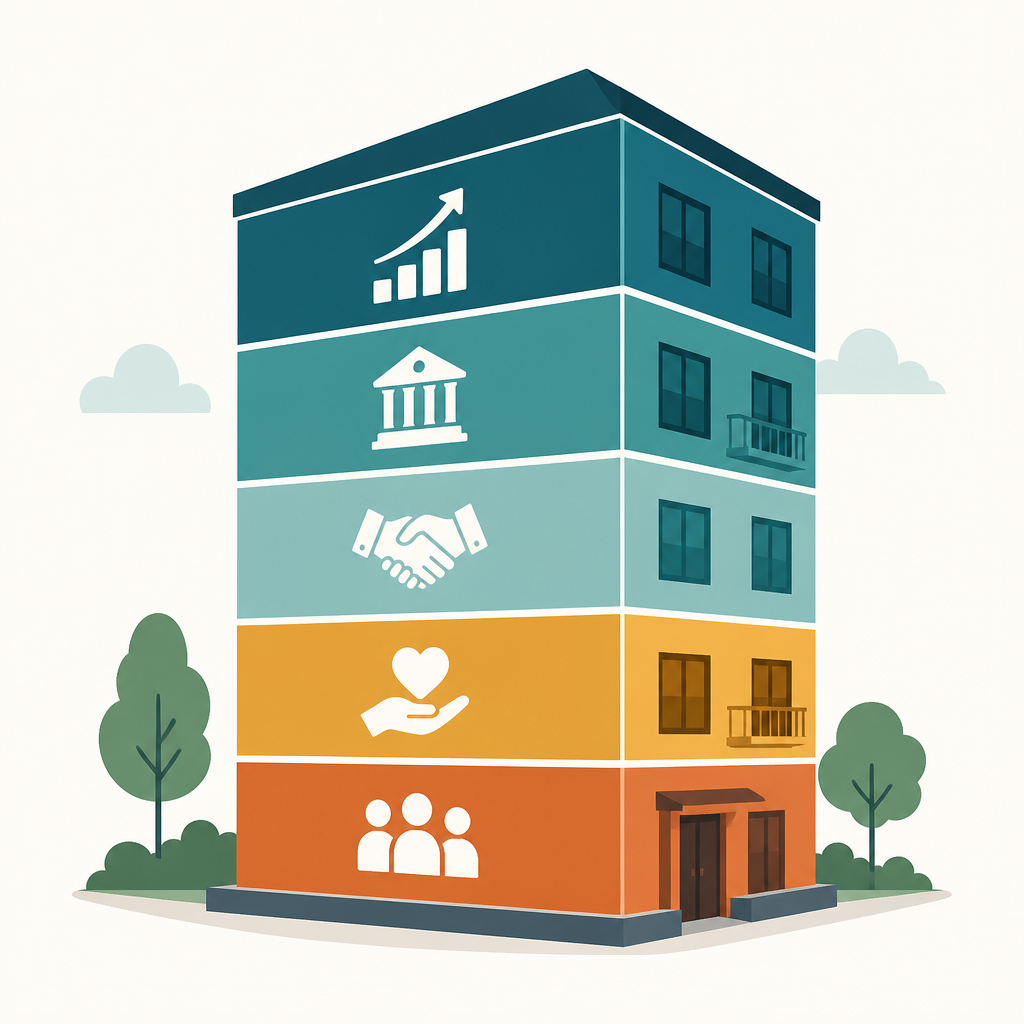
No single source finances an affordable co-op. A representative stack might look like:
- LIHTC equity — the anchor, reducing the amount that must be borrowed.
- Blanket mortgage from a bank or CDFI — the primary debt, sized to what affordable resident charges can support.
- Soft / subordinate debt from HOME, CDBG, or a housing trust fund — filling the gap behind the first mortgage.
- Grants and PRIs — closing the remaining gap and covering predevelopment.
- Member share loans or share purchases — resident equity that completes the structure.
The challenge is that these layers must balance: total sources have to equal total uses, each source's rules must be satisfied simultaneously, and the resulting debt service must stay within what affordability-capped charges can cover. Get one assumption wrong and the whole stack stops working. This is where disciplined financial modeling separates projects that close from projects that stall.
How Built By DAO + Blueprint fit in
Built By DAO is a venture studio for community-owned development. Through our ecosystem — including Urban Array's cooperative housing work in disinvested communities — we have seen how often promising co-ops die in the financing phase, not for lack of demand, but for lack of a clear, credible capital plan.
Blueprint is our software for planning, financing, and launching affordable housing cooperatives. It helps a founding group model the full capital stack — LIHTC equity, blanket mortgage, CDFI debt, soft debt, grants, and share loans — and test whether the numbers actually balance before they spend months chasing the wrong structure. With cooperatives now clearly eligible for federal housing programs under the 21st Century ROAD to Housing Act, the set of viable pathways is wider than ever, and modeling them carefully matters more than ever.
If you are exploring how to finance a housing cooperative, start by mapping your capital stack. Plan and stack your co-op's capital with Blueprint.
Frequently asked questions
What is the difference between a blanket mortgage and a share loan?
A blanket mortgage is a single loan on the entire cooperative property, held by the co-op corporation and repaid through members' monthly charges. A share loan is an individual loan a member takes out to buy their shares in the co-op. Most co-ops use both: a blanket mortgage at the corporate level and optional share loans for members who need to finance their share purchase.
Can affordable housing cooperatives use LIHTC?
Yes. LIHTC can provide anchor equity for cooperative projects, but the structure adds complexity — including a 15-year compliance period (often extended to 30 years), investor partnership arrangements, and sometimes a planned conversion to full resident ownership later. LIHTC almost never covers a project alone; it is combined with debt, grants, and soft loans.
What role do CDFIs play in co-op financing?
CDFIs are mission-driven lenders that fund the harder parts of a deal that conventional banks often avoid: acquisition and predevelopment loans, LIHTC bridge financing, and permanent blanket mortgages for cooperatives. They are frequently the partner that makes an affordable co-op transaction feasible.
How does the 21st Century ROAD to Housing Act help cooperatives?
The law's Velázquez provisions explicitly authorize housing cooperatives as eligible participants in federal housing programs, removing earlier statutory ambiguity that risked excluding them. By clarifying that co-ops qualify — including for covered mortgage loans on co-op units — the law widens the financing pathways available to cooperative developers and members.
Why do affordable co-ops need grants and soft debt?
Because limited equity cooperatives cap resale prices and serve income-restricted households, their resident charges are kept low — which means they can only support a limited amount of hard debt. Grants and soft (subordinate, below-market, often deferred) debt fill the gap between total project cost and what residents can sustainably repay.
Is this article financial advice?
No. This page is educational only and does not constitute financial, legal, tax, or investment advice. Cooperative financing structures are complex and vary by state and program. Consult qualified housing finance professionals, legal counsel, and a CPA before making decisions.