
The idea of DAO affordable housing sounds futuristic, but the principles behind it are older than the blockchain that made the term famous. A decentralized autonomous organization (DAO) is a group that pools resources and makes decisions together under transparent, agreed-upon rules. Strip away the technology and you are describing something housing cooperatives have done for more than a century: people coming together, contributing capital, and governing the place they live as shared owners.
What is new is the tooling. Modern governance software borrows the operational lessons of DAOs—transparent voting, auditable records, shared treasuries, and clear membership rules—and applies them to the very practical work of planning, financing, and running affordable housing. The result is a model that makes community-owned development easier to start and easier to trust. With the 21st Century ROAD to Housing Act (H.R.6644) now law as of June 2026, the timing has rarely been better.
What "DAO Affordable Housing" Actually Means
It helps to separate two things that often get blurred together: the technology of DAOs and the governance principles of DAOs.
The technology—smart contracts, tokens, on-chain treasuries—is one possible implementation. It is not the point, and for most housing projects it is not the right starting place. Housing is regulated, capital-intensive, and deeply local. Speculative crypto mechanics rarely fit, and projects that lead with token economics tend to lose sight of the residents.
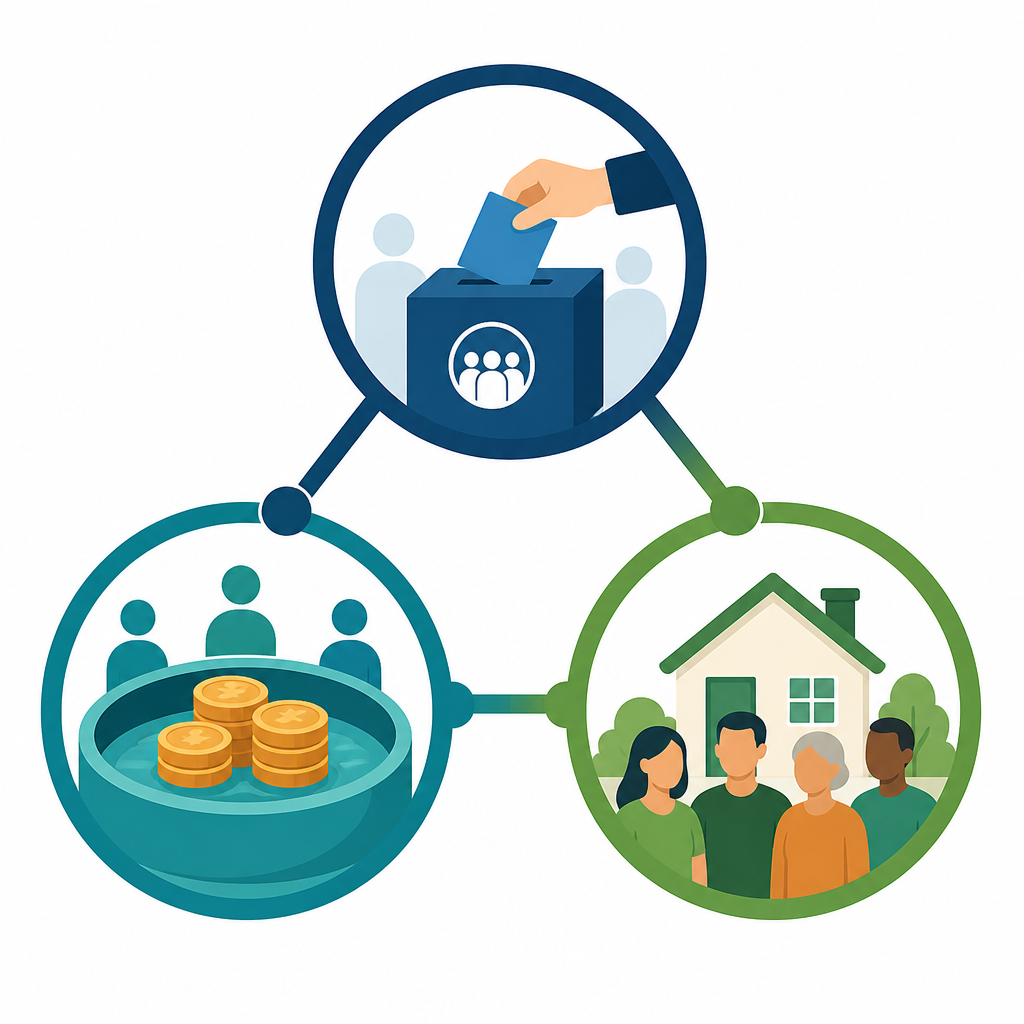
The principles are what transfer cleanly. DAOs are defined by three durable ideas:
- Transparent governance. Decisions, votes, and the rules behind them are visible to every member rather than buried in a sponsor's back office.
- Pooled capital. Members contribute to a shared treasury, and how that money moves is recorded and auditable.
- Member ownership. The people affected by decisions are the people who make them, on a one-member, one-vote basis rather than by share count.
When people say "DAO affordable housing," the grounded version means: housing developed and governed using these principles, supported by software that makes them practical at scale. That is a meaningful shift from the conventional model, where a developer owns the asset and residents are tenants with little say over the building's future.
Why DAOs and Housing Cooperatives Share DNA
Housing cooperatives are not a crypto invention. In a co-op, residents collectively own the corporation that owns the building. Each household holds a membership share, elects a board, votes on major decisions, and builds equity or stability over time depending on the co-op model. Limited-equity cooperatives, in particular, keep homes permanently affordable by capping resale prices—trading speculative upside for long-term stability.
Look at that structure next to a DAO and the overlap is striking:
| Principle | Housing Cooperative | DAO |
|---|---|---|
| Ownership | Member shares in the co-op corporation | Member stake in the organization |
| Governance | One member, one vote; elected board | Member voting on proposals |
| Capital | Pooled share purchases and reserves | Shared treasury |
| Transparency | Bylaws, meeting minutes, financials | Public proposals and records |
Both models answer the same question: how do a group of people own and govern something together, fairly and durably? Co-ops solved it with corporate and legal structures refined over a century. DAOs solved a parallel version with software and explicit rules. Bringing the two together means co-ops can adopt the operational discipline and transparency that good DAO tooling provides—without importing the speculation that gives crypto a bad name in housing circles.
This is the core insight behind community-owned development: the governance is not a gimmick. It is the mechanism that keeps a building affordable, accountable to residents, and resilient long after the original developer has moved on.
How DAO Principles Solve Real Affordable Housing Problems
Affordable housing development is hard for reasons that have nothing to do with ideology. Capital is fragmented, governance is opaque, and the people who live in a building often have the least power over its future. DAO-style governance addresses each of these directly.
Pooled capital lowers the barrier to ownership
Buying or developing a building is expensive, and no single moderate-income household can do it alone. Pooled capital is the entire point of a cooperative—and the entire point of a DAO treasury. When contributions, reserves, and expenditures are tracked transparently, members can see exactly where their money goes. That transparency is not a nicety; it is what makes people willing to pool money with neighbors in the first place.
Transparent governance builds trust
Many community development projects fail not for lack of money but for lack of trust. When decisions happen behind closed doors, members disengage and conflicts fester. DAO-inspired governance makes proposals, votes, and outcomes visible by default. Everyone can see what was decided, who decided it, and why. Applied to a housing co-op, that means a clear record of board elections, budget approvals, maintenance decisions, and rule changes.
Member ownership keeps housing affordable and accountable
The deepest problem in housing is that the people who live somewhere rarely control it. Member ownership flips that. Residents are the decision-makers, which aligns incentives toward long-term affordability and good stewardship rather than short-term resale value. Limited-equity co-op rules, encoded into the organization's governing documents, can keep a building affordable for generations.
Clear rules reduce coordination costs
Co-ops can stall under the weight of their own meetings. One reason DAOs scale is that the rules—quorum, voting thresholds, who can propose what—are written down and enforced consistently. Encoding those rules into governance software removes ambiguity and lets a co-op spend less time arguing about process and more time running the building.
What the 21st Century ROAD to Housing Act Changes
For years, a quiet obstacle held cooperative housing back: federal housing programs were not consistently written to include co-ops, leaving them at the margins of financing and subsidy systems built around landlords and individual homeowners.
The 21st Century ROAD to Housing Act (H.R.6644), passed in June 2026, is described as the largest housing affordability law since 1990. Within it, the Velázquez provisions explicitly authorize housing cooperatives in federal housing programs. In practical terms, that means co-ops are recognized as a legitimate, fundable model inside the federal housing toolkit—roughly 1.5 million families are already supported by cooperative housing, and clearer federal authorization makes the path to more co-ops less uncertain.
For the DAO affordable housing model, this is a turning point. The governance and ownership principles were always sound. What was missing was a financing and regulatory environment that treated member-owned housing as a first-class option. With co-ops explicitly written into federal programs, communities that want to develop housing they own and govern together now have firmer ground to build on.
How Built By DAO + Blueprint Fit In
Built By DAO is a venture studio for community-owned development. We take the governance and ownership principles that make DAOs work—transparency, pooled capital, member ownership—and apply them to the practical, regulated work of building affordable housing. Our focus is on the principles, not the speculation: real buildings, real residents, real ownership.
Across our ecosystem, that mission shows up in different forms. Urban Array develops cooperative housing in communities that have faced disinvestment. Running Start Digital extends the toolset that community organizations need to operate. And our flagship product, Blueprint, ties it together.
Blueprint is software to plan, finance, and launch affordable housing cooperatives. It operationalizes co-op governance the way good DAO tooling operationalizes collective decision-making: transparent voting, clear membership rules, shared financial visibility, and a structured path from "a group of neighbors with an idea" to "a chartered, financed, member-owned co-op." With co-ops now explicitly authorized in federal housing programs under the new law, Blueprint is built to help communities take advantage of that opening.
If you are exploring how to bring DAO affordable housing principles into a real project—whether you are organizing neighbors, advising a community group, or developing affordable housing—Blueprint is where the planning starts.
Plan your cooperative with Blueprint →
Frequently Asked Questions
Is DAO affordable housing the same as buying housing with cryptocurrency?
No. The DAO affordable housing model is about governance and ownership principles—transparent decision-making, pooled capital, and member ownership—not about speculation or paying for homes with crypto. The technology behind some DAOs is optional; the durable value is the governance structure, which maps directly onto how housing cooperatives already work.
How is a housing cooperative different from renting?
In a cooperative, residents collectively own the corporation that owns the building. Each household holds a membership share, votes on major decisions, and helps elect the board. Renters, by contrast, have a lease but no ownership stake or governance rights. Co-ops give residents long-term control and, in limited-equity models, permanent affordability.
Do you need blockchain to run a housing co-op with DAO principles?
No. The principles—transparency, pooled capital, one-member-one-vote governance—can be implemented entirely through conventional legal structures and software like Blueprint. Blockchain is one possible tool, but it is not required, and for most affordable housing projects the priority is sound governance and financing, not on-chain mechanics.
What did the 21st Century ROAD to Housing Act do for cooperatives?
Passed in June 2026, the Act includes Velázquez provisions that explicitly authorize housing cooperatives in federal housing programs. This gives co-ops clearer standing within federal financing and subsidy systems, making it more practical for communities to develop member-owned, permanently affordable housing.
How does Blueprint support cooperative housing development?
Blueprint is software that helps communities plan, finance, and launch affordable housing cooperatives. It operationalizes co-op governance—membership rules, transparent voting, and shared financial visibility—and guides a group from initial planning through financing and launch. You can learn more at blueprint.builtbydao.com.
Who is Built By DAO?
Built By DAO is a venture studio for community-owned development founded by Marquis Davis. It applies DAO governance principles—transparency, pooled capital, and member ownership—to affordable housing. Its ecosystem includes Urban Array (cooperative housing in disinvested communities), Running Start Digital, and the Blueprint platform.