
Sound housing cooperative reserves capital planning is one of the clearest dividing lines between a co-op that stays affordable for decades and one that lurches from crisis to crisis. A cooperative is a long-term landlord to itself: its members collectively own the building, and they alone are responsible for the roof that will need replacing in fifteen years, the boiler that will fail in twenty, and the parking lot that erodes a little every winter. Reserves and capital planning are how a cooperative converts those distant, lumpy, expensive obligations into smooth, predictable, manageable monthly contributions. This article is an educational overview of how that works. It is not financial, legal, or investment advice — every cooperative should work with a qualified reserve specialist, accountant, and attorney before making funding decisions.
This topic has become more consequential as cooperative housing gains federal footing. With the 21st Century ROAD to Housing Act (H.R. 6644) passed by Congress in June 2026 (now law as of July 2026), the Velázquez provisions explicitly authorize cooperatives in federal housing programs and are aimed at a cooperative sector already home to 1.5 million families. More co-ops entering the housing system means more boards learning, often for the first time, how to steward a building's long-term capital health.
Two Kinds of Reserves: Operating vs. Replacement
The first concept every cooperative board should internalize is that "reserves" is not one bucket. There are two distinct funds, and confusing them is a common and expensive mistake.
Operating reserves
An operating reserve is a short-term cushion. It covers the gap between expenses and income when something disrupts normal cash flow — a member falls behind on carrying charges, an insurance deductible comes due after a storm, or a vacancy in a commercial space lingers. Operating reserves are typically sized as a number of months of operating expenses. A frequently cited rule of thumb is three to six months of operating costs, though the right figure depends on the cooperative's size, tenant stability, and risk tolerance.
Consider a hypothetical 24-unit cooperative with annual operating expenses of $480,000, or $40,000 per month. A three-month operating reserve target would be $120,000. This money is meant to stay liquid and largely untouched — it is insurance against the unexpected, not a checking account for routine bills.
Replacement reserves
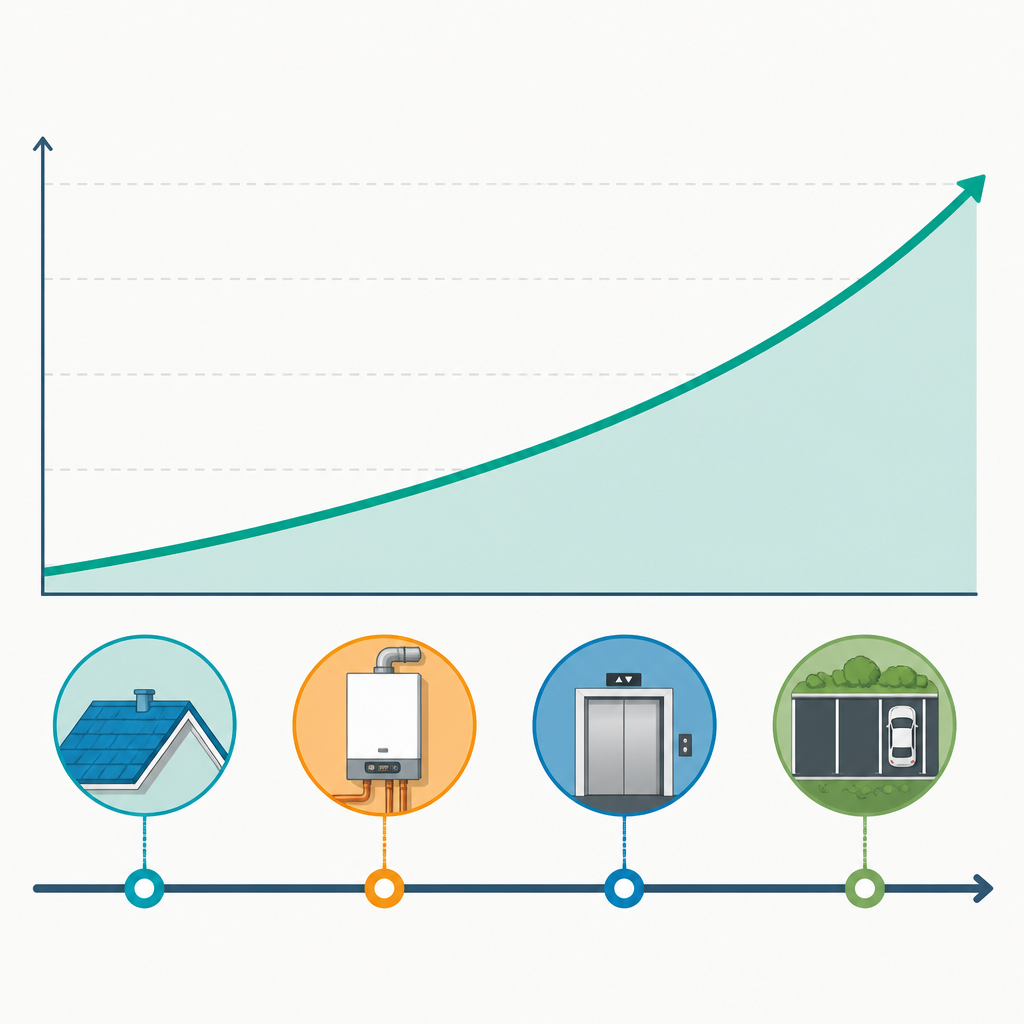
A replacement reserve (sometimes called a capital reserve) is the long-term fund that pays to replace major building components when they reach the end of their useful life. Roofs, elevators, boilers, HVAC systems, siding, windows, plumbing risers, and paved surfaces all wear out on predictable schedules. The replacement reserve exists so that when the roof's 25-year life expires, the money to re-roof is already sitting in the account — not financed through emergency borrowing or extracted from members in a panic.
The critical difference: operating reserves smooth out timing problems within a year, while replacement reserves smooth out the enormous cost of components that fail every 15, 20, or 30 years. A cooperative can have a healthy operating reserve and still be dangerously underfunded on replacements.
The Reserve Study: The Backbone of Capital Planning
You cannot fund what you have not measured. A reserve study is the analytical foundation of housing cooperative reserves capital planning. It is a professional assessment that answers two questions: what major components will the cooperative have to replace, and when? — and how much should the cooperative be setting aside each year to be ready?
A reserve study has two parts:
- The physical analysis inventories every major component, estimates its remaining useful life, and projects its future replacement cost (accounting for inflation). A reserve specialist walks the property, reviews maintenance records, and builds a component list — often 20 to 40 line items for a mid-sized building.
- The financial analysis takes that component list and models the reserve fund over a long horizon, commonly 30 years. It projects the fund's balance year by year, given current reserves, expected contributions, and the timing of each replacement.
The output is a funding plan: a recommended annual contribution that keeps the reserve fund from ever dipping below a prudent floor. Many cooperatives commission a full reserve study every three to five years and update it annually with current balances and any new information. Component lives are estimates, not certainties — a roof installed poorly may fail early; a well-maintained boiler may outlast its projection. The study is a living plan, not a one-time document.
Funding levels and what they mean
Reserve studies usually express a fund's health as percent funded — the ratio of actual reserves to the "fully funded balance" the component aging implies. A fund at 100% has set aside exactly what the wear-and-tear to date justifies. A fund at 30% is significantly behind. Lower funding levels correlate strongly with a higher probability of special assessments. There is no universal "right" number, but boards generally aim to stay out of the weakly-funded range where a single large failure can force an emergency.
How Underfunded Reserves Lead to Special Assessments
A special assessment is a one-time charge levied on members beyond their normal carrying charges, usually to cover a capital expense the reserve fund cannot. Special assessments are the symptom; chronic underfunding is the disease.
Here is the mechanism in a hypothetical example. Imagine a 30-unit cooperative whose boiler reaches end of life. A full replacement costs $300,000. If the cooperative has diligently funded its replacement reserve, that $300,000 is available and the boiler is replaced with no disruption to members. But if the board kept carrying charges artificially low for years and the reserve holds only $60,000, the cooperative faces a $240,000 shortfall. Divided across 30 units, that is $8,000 per household, often due within months.
For affordable housing cooperatives, this is not a minor inconvenience — it can be destabilizing. A surprise $8,000 bill can push lower-income members toward delinquency or force a sale of their shares. Underfunded reserves quietly transfer risk onto the households least able to absorb it. That is precisely the outcome diligent capital planning is designed to prevent. Adequately funded reserves convert a terrifying one-time bill into modest contributions made steadily by every member who benefited from the component over its life — which is also the fairer outcome across generations of members.
Setting Carrying Charges to Fund Reserves
In a cooperative, members pay monthly carrying charges (the co-op equivalent of rent or a condo's common charges). These charges must cover everything: the underlying mortgage, property taxes, insurance, utilities, maintenance, management — and reserve contributions. The temptation, especially in affordable co-ops where every dollar matters to members, is to keep carrying charges as low as possible by shortchanging the reserve line. This feels generous in the moment and is corrosive over time.
A disciplined budget treats the reserve contribution as a non-negotiable line item, derived directly from the reserve study's recommended annual funding, not as a leftover to be trimmed when the budget is tight.
A simplified hypothetical illustrates the discipline. Suppose a reserve study recommends an annual replacement-reserve contribution of $72,000 for a 24-unit cooperative. Spread across 24 units and 12 months, that is $250 per unit per month dedicated specifically to replacements. If the board omits this to keep charges low, members enjoy $250 more in their pockets each month — until the bill for a major system arrives and the missing contributions resurface as a special assessment, usually larger because of inflation and emergency-procurement premiums. Funding reserves through carrying charges is almost always cheaper and fairer than catching up through assessments.
Boards should also revisit carrying charges regularly. Construction and labor costs inflate; reserve targets rise accordingly. A reserve contribution set a decade ago and never adjusted is likely well below what current replacement costs require.
Capital Improvement Planning
Reserves handle the replacement of existing components. Capital improvement planning is the broader, forward-looking discipline of deciding which larger investments the cooperative will make and how to pay for them — both like-for-like replacements and genuine upgrades that change the building.
A capital improvement plan typically:
- Maintains a prioritized list of projects over a multi-year horizon (often 5 to 10 years), ranked by urgency, safety, cost, and member benefit.
- Distinguishes replacements from betterments. Re-roofing is a replacement (funded from reserves). Adding solar panels, upgrading to high-efficiency mechanicals, or improving accessibility is a betterment — usually funded through a mix of reserves, dedicated assessments, grants, or financing, because reserve funds are generally reserved for replacing what already exists.
- Sequences projects sensibly. You don't repave the parking lot the year before trenching it for new water lines. Coordinating timing avoids paying twice.
- Identifies funding sources for each project: replacement reserves, planned assessments, low-interest loans, energy-efficiency rebates, or — increasingly relevant after H.R. 6644 — federal cooperative housing programs.
A useful practice is to align the capital improvement plan with the reserve study's 30-year projection so the board sees the full picture: routine replacements and aspirational upgrades on one timeline, with a clear-eyed view of whether the cooperative can afford them without destabilizing members.
How Built By DAO + Blueprint fit in
Built By DAO is a venture studio for community-owned development, building tools that make cooperative ownership achievable for ordinary communities rather than only well-resourced specialists. Our flagship platform, Blueprint, is software to plan, finance, and launch affordable housing cooperatives — and that includes modeling the long-term capital health that this article describes.
Blueprint helps emerging and operating cooperatives translate reserve-study logic into living financial plans: projecting replacement timelines, testing how different carrying-charge levels affect reserve funding over decades, and stress-testing what a deferred contribution does to the odds of a future special assessment. As the 21st Century ROAD to Housing Act (passed by Congress in June 2026) brings cooperatives into federal housing programs, having defensible, well-documented capital plans matters more than ever — for members, for lenders, and for program compliance.
If you are forming a cooperative or strengthening one that already exists, explore how Blueprint can support your reserve and capital planning at blueprint.builtbydao.com.
Frequently Asked Questions
What is the difference between operating and replacement reserves in a housing cooperative?
Operating reserves are a short-term cushion (typically three to six months of operating expenses) that covers temporary cash-flow disruptions like delinquencies or insurance deductibles. Replacement reserves are a long-term fund that pays to replace major building components — roofs, boilers, elevators — when they reach the end of their useful life. A co-op needs both; a healthy operating reserve does not protect against an underfunded replacement reserve.
How often should a housing cooperative get a reserve study?
A common practice is to commission a full professional reserve study every three to five years and update it annually with current reserve balances and any new information about component condition. Because component life estimates and replacement costs change over time, the study is meant to be a living plan rather than a one-time report.
What causes special assessments in a co-op?
Special assessments are usually caused by chronically underfunded reserves. When a major component fails and the replacement reserve cannot cover the cost, the board levies a one-time charge on members to make up the shortfall. Keeping carrying charges artificially low by underfunding reserves is the most common root cause.
How much should carrying charges allocate to reserves?
There is no universal figure — the right contribution comes from the cooperative's reserve study, which calculates the annual amount needed to keep the replacement fund adequately funded over a long horizon (often 30 years). Boards should treat that recommended contribution as a fixed budget line and revisit it regularly as construction and labor costs rise.
Can replacement reserves be used for building upgrades?
Generally, replacement reserves are intended to replace existing components like-for-like, not to fund betterments such as solar panels or accessibility upgrades. Those improvements are usually funded through a capital improvement plan using a mix of dedicated assessments, financing, grants, or federal programs. Always confirm the specifics with your accountant and governing documents.
Is this article financial advice?
No. This is an educational overview of how reserves and capital planning work for housing cooperatives. Every cooperative's situation is different, and you should consult a qualified reserve specialist, accountant, and attorney before making funding or budgeting decisions.