
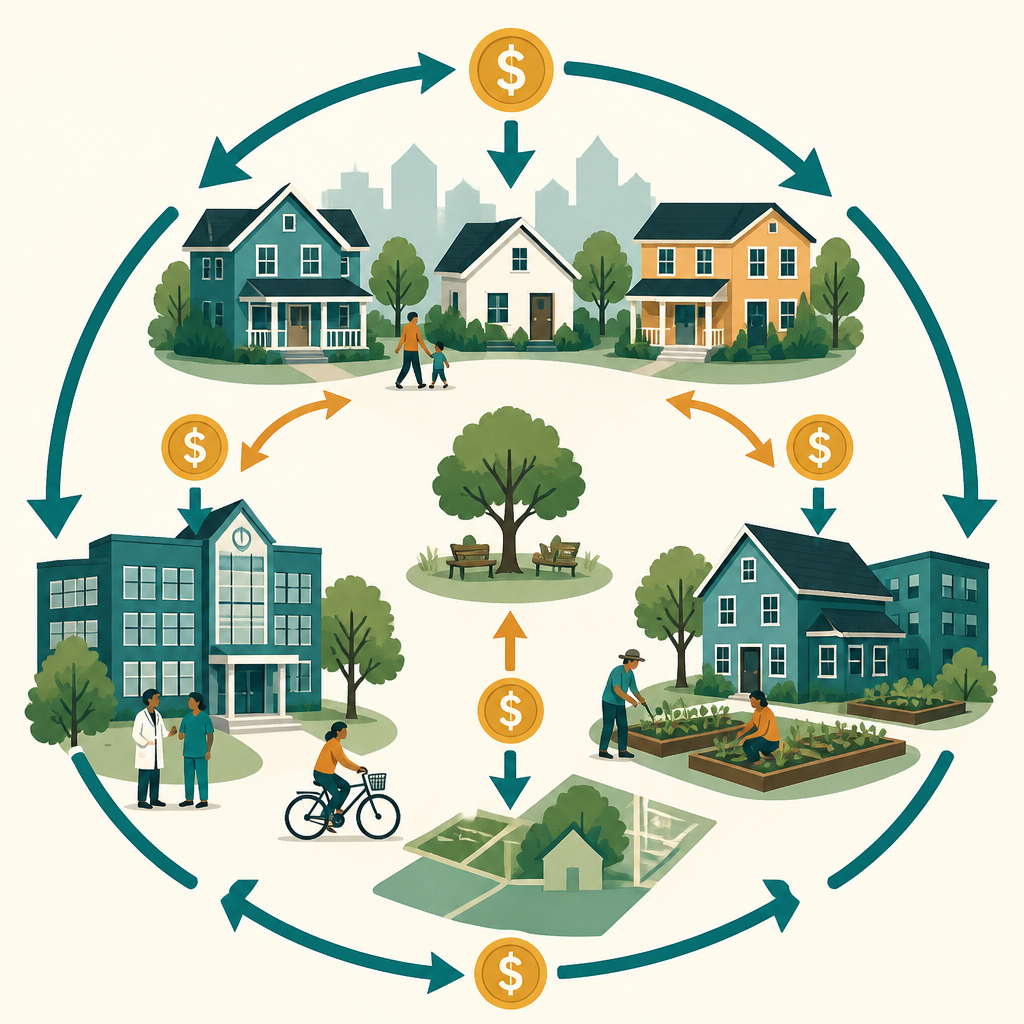
Community wealth building cooperative housing sits at the intersection of two ideas that, taken together, change who actually benefits when a neighborhood grows. The first idea is that wealth created in a place should stay in that place. The second is that housing — the single largest expense for most families and the largest store of household wealth in the country — is one of the most powerful tools we have for keeping it there. When the two are combined, a community stops being a place that wealth passes through on its way somewhere else and starts being a place that accumulates and recirculates it.
This page explains what community wealth building means, where it came from, and why cooperative housing belongs at the center of it rather than the margins. It is written for residents, organizers, municipal staff, mission-driven developers, and anyone trying to understand how ownership models translate into durable local prosperity.
What Community Wealth Building Actually Means
Community wealth building is an economic development approach that asks a different question than conventional growth strategy. Instead of "How do we attract outside investment and hope it trickles down?" it asks "How do we build assets that the community owns and controls, so the returns stay local?"
The distinction matters. A standard development deal might bring jobs, a new building, and a ribbon-cutting — but if the developer, the employer, and the eventual owner of the appreciated land are all headquartered elsewhere, most of the value generated leaves the neighborhood. Rent leaves. Profit leaves. Equity leaves. What remains is often higher costs for the people who were already there, and the slow pressure of displacement.
Community wealth building tries to plug those leaks. It does this through several connected strategies:
- Local and broad-based ownership of land, housing, and enterprise, so appreciation and profit accrue to residents.
- Anchor institutions — hospitals, universities, governments, large nonprofits — that are rooted in place and can redirect their spending, hiring, and investment toward the local economy.
- Cooperatives and employee ownership, which distribute control and surplus among workers and members rather than absentee shareholders.
- Community control of land, most often through community land trusts (CLTs), which permanently remove land from the speculative market.
None of these are new on their own. What community wealth building does is treat them as a system, coordinated at the scale of a city or region.
The Cleveland Model and the Preston Model
The most cited example is what's commonly called the Cleveland model. In Cleveland's Greater University Circle neighborhoods — areas that had experienced decades of disinvestment despite sitting next to some of the wealthiest anchor institutions in the state — organizers asked a simple question: those hospitals and universities buy hundreds of millions of dollars of goods and services every year, so what if even a fraction of that procurement went to businesses owned by local residents?
The answer became the Evergreen Cooperatives, a network of worker-owned businesses — an industrial laundry, a solar installation company, a hydroponic greenhouse — designed to meet anchor institution demand while building equity for employee-owners who live nearby. The point was never a single co-op. It was a deliberately engineered local economy in which anchor demand, community ownership, and resident employment reinforced one another.
The idea crossed the Atlantic and became the Preston model in the United Kingdom, where the city of Preston, Lancashire, responded to a collapsed regeneration deal by redirecting the procurement of its own anchor institutions back into the local and regional economy, and by actively supporting cooperative enterprise. Preston became shorthand in policy circles for "what a council can do with the levers it already controls."
Both models share a core insight: the money is already flowing through the community; the question is whether the community owns the channels it flows through. Cooperative housing is one of the most important of those channels — and one of the most overlooked.
Where Cooperative Housing Fits as an Anchor of Place-Based Wealth
Most discussions of the Cleveland model focus on worker cooperatives. But housing is arguably the larger lever, for three reasons.
First, scale of household spending. Housing is typically the biggest line item in a family budget. When that spending flows to an absentee landlord or a distant REIT, it leaves the community every month. When it flows into a resident-owned cooperative, it stays — recirculating into maintenance, reserves, and the equity of members.
Second, scale of household wealth. For most American families, home equity is the single largest component of net worth, and the racial wealth gap is, to a substantial degree, a homeownership and home-equity gap. Communities that have been redlined and disinvested were systematically locked out of the asset class that built wealth for everyone else. Cooperative housing offers a path into ownership for households who can't access a conventional mortgage on a single-family home — and it does so collectively, which is often the only way it pencils in a high-cost or long-disinvested market.
Third, permanence. A worker co-op can thrive and still sit in a neighborhood that gentrifies around it until its members are priced out of where they live. Housing is the asset that anchors people in place. Get the housing right and the rest of the community wealth building agenda has somewhere to stand.
How housing cooperatives work
In a housing cooperative, residents don't rent from a landlord and don't individually own their units. Instead, they own shares in a cooperative corporation that owns the building, and that share gives them the right to occupy a home and a vote in how the cooperative is run. Decisions about budgets, maintenance, and rules are made democratically — one member, one vote — regardless of unit size.
Co-ops come in a few flavors. In a market-rate co-op, shares can appreciate and sell at whatever the market bears. In a limited-equity cooperative (LEC), resale prices are capped by formula so that homes stay affordable for the next member — trading some individual upside for permanent, community-wide affordability. Limited-equity co-ops are the model most aligned with community wealth building, because they let members build modest, real equity while keeping the housing affordable in perpetuity.
Community land trusts and the "land plus building" stack
Cooperative housing pairs naturally with community land trusts. A CLT is a nonprofit that owns land permanently and removes it from the speculative market; the homes or buildings on that land are owned by residents or co-ops through long-term ground leases. Stacking a limited-equity housing cooperative on top of CLT-held land is one of the most durable ownership structures available: the land can never be flipped, the building is democratically owned by the people who live in it, and affordability is locked in for generations.
ESOPs, co-ops, and the broader ownership ladder
It helps to see cooperative housing as one rung on a broader ladder of broad-based ownership. Employee stock ownership plans (ESOPs) put company equity in workers' hands. Worker cooperatives give workers both ownership and governance. Consumer and purchasing co-ops keep retail and supply margins local. Community land trusts socialize land. Housing cooperatives socialize the home. Each addresses a different leak in the local economy; together they form a coherent strategy for keeping wealth in the community that produces it.
Policy Tailwinds: The 21st Century ROAD to Housing Act
For years, one of the biggest obstacles to scaling cooperative housing was that many federal housing programs were written around individual homeownership and conventional rental, with co-ops treated as an afterthought or excluded outright.
That landscape shifted in June 2026, when the 21st Century ROAD to Housing Act (H.R. 6644) was passed by Congress. The legislation includes provisions championed by Congresswoman Nydia Velázquez that explicitly authorize and accommodate cooperative housing within federal housing programs — recognizing co-ops as a legitimate, fundable form of affordable housing rather than an exception to be worked around.
The practical significance is large. Co-ops already support roughly 1.5 million families across the United States. Clearer federal authorization makes it meaningfully easier for new cooperatives to access programs, financing, and technical assistance that were previously difficult to navigate, lowering one of the most stubborn barriers to forming a co-op in a disinvested community. For organizers who have spent years explaining their model to programs that had no box to check, that is a structural change, not a cosmetic one.
How Built By DAO + Blueprint Fit In
Built By DAO is a venture studio for community-owned development. Its work is organized around a simple thesis: the ownership structures that build community wealth — co-ops, CLTs, resident control — are sound, but they are hard to plan, finance, and launch, and that difficulty is what keeps them rare. Lower the difficulty and you get more of them.
That work runs across the studio's brands. Urban Array develops cooperative housing in disinvested communities, putting the model into the ground rather than the abstract. Running Start Digital builds the digital capacity that mission-driven projects usually can't afford. And the flagship product, Blueprint, is software built specifically to plan, finance, and launch affordable housing cooperatives — turning the months of fragmented spreadsheets, legal structuring, and capital stacking that normally precede a co-op into a guided, repeatable process.
Founded by Marquis Davis, Built By DAO treats cooperative housing not as charity but as infrastructure for place-based wealth — the anchor that lets the rest of the community wealth building agenda hold.
Ready to see how a cooperative housing project comes together? Explore Blueprint at blueprint.builtbydao.com to start planning, financing, and launching a housing co-op.
Frequently Asked Questions
What is the difference between community wealth building and traditional economic development?
Traditional economic development usually focuses on attracting outside investment and employers, on the theory that growth will trickle down to residents. Community wealth building focuses on local and broad-based ownership of assets — land, housing, enterprise — so that the returns from growth stay in the community instead of flowing out to absentee owners.
How is cooperative housing different from renting or buying a home?
In a housing cooperative you neither rent from a landlord nor individually own a unit. You own a share in a cooperative that owns the whole building, which gives you the right to occupy your home and an equal vote in how the co-op is run. It offers a path to ownership and stability for households who may not qualify for a conventional single-family mortgage, and it keeps housing costs and decisions in residents' hands.
What is a limited-equity cooperative?
A limited-equity cooperative (LEC) caps the resale price of member shares by a set formula. Members still build modest, real equity, but the cap keeps homes affordable for the next member in perpetuity. It's the cooperative model most closely aligned with community wealth building because it balances individual equity with permanent, community-wide affordability.
How do community land trusts relate to housing cooperatives?
A community land trust permanently owns land and removes it from the speculative market, while residents or co-ops own the buildings through long-term ground leases. Pairing a limited-equity housing cooperative with CLT-held land creates one of the most durable affordable-ownership structures available: the land can't be flipped, and the building is democratically owned by the people who live in it.
What changed for co-ops with the 21st Century ROAD to Housing Act?
The 21st Century ROAD to Housing Act (H.R. 6644), passed by Congress in June 2026 (now law as of July 2026), includes Velázquez provisions that explicitly authorize cooperative housing within federal housing programs. This makes it easier for new co-ops to access federal financing and support, removing a long-standing barrier for cooperatives that previously didn't fit neatly into existing programs.
How does Built By DAO help launch cooperative housing?
Built By DAO is a venture studio for community-owned development. Its flagship product, Blueprint, is software that helps organizers and developers plan, finance, and launch affordable housing cooperatives, while its Urban Array brand develops co-op housing directly in disinvested communities. The goal is to make the cooperative model easier to execute so more communities can use it.