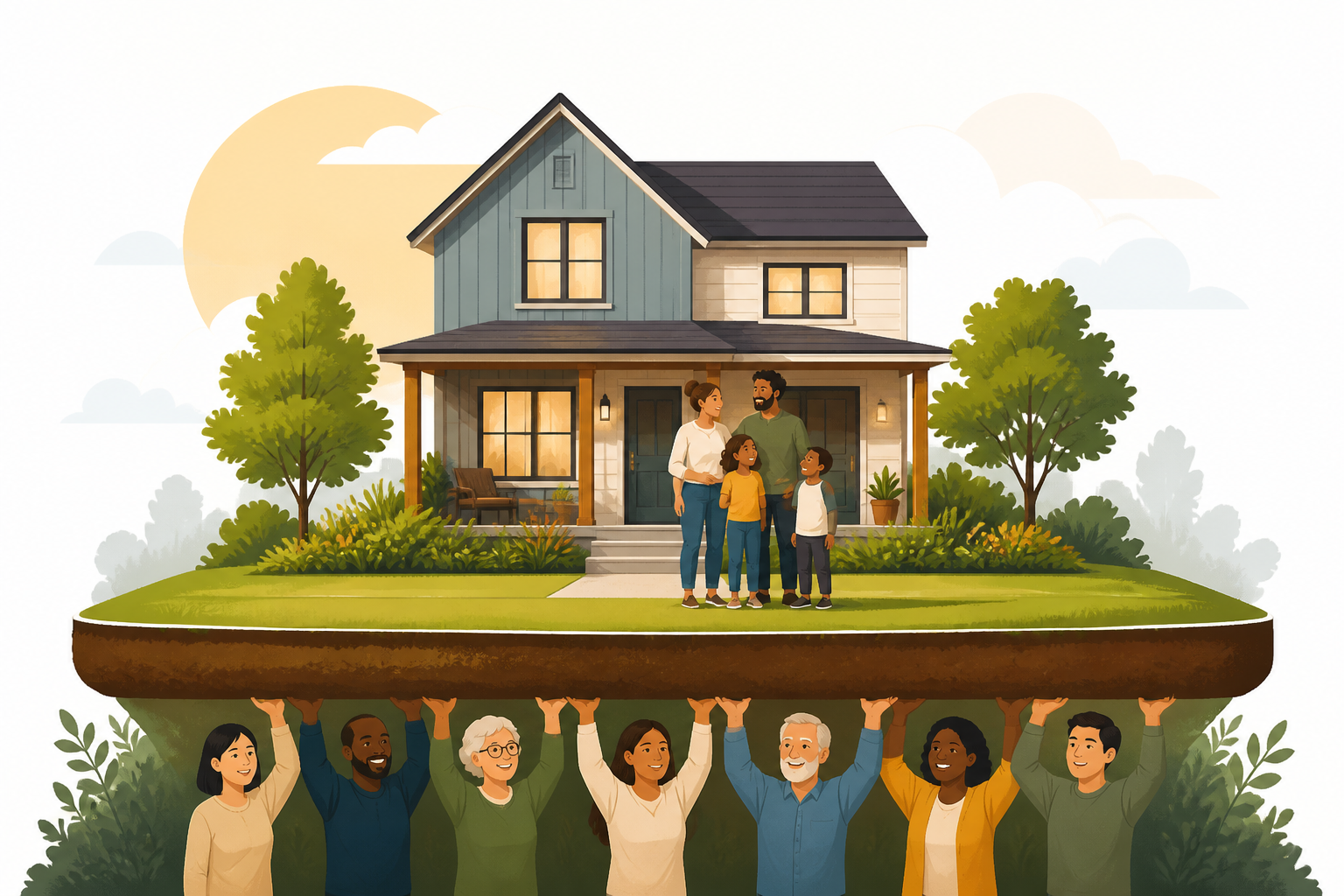
A community land trust is one of the most durable tools we have for keeping homes affordable across generations. Where most affordability programs expire after 15, 30, or 40 years, a community land trust is designed to hold affordability in place forever. It does this not through a subsidy that runs out, but through a permanent change to how ownership itself is structured. This guide explains how the model works in depth: the ground-lease mechanism, the split between owning land and owning improvements, the tripartite board that governs the trust, the resale formula that preserves affordability, the long-term stewardship role, and how CLTs pair naturally with housing cooperatives.
If you steward land, advise a nonprofit, sit on a housing commission, or simply want to understand why community land trusts keep coming up in policy conversations, this is the foundation.
What a Community Land Trust Actually Is
A community land trust is a nonprofit organization that acquires and holds land on behalf of a community, with a mission to provide affordable access to that land over the long term. The trust does not flip property or chase market returns. It is a steward. Its purpose is to take land permanently out of the speculative market so that the homes and other uses sitting on top of it can stay affordable no matter what surrounding property values do.
The model traces its modern American roots to the late 1960s civil rights movement, when organizers studied land-tenure approaches from around the world and adapted them to the goal of secure, affordable land access for communities that had historically been locked out of ownership. Since then, hundreds of community land trusts have formed across the United States, supporting homeownership, rental housing, community gardens, commercial space, and farmland.
The defining feature is simple to state and powerful in practice: the trust keeps the land, and residents own what sits on it.
The Ground-Lease Model: How Ownership Is Split
The mechanism that makes a community land trust work is the ground lease. Instead of selling land and buildings together as a single bundle the way a conventional sale does, the trust separates the two.
Here is the basic structure:
- The community land trust owns the land and retains it indefinitely.
- The homeowner owns the building or unit — the "improvements" on the land.
- The two parties sign a long-term ground lease, typically running 99 years and renewable, that gives the homeowner the right to use the land and live there.
This is dual ownership in the literal sense. The homeowner holds title to their home, builds equity, can pass the home to heirs, and enjoys the security of ownership. The trust holds title to the land underneath and uses that ongoing ownership to enforce the affordability commitments written into the lease.
Because the homeowner is not buying the land, the purchase price is meaningfully lower than a comparable market-rate home. Land is often the single most expensive and most volatile component of housing cost, especially in high-demand areas. By removing land from the transaction, the community land trust brings the home within reach of buyers who would otherwise be priced out.
What the homeowner pays
A community land trust homeowner generally pays a modest monthly ground-lease fee to the trust in exchange for the right to use the land. This fee is usually small and is set to keep the total housing cost affordable rather than to generate profit. Homeowners are still responsible for their mortgage, property taxes on their portion, insurance, and maintenance, just as any homeowner would be. The ground-lease fee is an addition that funds the trust's stewardship work.
What the ground lease controls
The ground lease is the legal heart of the arrangement. Beyond granting use of the land, it sets the rules that protect the public investment and the community's interest, including:
- The resale formula that governs how much the home can be sold for later.
- The requirement that the home remain owner-occupied as a primary residence.
- The trust's right of first refusal or right to designate the next buyer when the owner sells.
- Maintenance standards and limits on certain uses.
- Procedures for refinancing, inheritance, and dispute resolution.
These provisions travel with the land, not with any individual owner. That is why affordability survives one sale after another: each new buyer signs the same kind of ground lease and inherits the same commitments.
The Resale Formula: How Affordability Is Preserved Forever
The single most important affordability mechanism in a community land trust is the resale formula. When a homeowner decides to sell, they cannot sell at whatever the open market would bear. Instead, the resale price is determined by a formula written into the ground lease.
The goal of the formula is to balance two interests that pull in opposite directions:
- The seller deserves a fair return. Homeowners build real equity, recover their down payment and principal, and earn a reasonable share of appreciation. A CLT home is genuine ownership, not glorified renting.
- The next buyer deserves an affordable home. The home must remain reachable for a household at a similar income level to the one the program was designed to serve.
Common resale formula approaches include:
- Appraisal-based formulas, where the owner receives their original purchase price plus a fixed percentage (often around 25 percent) of the appraised increase in value.
- Index-based formulas, where the allowable price grows in step with changes in area median income, so the home stays affordable to the same income band over time.
- Fixed-rate formulas, where the price rises by a set annual percentage.
- Itemized formulas, which add credit for approved capital improvements the owner made.
Each approach gives the homeowner a real but limited share of appreciation. The portion of appreciation that the formula holds back is what stays in the home, passed forward to keep it affordable for the next family. This is the quiet engine of permanent affordability: a one-time public or philanthropic subsidy is captured in the home and recycled at every resale, instead of being cashed out and lost the first time the property sells.
Tripartite Board Governance
A community land trust is accountable to more than its current homeowners, so its governance reflects a broader set of interests. The classic structure is the tripartite board: a governing board divided into three equal parts.
- One third — CLT residents (leaseholders). People who live in homes on trust land. They bring the lived experience of being a community land trust homeowner and protect the interests of residents.
- One third — community members. People who live in the broader service area but do not lease from the trust. They represent the wider public interest and the neighbors who benefit from durable affordability.
- One third — public-interest representatives. Local officials, funders, technical experts, and others who safeguard the long-term mission and the public investment.
Splitting governance three ways is deliberate. It prevents any single group from steering the trust toward its own short-term advantage. Residents cannot vote to dissolve the affordability protections and cash out; the wider community cannot ignore the people who actually live there; and public stakeholders keep the mission anchored across decades and leadership changes. The tripartite board is how a community land trust stays true to its founding purpose long after its founders are gone.

Stewardship: The Work That Never Ends
A conventional affordable-housing developer builds, sells, and moves on. A community land trust does the opposite. Its defining commitment is stewardship — the ongoing, long-term work of supporting homeowners and protecting affordability for the life of the trust.
Stewardship typically includes:
- Buyer education and preparation, so prospective owners understand the model, the resale formula, and their responsibilities before they buy.
- Lending support, helping buyers find mortgage products that work with the ground-lease structure.
- Default and foreclosure prevention, intervening early when an owner falls behind to keep families housed and homes within the program.
- Resale management, guiding owners through the formula-based sale process and identifying the next income-qualified buyer.
- Property and capital oversight, ensuring homes are maintained and major repairs are addressed.
This long-horizon stewardship is part of why community land trust homeowners have historically shown strong housing stability, including lower rates of foreclosure during downturns than the broader market. The trust is not a passive landholder; it is an active partner that has a permanent stake in each homeowner's success.
How CLTs Pair With Housing Cooperatives
Community land trusts and housing cooperatives are often discussed side by side, and for good reason: they solve different problems and combine well. (For a direct, side-by-side breakdown of the two models, see our separate CLT-versus-co-op comparison. This section focuses on how they work together.)
A housing cooperative is a structure in which residents collectively own and democratically govern their housing, usually through a corporation in which each household holds a share. The co-op handles shared ownership, joint decision-making, and collective management of a multi-unit property.
A community land trust handles the land underneath and locks in affordability across generations.
Stack them, and each covers the other's gap:
- The CLT owns the land and enforces permanent affordability through the ground lease and resale formula.
- The co-op owns the building on that land and governs daily life democratically among residents.
- The ground lease between the trust and the cooperative carries the same affordability protections, so the homes stay affordable even as individual co-op members come and go.
This pairing is especially powerful for limited-equity cooperatives, where members' resale prices are already capped to preserve affordability. Putting that co-op on community land trust land adds a second, durable layer of protection at the land level and brings the trust's stewardship capacity to bear on the whole property. The result is community-owned housing that is both democratically governed and permanently affordable — exactly the kind of structure that recent federal policy is beginning to recognize.
Where Federal Policy Is Headed
For most of their history, community land trusts and cooperatives operated at the margins of federal housing programs, which were built around conventional single-owner models. That is changing. The 21st Century ROAD to Housing Act (H.R. 6644), passed by Congress in June 2026 (now law as of July 2026), includes provisions championed by Representative Nydia Velázquez that authorize cooperative housing within federal housing programs and are aimed at a cooperative sector already home to roughly 1.5 million families. For a field that has long had to fit shared-ownership models into frameworks that were never designed for them, this is a meaningful shift toward treating community-owned housing as a first-class option.
How Built By DAO + Blueprint Fit In
Understanding the community land trust model is one thing. Actually planning, financing, and launching permanently affordable, community-owned housing is another — and the operational complexity is exactly where most good intentions stall.
That is the problem Built By DAO exists to solve. Built By DAO is a venture studio for community-owned development, and our flagship software, Blueprint, is built to take groups from idea to launch. Blueprint helps you plan affordable housing cooperatives, model the financing, structure the ownership, and navigate the path to opening — including projects that combine a cooperative with community land trust land. Instead of reinventing the legal, financial, and governance scaffolding from scratch, you get a guided platform designed around how these models actually work.
If you are exploring a community land trust, a cooperative, or both, Blueprint is the tool that turns the model into a real, launchable project.
Plan your community-owned housing project with Blueprint →
Frequently Asked Questions
Do community land trust homeowners build equity?
Yes. A community land trust homeowner owns their home, pays down a mortgage, and earns a real share of appreciation set by the resale formula. The equity is more limited than on the open market because the formula holds back a portion to keep the home affordable for the next buyer, but it is genuine ownership with a meaningful return — not renting.
How long does the ground lease last?
Ground leases in community land trusts are typically 99 years and renewable. Because the affordability terms are written into the lease and the trust permanently owns the land, the protections carry forward through every resale rather than expiring after a set period.
Can a CLT home be passed on to heirs?
In most cases, yes. The ground lease generally allows the home to be inherited, with the heir taking on the same lease terms and resale obligations. If the heir does not intend to live there as a primary residence, the trust's resale provisions usually apply so the home can pass to a new income-qualified owner.
What happens to affordability when the owner sells?
The resale formula sets a maximum price that keeps the home affordable to a household at a similar income level. The trust typically helps identify the next qualified buyer, who signs a new ground lease with the same protections. Affordability is preserved at every sale rather than ending the first time the home changes hands.
How is a community land trust different from a housing cooperative?
A community land trust owns and stewards the land and enforces permanent affordability through the ground lease. A housing cooperative is a structure for residents to collectively own and democratically govern a building. They address different layers — land versus building — and are frequently combined, with a co-op sitting on CLT-owned land. (See our dedicated comparison page for a full side-by-side.)
Who governs a community land trust?
Most community land trusts use a tripartite board split into three equal thirds: residents who lease from the trust, community members from the broader service area, and public-interest representatives. This balance keeps the trust accountable to everyone with a stake in long-term affordability.