Green Building Standards in Community Housing
Community-owned housing should lead on sustainability. Here are the certifications and practices that Built By DAO uses to build greener homes.
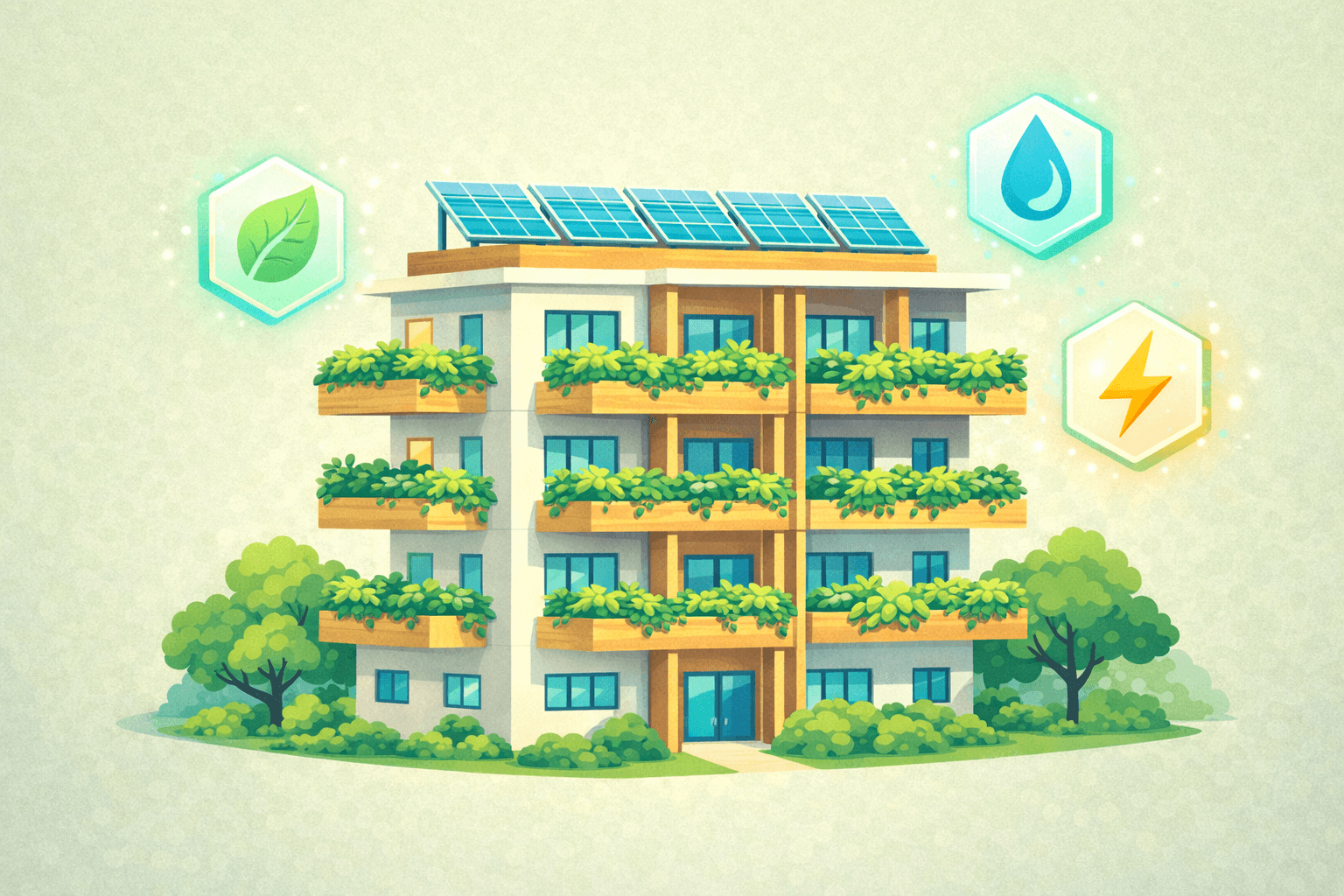
Why Community Housing Should Lead on Sustainability
Buildings account for roughly 40% of US energy consumption and about 30% of greenhouse gas emissions. Residential housing is the single largest category within that number. If we are going to make meaningful progress on climate goals, housing has to change.
Community-owned housing is uniquely positioned to lead that change. Here is why:
- Long time horizons. Community housing is built to serve residents for decades, not to flip for profit in five years. Investing in energy efficiency pays off over that timeline even when it costs more upfront.
- Aligned incentives. In community-owned housing, the people who pay the utility bills are the same people who decide how the building is built. They benefit directly from lower energy costs.
- Values-driven governance. DAO-governed communities can vote to prioritize sustainability — not just because it saves money, but because it reflects the values of the people who live there.
At Built By DAO, sustainability is not an optional upgrade. It is a core commitment built into every development from the design phase.
The Major Green Building Certifications
Several national and international certification programs provide frameworks for sustainable construction. Here are the most relevant ones for residential housing:
LEED (Leadership in Energy and Environmental Design)
LEED is the most widely recognized green building certification in the United States, administered by the US Green Building Council. It evaluates buildings across several categories:
- Energy performance — efficiency of heating, cooling, lighting, and appliances
- Water efficiency — fixtures, landscaping, and stormwater management
- Materials and resources — recycled content, local sourcing, waste reduction
- Indoor environmental quality — ventilation, air quality, natural daylight
- Location and transportation — proximity to transit, walkability, bike infrastructure
LEED awards four levels: Certified, Silver, Gold, and Platinum. Each level requires accumulating points across these categories.
Energy Star
Energy Star certification for residential buildings focuses specifically on energy performance. A certified building uses at least 15-30% less energy than a standard building of the same type. It is a simpler, more focused certification than LEED, making it accessible for smaller developments.
For residents, Energy Star certification translates directly to lower utility bills — typically $200-400 per year in savings compared to a non-certified unit.
Passive House (Passivhaus)
Passive House is the most rigorous energy standard for buildings in the world. Developed in Germany, it requires:
- Airtight building envelope — minimizing uncontrolled air leakage
- Continuous insulation — eliminating thermal bridges
- High-performance windows — triple-pane, low-e coated
- Heat recovery ventilation — recovering 80-90% of outgoing heat
- Maximum heating demand of 15 kWh/m² per year — roughly 80-90% less energy than a conventional building
Passive House buildings are so well-insulated and airtight that they can be heated primarily by the body heat of occupants and passive solar gain. The result is extraordinary energy efficiency and near-zero utility costs for heating and cooling.
National Green Building Standard (NGBS)
NGBS is developed by the National Association of Home Builders and focuses specifically on residential construction. It is often more practical than LEED for apartment developments, with clear prescriptive requirements for:
- Lot design and development
- Resource efficiency
- Energy efficiency
- Water efficiency
- Indoor environmental quality
- Building operation and maintenance
What Built By DAO Prioritizes
We do not pursue certifications for their marketing value. We pursue them because they result in buildings that are cheaper to operate, healthier to live in, and better for the environment. Here are our specific priorities:
High-Performance Envelope
The building envelope — walls, roof, windows, and foundation — is the single most important factor in energy performance. We target:
- R-30+ wall insulation (continuous exterior insulation to eliminate thermal bridging)
- R-50+ roof insulation
- Triple-pane or high-performance double-pane windows with low-e coatings
- Airtightness testing to verify envelope performance before occupancy
A well-built envelope reduces heating and cooling loads by 50-70%, which means smaller (and cheaper) HVAC systems and dramatically lower utility bills.
Electrification
New Built By DAO developments are designed as all-electric buildings — no natural gas. This includes:
- Heat pump HVAC — 3-4x more efficient than electric resistance heating and more efficient than gas furnaces
- Heat pump water heaters — 2-3x more efficient than traditional electric water heaters
- Induction cooktops — faster, safer, and more efficient than gas ranges
All-electric buildings are grid-ready. As the electrical grid gets cleaner (more solar, wind, and storage), all-electric buildings automatically reduce their carbon footprint without any additional investment.
Water Conservation
We specify WaterSense-certified fixtures throughout:
- Low-flow showerheads (2.0 GPM or less)
- Dual-flush toilets (1.28/0.8 GPF)
- Aerator faucets in kitchens and bathrooms
- Native and drought-resistant landscaping where applicable
Combined, these measures reduce water consumption by 30-40% compared to standard fixtures.
Indoor Air Quality
Healthy indoor air is not a luxury. We require:
- Low-VOC paints, adhesives, and sealants throughout
- Balanced ventilation with ERV or HRV systems (bringing in filtered fresh air while recovering energy)
- No carpet in common areas (hard surfaces are easier to maintain and better for air quality)
- Continuous exhaust ventilation in kitchens and bathrooms
Durable, Low-Maintenance Materials
Community housing should be built to last. We specify materials based on lifecycle cost, not just upfront price:
- Fiber cement or metal siding instead of vinyl (longer lifespan, better fire resistance)
- Standing seam or high-quality asphalt roofing with 30-50 year warranties
- Concrete or engineered wood structures designed for 75+ year service life
The Cost Question
Green building costs more upfront. That is true. High-performance windows, continuous insulation, and heat pump systems add approximately 5-10% to construction costs compared to code-minimum construction.
But the lifecycle economics are overwhelmingly favorable:
- Lower utility costs save residents $500-1,500 per year depending on climate and building size
- Reduced maintenance from durable materials and systems designed for longevity
- Higher occupancy rates — tenants prefer healthier, more comfortable, and less expensive-to-operate units
- Higher property values — green-certified buildings consistently appraise higher and command premium rents in the market
For a building designed to serve the community for decades, the upfront premium pays for itself many times over.
Sustainability as Governance
Here is what makes Built By DAO's approach different from a developer who checks a green certification box: our residents vote on sustainability priorities.
The community can propose and vote on:
- Installing rooftop solar panels
- Adding electric vehicle charging stations
- Implementing composting programs
- Pursuing additional green certifications
- Allocating reserve funds toward efficiency upgrades
Sustainability in a DAO-governed building is not a marketing decision made by a developer. It is a community decision made by the people who live with the results.
Live in a Building Built Right
Built By DAO is committed to green building standards that reduce costs, improve health, and respect the environment. Every development is designed for performance, not just appearance.
Join the waitlist to live in a community that builds better, or learn about our development approach.
Related Posts

Community Property Management: From Repair Request to Completed Work
How community-owned buildings can connect maintenance, budgets and accountable operators, with a practical repair-to-completion example.
Detroit Side Lots, Neighborhood Lots, and Community Projects: Which Path Fits?
Compare Detroit Side Lots, Neighborhood Lots, and group project routes, then prepare the parcel, ownership, budget, and maintenance plan.
Chicago’s Missing Middle Housing: From Vacant Lot to Homes
How Chicago vacant lots can become small-scale homes: the City’s Missing Middle initiative, site checks, community design, financing, and delivery.